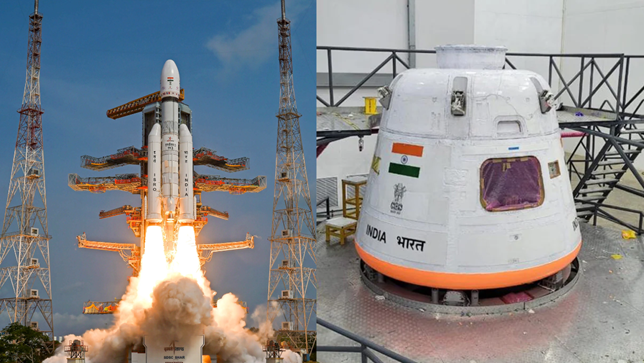
Context
- Recently, discussions regarding the safe return and recovery of Indian astronauts under the Gaganyaan Mission have gained prominence as ISRO intensifies its testing phase. As of April 2026, with the uncrewed G1 mission on the horizon, the focus has shifted toward the critical “Descent and Recovery” phase.
- Unlike the Russian Soyuz or Chinese Shenzhou which primarily use land-based landings, India’s Gaganyaan will utilize a water-based splashdown in the Bay of Bengal, necessitating a complex multi-stage parachute system and coordinated naval recovery operations.
1. Mission Overview
The Gaganyaan programme aims to demonstrate India’s indigenous capability to send a human crew to Low Earth Orbit (LEO) and bring them safely back to Earth.
- Orbit: 400 km circular orbit.
- Duration: 1 to 3 days (expandable up to 7 days).
- Crew: 3 members (Astronaut-designates: Gp Capt P.B. Nair, Gp Capt Ajit Krishnan, Gp Capt Angad Pratap, and Wg Cdr Shubhanshu Shukla).
- Landing: Planned splashdown in the Indian Ocean.
2. Spacecraft Components
The Gaganyaan spacecraft, known as the Orbital Module, consists of two main parts:
- Crew Module (CM): A double-walled, pressurized habitable space designed to maintain an Earth-like environment (temperature, oxygen, humidity) for the astronauts.
- Service Module (SM): An unpressurized structure containing the propulsion system, power systems (solar arrays), and avionics to support the CM in orbit.
3. Launch Vehicle: Human-Rated LVM3 (HLVM3)
ISRO’s heavy-lift launcher, LVM3, has been re-configured to meet “Human Rating” standards, ensuring high reliability and safety.
- Three Stages:
1. S200 Solid Boosters: Two large solid motors.
2. L110 Liquid Core: Powered by clustered Vikas engines.
3. C25 Cryogenic Stage: Powered by the CE-20 engine (liquid hydrogen and liquid oxygen).
- Safety Factor: Includes an Integrated Health Monitoring System to detect anomalies in real-time.
4. Key Safety and Technology Elements
- Crew Escape System (CES): A crucial safety mechanism that can pull the Crew Module away from the rocket in case of an emergency during launch or ascent.
- Environmental Control and Life Support System (ECLSS): Maintains pressure, removes CO2, and manages waste and temperature.
- Vyommitra: A female-looking humanoid robot (“Half-humanoid”) designed to simulate human functions and monitor module parameters during uncrewed missions to ensure safety before humans fly.
5. Phases of the Mission
- TV-D1 (Test Vehicle Abort Mission): Successfully demonstrated the Crew Escape System in October 2023.
- Gaganyaan G1 (Uncrewed): Expected in 2026; will carry Vyommitra.
- Gaganyaan G2: Second uncrewed mission for final system validation.
- H1 (Manned Mission): The final crewed flight (tentatively 2026-2027).
Q. With reference to the Gaganyaan Mission, consider the following statements:

Statement-I: The LVM3 rocket used for Gaganyaan is a three-stage launch vehicle that utilizes a cryogenic engine in its final stage.

Statement-II: The humanoid robot ‘Vyommitra’ is designed to remain in the Service Module to control the propulsion and power systems during the uncrewed flight.

Which one of the following is correct in respect of the above statements?
(a) Both Statement-I and Statement-II are correct and Statement-II is the correct explanation for Statement-I.
(b) Both Statement-I and Statement-II are correct and Statement-II is not the correct explanation for Statement-I.
(c) Statement-I is correct but Statement-II is incorrect.
(d) Statement-I is incorrect but Statement-II is correct.

Solution: (c)

• STATEMENT I CORRECT: The LVM3 (Human-Rated) is indeed a three-stage vehicle consisting of solid boosters, a liquid core, and a cryogenic upper stage (CE-20).

• STATEMENT II INCORRECT: Vyommitra is a humanoid robot placed inside the Crew Module (not the Service Module) to simulate human presence, monitor cabin parameters, and operate switches to test the life-support systems.