By reading this article you can solve the below UPSC PYQ-
India has achieved remarkable successes in unmanned space missions including the Chandrayaan and Mars Orbitter Mission, but has not ventured into manned space mission, both in terms of technology and logistics? Explain critically. [GS 3 Space Technology] (2017)
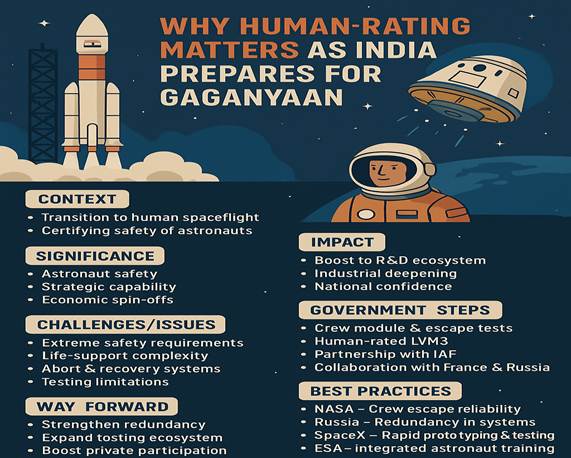
CONTEXT
Human-Spaceflight Transition: India is moving from launching satellites to launching humans into space under the Gaganyaan Mission, requiring systems designed with near-zero tolerance for failure.
I. Significance and Objectives
The mission’s importance extends far beyond space exploration:3
- National Prestige and Global Leadership: Success will place India in an elite group of four nations (after the USA, Russia, and China) with the capability to undertake human spaceflight. This significantly boosts India’s global prestige, showcasing its technological prowess and enhancing its strategic standing.
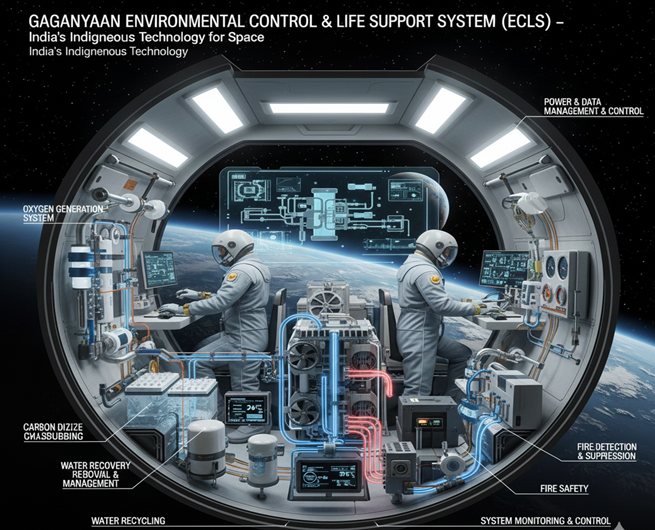
- Technological Advancement and Spinoffs: The project necessitates the indigenous development of several complex and cutting-edge technologies, including the Environmental Control and Life Support System (ECLSS), crew escape systems, and advanced re-entry mechanisms. These technologies will have significant spinoff benefits for medicine, engineering, advanced materials, and public applications.
- Economic Growth and Employment Generation: The mission provides a massive stimulus to the domestic aerospace industry, public sector units (PSUs), private industries, and MSMEs. It is expected to create thousands of high-skilled employment opportunities and foster a wider industrial-academic ecosystem.
- Catalyst for Research and Academia: Gaganyaan establishes a unique platform for microgravity research in life sciences, materials science, and physics. It promotes collaboration between ISRO, national academic institutions, and research labs, encouraging youth to pursue careers in STEM (Science, Technology, Engineering, and Mathematics).
- Foundation for Future Exploration: Gaganyaan is the stepping stone for a sustained Indian Human Space Exploration Programme. It lays the groundwork for future advanced missions, including the development of an Indian Space Station and potential exploratory missions to the Moon and Mars.
II. Technological Impacts
The mission’s requirements force innovation in core areas:
- Human-Rated Launch Vehicle (HLVM3): The existing heavy-lift launcher, LVM3 (GSLV Mk-III), has been re-configured and rigorously tested to achieve human-rating. This involves adding redundancy and ensuring the vehicle adheres to safety standards far stricter than those for unmanned missions, specifically concerning structural integrity, propulsion, and reliability (requiring a failure probability of approx 0.2% or less).
- Crew Escape System (CES): This is a critical safety system using quick-acting, high-burn-rate solid motors to pull the Crew Module (CM) away from the launch vehicle in milliseconds during an emergency at the launch pad or during ascent. Successful testing of the CES demonstrates a paramount commitment to crew safety.
- Orbital Module (OM) Development: This module comprises the Crew Module (CM), which is the habitable, pressurised space with an Earth-like environment, and the Service Module (SM), which provides propulsion, power, and thermal control in orbit. The CM requires a specialised Thermal Protection System (TPS) for re-entry and a sophisticated deceleration and flotation system (multi-parachute deployment) for ocean recovery.
III. Critical Challenges and Issues
The complexity of human spaceflight presents formidable challenges:
- Human-Rating Certification and Reliability: Achieving and maintaining the necessary fail-safe reliability across all systems remains the most critical challenge. This involves testing components under off-nominal conditions and building quadruple redundancy into major active systems.
- Life Support Systems (ECLSS): Developing a fully indigenous Environmental Control and Life Support System to manage oxygen supply, carbon dioxide removal, humidity, temperature control, and waste management within the confined Crew Module for three days is a major technological hurdle.
- Astronaut Training and Simulation Facilities: While generic training was provided through international cooperation (e.g., Russia’s Roscosmos), India is rapidly developing its own advanced training infrastructure, including simulators and training centres in Bengaluru, to cater to specific mission dynamics and zero-gravity familiarisation.
- Microgravity and Health Issues: Managing the physiological and psychological effects of the space environment on the ‘Vyomanauts’—including radiation exposure, bone density loss, muscle atrophy, and potential for isolation-related stress—requires rigorous aeromedical and bioastronautics research.
- Budgetary and Timeline Constraints: Executing a project of this scale and complexity requires sustained, judicious funding allocation and continuous efforts to meet the revised timelines, which have been impacted by global events.
IV. Government Interventions
The government and ISRO have taken specific, multi-pronged steps to mitigate risks and ensure success:
- Precursor Missions (Uncrewed Flights): The plan mandates two uncrewed test flights (G1 and G2) before the crewed mission.23 The G2 mission will carry the female humanoid robot ‘Vyommitra’ to simulate human functions and monitor critical parameters like microgravity effects on life support systems.
- Critical Test Vehicle (TV) Flights: The launch of Test Vehicle (TV-D1) demonstrated the in-flight performance of the Crew Escape System (CES) and the parachute-based recovery sequence, validating the crucial ‘abort’ mechanism.
- Dedicated Institutional Mechanism: The establishment of the Human Space Flight Centre (HSFC) in Bengaluru as the dedicated lead centre spearheads all mission activities, including human rating, crew selection, and training.
- International Collaboration: India has leveraged international expertise, notably from Russia (Roscosmos) for generic astronaut training and France (CNES) for cooperation in space medicine, to fill technology gaps and build capacity.
- Private Sector Engagement: The government is actively promoting private sector participation through reforms and the establishment of IN-SPACe, allowing Indian industry to develop critical hardware and sub-systems, thus building a resilient supply chain.
WAY FORWARD
- Strengthen Redundancy: Build systems with multiple backups to minimise single-point failures.
- Expand Testing Ecosystem: Create India’s first Space Environment Simulation Facility (SESF) for radiation, vacuum, microgravity.
- Boost Private Participation: Encourage startups in life-support, materials, sensors, under IN-SPACe and NSIL.
- International Benchmarking: Adopt NASA’s Human-Rating Requirements (HRR-8705.2) and ESA equivalent standards.
- Accelerate Space Medicine Research: Create a dedicated Indian Institute of Space Medicine for astronaut health & rehabilitation.
- Develop Long-Term Roadmap: Move from Gaganyaan → Indian Space Station (2035) → Lunar Human Mission (2040).
BEST PRACTICES
NASA – Crew Escape Reliability: Integrated abort modes from launchpad to orbit—India should ensure continuous abort capability.
Russia – Redundancy in Systems: Soyuz spacecraft uses triple-layer redundancy, making it the world’s safest crew transport.
SpaceX – Rapid Prototyping & Testing: Iterative development with frequent testing accelerates learning and improves safety.
ESA – Integrated Astronaut Training: European Astronaut Centre model for holistic training: medical, psychological, operational.
CONCLUSION
Human-rating is the heart of Gaganyaan, transforming India from a satellite launch nation to a human spaceflight power. It underpins safety, global credibility, and technological depth. While challenges are formidable—from life-support to mission reliability—India’s systematic approach, global collaborations, and investment in R&D place it on the right track.
Gaganyaan and human-rating are not just technological milestones—they mark India’s arrival in the new frontier of human space exploration and strategic capability.
RECAP