After Reading This Article You Can Solve This UPSC Mains Model Question:
The Great Nicobar Project has triggered debates over development versus ecological sustainability. Critically examine. (15 Marks, GS-3 Environment)
Context:
Recently a special bench of the National Green Tribunal (NGT) cleared Great Nicober Project, citing its “strategic importance” despite ongoing ecological and tribal rights litigation.
Origin of the Great Nicobar Project:
- Conceived by: NITI Aayog in 2021.
- Implementing Agency: Andaman and Nicobar Islands Integrated Development Corporation (ANIIDCO).
- Scale: Covers ~166 sq. km (~18% of the island’s 910 sq. km area).
Key Components of the Great Nicobar Project:
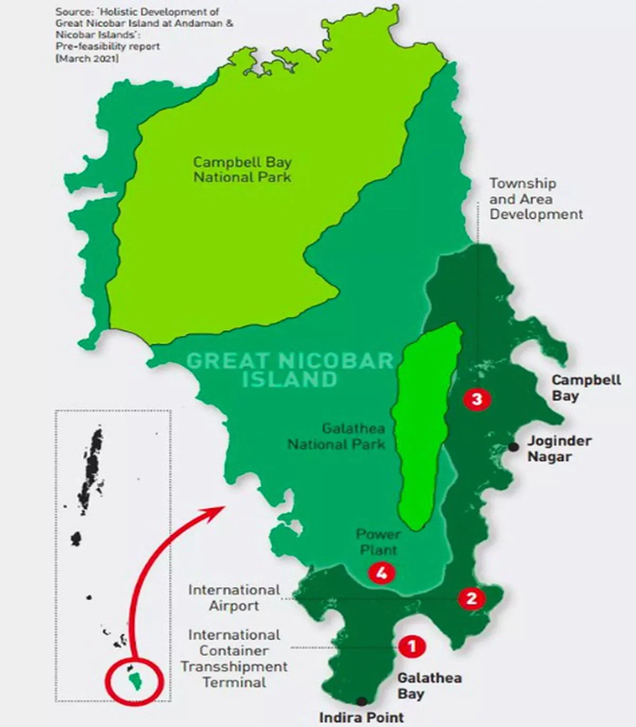
The project is built on four major pillars designed to create a self-sustaining economic ecosystem:
I. International Container Transshipment Terminal (ICTT)
- Location: Strategically sited at Galathea Bay on the island’s southeastern coast.
- Capacity: Planned to handle 16 million TEUs (Twenty-foot Equivalent Units) at full capacity, with Phase-I (4 million TEUs) expected by 2028.
- Advantage: Features a natural water depth of over 20 meters, allowing it to host “Ultra Large Container Vessels” without the need for extensive, expensive dredging.
II. Greenfield International Airport
- Dual-Use Facility: Designed for both civilian tourism and defense/military logistics.
- Capacity: Capable of handling a peak hour traffic of 4,000 passengers. It will bolster the Andaman and Nicobar Command (ANC) for rapid deployment in the Indo-Pacific.
III. Gas and Solar-Based Power Plant
- Capacity: A 450-MVA hybrid power plant.
- Function: Intended to provide uninterrupted, “de-dieselized” energy to the terminal, airport, and new township using a mix of conventional gas and renewable solar energy.
IV. Greenfield Smart City / Township
- Vision: A modern township spread over 160 sq. km to support a projected population of 3.5 lakh residents (currently ~8,000).
- Infrastructure: Includes residential zones, luxury tourism resorts, a cruise ship terminal, and industrial hubs to attract global investment.
Significance of the Great Nicobar Project:
Great Nicobar is often referred to as India’s “unsinkable aircraft carrier” in the Bay of Bengal.
1. Geostrategic & Security
- Maritime Chokepoint Control: Located approx 90 nautical miles from the Strait of Malacca; provides a “vantage point” to monitor 40% of global trade.
- Counter-Balancing China: Acts as a strategic bulwark against the “String of Pearls” (e.g., Gwadar, Hambantota) and presence in the Coco Islands.
- Tri-Service Command (ANC): The project enhances the operational reach of the Andaman and Nicobar Command (ANC)—India’s only integrated tri-service command, facilitating rapid deployment of air and naval assets.
2. Economic & “Blue Economy”
- Transshipment Sovereignty: Aims to capture the 75% of Indian cargo currently transshipped at Colombo or Singapore, saving approx. 200–220 million annually in forex.
- Natural Advantage: Galathea Bay offers a depth of >20m, accommodating “Ultra Large Container Vessels” without heavy dredging.
- Blue Economy Growth: It aligns with the Maritime India Vision 2030, fostering ancillary industries like ship repair, bunkering (refueling), and duty-free trade zones.
- Tourism Potential: Aim to position the Andaman and Nicobar Islands as a global tourism destination, competing with the Maldives and Mauritius.
3. Diplomatic & Regional Leadership
- “Act East” Policy: Serves as a physical and economic bridge to ASEAN nations.
- Net Security Provider: Enhances India’s capacity for HADR (Humanitarian Assistance and Disaster Relief) and anti-piracy operations in the Bay of Bengal.
- Multilateral Influence: Strengthens India’s central role in BIMSTEC and the Indian Ocean Rim Association (IORA).
4. Socio-Economic Impact
- Employment: Projected creation of 1 lakh jobs (direct and indirect).
- Infrastructure Frontier: Introduces a dual-use airport and a 450-MVA power plant, providing modern amenities to India’s southernmost remote frontier, potentially improving the quality of life for the local populace (if balanced with tribal rights).
Key Concerns of the Great Nicobar Project:
1. Ecological & Environmental Risks
- Massive Deforestation: Diversion of 130 sq. km of primary tropical rainforest. Official estimates state 9.64 lakh trees will be felled, though independent experts suggest the number could exceed 30 lakhs.
- Endangered Flagship Species:
- Giant Leatherback Turtle: Galathea Bay is India’s largest nesting site; construction threatens this globally unique habitat.
- Nicobar Megapode: An endemic mound-building bird whose habitat is directly in the project zone.
- Nicobar Macaque: Habitat fragmentation will lead to increased human-animal conflict.
- Coral Reefs & Mangroves: Dredging for the port will lead to siltation, choking 20,000+ coral colonies and destroying mangroves that act as natural tsunami buffers.
2. Tribal Rights and Social Concerns
- Threat to PVTGs: The island is home to the Shompen (a Particularly Vulnerable Tribal Group) and the Nicobarese.
- Constitutional & Legal Violations:
- Forest Rights Act (FRA), 2006: Allegations that the “Free, Prior, and Informed Consent” (FPIC) of the Tribal Council was coerced or bypassed.
- Article 338-A: The National Commission for Scheduled Tribes (NCST) was reportedly not consulted as mandated.
- Cultural Genocide: Genocide experts have warned that the influx of 3.5 lakh people (compared to the current ~8,000) could expose isolated tribes to “outside” diseases and lead to the loss of their nomadic hunter-gatherer lifestyle.
3. Geological and Disaster Vulnerability
- Seismic Zone V: The island lies in the highest earthquake-risk zone. It is situated on the Andaman-Sumatra subduction zone, the same fault line that triggered the 2004 Tsunami.
- Tectonic Subsidence: During the 2004 event, Great Nicobar underwent a permanent 15-foot subsidence (sinking).
4. Regulatory and Institutional Gaps
- “Opaque” Clearances: Many environmental clearance details were withheld under the “national security” clause, hindering public and scientific scrutiny.
- Flawed Impact Assessment: The Environmental Impact Assessment (EIA) was criticized for being based on single-season data and downplaying the likelihood of future mega-earthquakes.
- Denotification: The government denotified the Galathea Bay Wildlife Sanctuary and parts of the Tribal Reserve specifically to facilitate the port construction.
Way Forward
- Effective Coral Translocation: Instead of mere “scattered” translocation, adopt international best practices (like the Biorock technology) for coral regeneration and monitor the survival rate of the 20,000+ colonies through third-party audits.
- Nature-Based Coastal Defense: Prioritize “Green-Gray” infrastructure—using mangrove restoration and artificial reefs alongside sea walls to mitigate tsunami and erosion risks.
- Health Safeguards: Establish a “Biosecurity Protocol” to prevent the transmission of outside diseases to the Shompen, maintaining their “limited contact” status even as the island’s population grows.
- Independent Oversight Authority: Create a multi-stakeholder body comprising environmentalists, tribal representatives, and security experts to oversee compliance with the Environment Clearance (EC) conditions.
- Public Disclosure: As per the NGT’s latest deliberations, the government should release non-sensitive portions of the High-Powered Committee (HPC) reports to build public trust.
- Climate-Resilient Engineering: Given the Seismic Zone V status, all infrastructure must adhere to the highest Eurocode 8 or equivalent earthquake-resistant standards, with mandatory periodic “Seismic Audit.”
Conclusion
Integrating strategic depth with ecological sanctity, the project must evolve as a “Green Maritime Hub.” By leveraging sustainable engineering and tribal-inclusive governance, India can transform Great Nicobar into a futuristic frontier that balances Indo-Pacific leadership with high-value biodiversity conservation.