Why in the News?
- A Supreme Court-appointed Special Investigation Team (SIT) investigated the Reliance Foundation’s Vantara project in Jamnagar, Gujarat – India’s largest private zoo. SIT report highlighted concerns about the acquisition, import, and care of wild animals.
- Recently, the CITES committee – the international body regulating cross-border wildlife trade – also inspected Vantara.
- The CITES committee raised concerns regarding permits, traceability of imported animals, and the overall management of wildlife, which has implications for India’s global credibility.
Key Points from the News
1. Background of Vantara and SIT Investigation
- Vantara Zoo in Jamnagar had permits for over 30,000 animals and had acquired animals from abroad.
- Public criticism of the zoo’s operations was termed “unjustified” by the Court.
- SIT’s report was submitted to the Supreme Court but only a summary was appended in the order; the full report contained relevant observations regarding animal acquisition, care, and infrastructure.
2. Observations by CITES Committee
- The CITES team examined:
- Permits issued for importing endangered animals.
- Acquisition practices and infrastructure.
- Expertise available for animal care.
- The committee noted inconsistencies between what was reported in permits and actual animal transfers.
- Example: Czech Republic reported that Vantara “sold” animals to procurement arms, while Vantara claimed only ancillary costs were incurred (insurance, transport).
- Importance: Indian laws prohibit commercial procurement of endangered animals by zoos; CITES emphasizes traceability and proper documentation.
3. Implications for India’s Wildlife Management
- International Reputation: Translucent reporting and weak enforcement could erode global trust in India’s wildlife governance.
- CITES Compliance:
- Objective of CITES: curb wildlife trafficking.
- India must ensure proper permits, traceability, and cross-border coordination.
- Domestic Enforcement Gap:
- Observations suggest authorities need to proactively investigate suspect transactions.
- Weak coordination between exporting countries and India can lead to misreporting or illegal transfers.
4. Challenges Highlighted
| Aspect | Challenge | Implication |
| Permits & Documentation | Inaccurate details in permits | Non-compliance with CITES, reputational risk |
| Animal Procurement | Ambiguity between sale and ancillary costs | Potential legal/ethical violations |
| Cross-border Coordination | Need for verification with exporting countries | Traceability issues, weak enforcement |
| Infrastructure & Expertise | Ensuring adequate care for large number of animals | Animal welfare concerns, negative international perception |
5. Recommendations for India
- Strengthen transparency in wildlife management and permit issuance.
- Enhance traceability of cross-border animal transfers.
- Improve infrastructure and training in zoos for animal welfare.
- Foster proactive engagement with CITES counterparts and other countries.
- Public disclosure of reports (like SIT) to maintain accountability and credibility.
Conclusion
India’s wildlife management is under scrutiny both domestically and internationally. Ensuring transparency, compliance with CITES, and strengthening infrastructure and expertise in zoos is critical. Failure to act decisively could erode India’s global credibility in biodiversity conservation and wildlife governance.
India’s Wildlife Management System
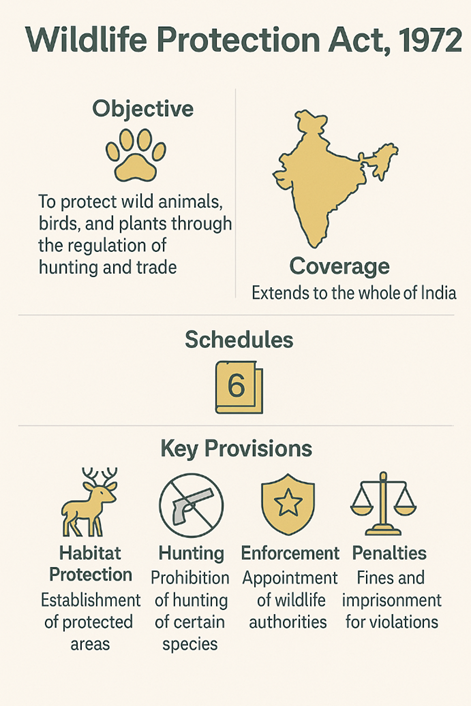
India’s Wildlife Management System is an elaborate framework involving legal, policy, scientific, and community-driven measures aimed at conserving the nation’s rich biodiversity.
Institutional and Legal Framework
- The Wildlife Division of the Ministry of Environment, Forest and Climate Change (MoEFCC) is the nodal authority for overseeing wildlife management, headed by the Director, Wildlife Preservation under the Wildlife (Protection) Act, 1972.
- The Wildlife (Protection) Act, 1972 is the chief statute, establishing protected areas (National Parks, Sanctuaries, Conservation Reserves, Community Reserves), imposing strict penalties for poaching, trade, and habitat destruction, and enabling the formation of bodies like the National Tiger Conservation Authority and Wildlife Crime Control Bureau.
Major Policy Initiatives & Schemes
- Project Tiger (1973) and Project Elephant (1992) are flagship species-focused conservation programs.
- The Centrally Sponsored Scheme ‘Integrated Development of Wildlife Habitats’ funds state/UT conservation efforts, including habitat restoration, anti-poaching measures, community engagement, research, and staff training.
- Newer strategies include the Action Plan for Vulture Conservation (2020–2025), National Conservation Strategy for the Greater One-Horned Rhinoceros (2019), and tech adoption such as M-STrIPES (tiger monitoring), camera traps, drones, and e-surveillance.
Mechanisms for Community and NGO Participation
- Joint Forest Management (JFM) and Eco-Development Committees promote community-based conservation.
- NGOs and research bodies (Wildlife Institute of India, Bombay Natural History Society, Salim Ali Centre for Ornithology) play key roles in research, monitoring, and advocacy.
Scientific, Technological, and Research Components
- Increasing investment in GIS, remote sensing, drones, and AI-driven monitoring for anti-poaching and ecological surveys.
- Standardized protocols for wildlife population estimation, genetic analysis, and forensic laboratories for wildlife crime investigation.
- Field research stations in biodiversity hotspots to facilitate ecosystem studies, capacity building, and best practices dissemination.
Wildlife Management Infra & Special Projects
- Over 100 National Parks, nearly 500 Wildlife Sanctuaries, 18 Biosphere Reserves, and several Conservation/Community Reserves.
- Emergency measures like Special Tiger Protection Force, intensive patrolling, monsoon anti-poaching squads, and translocation projects for endangered species.
- Restoration and rewilding initiatives for species like the Indian Bustard, Nilgiri Tahr, Sangai Deer, Hangul, and vultures.
Challenges Facing Indian Wildlife Management
| Challenge | Explanation | Example/Impact |
| Habitat loss & fragmentation | Urbanization, deforestation, infrastructure in eco-sensitive areas | Half of India’s forest cover lost; isolated populations |
| Poaching & illegal trade | High-value illegal trade in tigers, elephants, pangolins, etc. | Persistent demand, international smuggling |
| Human-wildlife conflict | Expansion of agriculture and settlements into wildlife habitats | 2853 human deaths (human-elephant conflict, last five years) |
| Implementation lapses | Understaffed departments, lack of training, slow judiciary | Weak law enforcement; low conviction rates |
| Funding/resource constraints | Less than 1% of government R&D spending to wildlife | Underfunded protection, monitoring |
| Climate change | Altered migration, breeding patterns, and habitat shifts | Increased species vulnerability |
| Limited local/community support | Conservation goals sometimes ignore livelihoods | Reduced effectiveness and buy-in |
Recent Reforms and Recommendations
- Expand technology use: Drones, M-STrIPES in more protected areas, camera traps, AI analytics for patrolling and data collection.
- Species-specific sensitivity mapping and cumulative impact assessment for infrastructure projects.
- Strategic environmental assessment for all development activities near wildlife habitats.
- Human-wildlife conflict mitigation: Community insurance, rapid response teams, barrier crops, and early warning systems.
- Policy for CSR funding to conservation projects, public-private partnerships, and more research funding.
Examples and Case Studies
- The Satpuda Landscape Tiger Partnership demonstrates public-private partnership efficiency for tiger protection.
- Recovery of Vultures: Ban on diclofenac and establishment of vulture safe zones result in population recovery.
- E-surveillance in Kaziranga led to a steep fall in poaching incidents.
Conclusion
India’s wildlife management system is multilayered, balancing legal safeguards, scientific management, robust institutional frameworks, community participation, and targeted funding. Persistent challenges remain—habitat fragmentation, poaching, enforcement gaps, and resource limitations—necessitating continuous innovation and the mainstreaming of conservation into development planning at all administrative levels.
This comprehensive approach, combined with standardized protocols, adaptive management, and rigorous accountability, provides a model for large-scale biodiversity conservation in the Globall South.
Source: Greater openness: On India and wildlife management – The Hindu
| Year | Question |
| 2022 | Analyse the features and objectives of the Wildlife (Protection) Amendment Act, 2022 and evaluate its impact on the conservation and management of wildlife. |
| 2020 | Discuss the meaning of ‘carrying capacity’ and how its understanding is vital in planning for sustainable development of a region. |
| 2018 | How does biodiversity vary in India? How is the Biological Diversity Act, 2002 helpful in conservation of flora and fauna? |