Why in the News?
- Recently, Greenland surfaced as a flashpoint in international relations following remarks by the U.S. administration suggesting a potential annexation or takeover of the island for national security reasons.
- This follows a major U.S. military operation in Venezuela and has triggered a diplomatic standoff. Danish Prime Minister Mette Frederiksen warned that such a move would violate the sovereignty of a NATO ally, potentially leading to the collapse of the military alliance.
General Overview of Greenland
- Political Status: Greenland is a self-governing autonomous territory within the Kingdom of Denmark. While it governs domestic affairs (education, health, resources), Denmark retains control over defense, foreign policy, and monetary affairs.
- Global Standing: It is the world’s largest non-continental island, located between North America and Europe.
- Continental Paradox: Geographically, it is part of the North American continent (located on the North American Tectonic Plate), but politically and culturally, it is deeply integrated with Europe.
- Demographics: The majority of the population are Inuit (indigenous people).
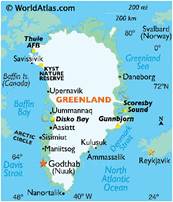
- Capital: Nuuk, (formerly known as Godthåb), situated on the southwest coast, is the principal administrative and economic centre of Greenland.
Geographical Features & Landforms of Greenland
Greenland is located in the Northern Hemisphere, with most of its landmass lying within the Arctic Circle.
- The Ice Sheet: Approximately 80% of the landmass is covered by the Greenland Ice Sheet, the second-largest ice body in the world after Antarctica.
- Topography: The interior is a massive ice-covered plateau, while the edges are fringed by high mountain ranges and deep fjords.
- Highest Point: Gunnbjørn Fjeld (3,694m), situated in the Watkins Range; it is the highest peak in the entire Arctic circle.
- Rivers & Lakes: Greenland lacks long, perennial river systems. Most are short meltwater streams formed by seasonal glacial melting. Notable examples include the Børglum Elv (one of the largest) and the Qinnguata Kuussua.
- Fjords: It contains the world’s largest fjord system, Scoresby Sund, on the eastern coast.
Geographical Boundaries & Location of Greenland
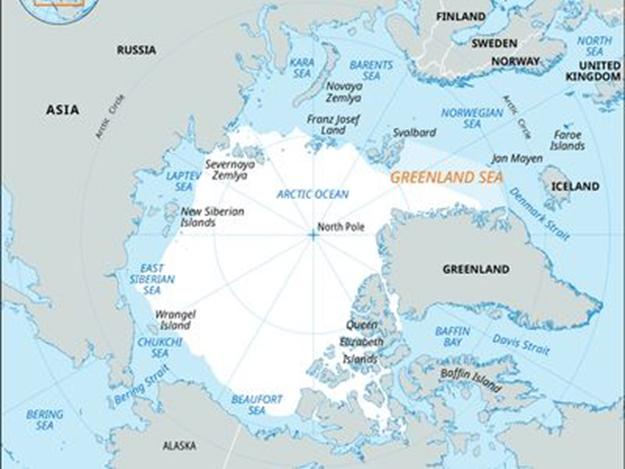
Greenland is strategically located between the Arctic and Atlantic Oceans. Its maritime and physical borders include:
- North: Arctic Ocean.
- East: Greenland Sea (separating it from Svalbard) and Denmark Strait (separating it from Iceland).
- West: Baffin Bay and Davis Strait (separating it from Canada’s Baffin Island).
- Southwest: Labrador Sea.
- Northernmost Point: Kaffeklubben Island is often cited as the northernmost point of land on Earth.
Climate and Vegetation of Greenland
- Climate Zone: Entirely within the Polar Zone, featuring an Arctic climate.
- High Arctic (North): An Arctic Desert with minimal precipitation (e.g., Peary Land).
- Low Arctic (South): Maritime influence brings slightly higher humidity.
- Vegetation: Primarily Tundra. Due to the permafrost and extreme winds (Piteraq), tall trees cannot grow naturally.
- Flora: Mosses, lichens, sedges, and dwarf shrubs like the Arctic Willow.
- Qinngua Valley: The only natural forest in Greenland, home to Downy Birch and Grey-leaf Willow reaching 7-8 meters.
- Recent Shift (“Greening”): Climate change is leading to “Shrubification,” where larger shrubs move northward, and retreating ice is forming new wetlands.
Mineral Wealth: The “Arctic Treasure Chest”
As the Greenland Ice Sheet melts, the island is emerging as a “resource frontier” critical for the global green energy transition and defense technology.
- Rare Earth Elements (REEs): Greenland hosts some of the world’s most significant deposits of REEs (e.g., Neodymium, Praseodymium, Dysprosium).
- Strategic Base Metals: The island possesses world-class deposits of Zinc and Lead (e.g., Citronen Fjord in the North). It also holds significant Iron Ore (Isua Mine), Copper, and Molybdenum.
- Precious Metals & Platinum Group: Southern Greenland is a hotspot for Gold (Nalunaq mine), while the Skaergaard intrusion on the East coast contains substantial Palladium and Platinum, vital for high-end electronics.
- Energy Reserves: Offshore basins in Baffin Bay are estimated to hold 17–31 billion barrels of oil. However, in 2021, Greenland joined the Beyond Oil and Gas Alliance (BOGA), shifting focus to its massive Hydropower potential.
- Gemstones & High-Value Minerals: Greenland is globally renowned for high-quality Rubies and Pink Sapphires (Aappaluttoq mine). It also hosts significant reserves of Graphite (for EV batteries) and Diamonds.
Strategic & Geopolitical Significance of Greenland
- Ballistic Missile Defense: Greenland hosts the Pituffik Space Base (formerly Thule Air Base). It is the northernmost U.S. military installation and a critical node in the Ballistic Missile Early Warning System (BMEWS).
- The GIUK Gap: Greenland forms the first part of the Greenland-Iceland-UK (GIUK) Gap, a strategic maritime chokepoint used to monitor and restrict Russian naval and submarine movements into the Atlantic.
- Arctic Shipping Routes: As Arctic ice retreats, the Northwest Passage and the Transpolar Sea Route become viable, potentially reducing shipping times between Europe and Asia by 40%.
- Arctic Council: Greenland plays a key role in the Arctic Council, which governs Arctic environmental protection and maritime law.
- Geopolitical Sovereignty: While Nuuk (the capital) manages domestic affairs under the Self-Government Act of 2009, Copenhagen (Denmark) retains control over Foreign Policy, Defense, and Currency.
Consider the following water bodies in relation to Greenland:
1. Baffin Bay
2. Davis Strait
3. Denmark Strait
4. Greenland Sea

Which of the above separate Greenland from Canada?
(a) 1 and 2 only
(b) 2 and 3 only
(c) 1, 3 and 4 only
(d) 1, 2, 3 and 4

Answer: (a) 1 and 2 only
Baffin Bay (1) is Correct: Baffin Bay lies between the western coast of Greenland and Baffin Island (Canada). It forms a major maritime boundary separating Greenland from the Canadian Arctic region.
Davis Strait (2) is Correct: Davis Strait connects Baffin Bay with the Labrador Sea and lies between southwestern Greenland and Canada’s Nunavut territory, thereby separating Greenland from Canada.
Denmark Strait (3) is Incorrect: Denmark Strait lies between Greenland and Iceland, not Canada. It separates Greenland from the island nation of Iceland in the North Atlantic.
Greenland Sea (4) is Incorrect: The Greenland Sea is located east of Greenland, separating it from Svalbard (Norway) and parts of the Arctic Ocean region, not from Canada.