
Why is this in the news?
- IIT Kanpur recently carried out two cloud-seeding flights over Delhi (28 October). The flights used aircraft and flares to disperse hygroscopic/flaring material into clouds but produced no measurable rainfall; some local areas reported light drizzle and small air-quality improvement.
Background and Context
- Rising air pollution and climate-induced stress have prompted governments to explore technological interventions such as cloud seeding for short-term relief.
- Delhi, plagued by post-harvest stubble smoke and meteorological inversion, faces annual air quality emergencies, leading authorities to consider cloud seeding to trigger rain that could wash away suspended pollutants.
- Globally, cloud seeding has been used both for increasing rainfall in drought-prone regions and suppressing hail or modifying fog at airports. However, its success rate remains contested.
- The renewed focus on cloud seeding in India stems from the need to address water scarcity, agricultural vulnerability, and urban air pollution — making it an issue of scientific, administrative, and environmental importance.
What is Cloud Seeding?
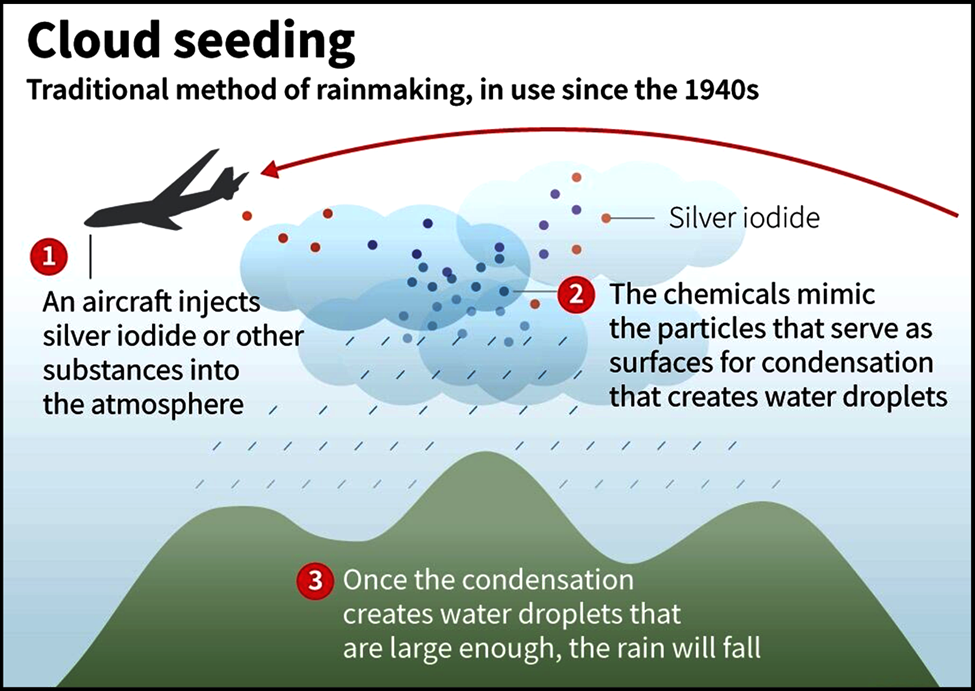
- Definition: Artificial induction of rainfall by introducing condensation or ice-nucleating particles into clouds to enhance droplet coalescence or ice-crystal formation.
- Mechanism: Aircraft or rockets disperse hygroscopic materials (like sodium chloride) or glaciogenic materials (like silver iodide) into moisture-laden clouds.
- These particles act as nuclei for condensation.
- When droplets grow large enough, they fall as rain.
What Are Cloud Seeding Chemicals?
- Cloud seeding chemicals are the core agents used to artificially induce or enhance precipitation by modifying the natural microphysical processes within clouds.
- These substances act as condensation or ice nuclei, depending on the cloud type (warm or cold) and surrounding atmospheric conditions. Their purpose is to catalyse the growth of water droplets or ice crystals, ultimately leading to rainfall or snowfall.
Key Chemical Agents Used
| Chemical | Function | Cloud Type | Notable Characteristics / Use Case |
| Silver Iodide (AgI) | Serves as an ice-nucleating agent | Cold clouds | Structure similar to ice; widely used in high-altitude or cold regions |
| Sodium Chloride (NaCl) | Acts as hygroscopic nuclei | Warm clouds | Encourages droplet growth; used in tropical/coastal areas |
| Potassium Iodide (KI) | Ice-nucleating agent | Cold clouds | Less toxic substitute for AgI; eco-friendlier option |
| Dry Ice (Solid CO₂) | Rapid cooling to create ice crystals | Supercooled clouds | Commonly dispersed from aircraft; fast but short-term results |
| Liquid Propane | Expands into ice nuclei | Supercooled clouds | Used for localized and time-bound precipitation efforts |
| Calcium Chloride (CaCl₂) | Enhances droplet coalescence | Warm clouds | Tested in Indian dry regions such as Rajasthan for rain enhancement |
Types of Cloud Seeding Techniques
Cloud seeding can be classified based on method, temperature, and delivery mechanism. The following are the most recognized types:
1. Warm-Cloud Hygroscopic Seeding
- Process: Hygroscopic salts like sodium chloride are dispersed into warm clouds (temperature above 0°C).
- Mechanism: The salts absorb moisture, increasing droplet size through collision and coalescence.
- Indian Example: Trials in Maharashtra and Pune recorded rainfall enhancement up to 20–24% under optimal cloud conditions.
2. Cold-Cloud (Glaciogenic) Seeding
- Process: Ice-nucleating materials such as silver or potassium iodide are released into supercooled clouds (below 0°C).
- Outcome: Ice crystals form and grow by absorbing moisture, eventually falling as snow or rain.
- Application: Common in hilly or drought-prone areas (e.g., the Western Himalayas).
3. Hygroscopic Rocket or Drone Seeding
- Process: Rockets or UAVs inject seeding materials into inaccessible or small cloud formations.
- Agents: Flare-based or aerosolized salts.
- Modern Development: India’s IIT Kanpur and CAIPEEX use radar and machine-learning systems for target cloud identification.
4. Ground-Based Generator Seeding
- Process: Ground generators burn silver iodide or salt mixtures, releasing particles that rise with updrafts.
- Use Case: Suitable for large catchments or reservoir catchment areas; tested in India’s RCPR programme (1957–66).
5. Fog and Frost Mitigation Seeding
- Process: Used to disperse fog (for aviation safety) or prevent frost damage.
- Agents: Hygroscopic aerosols or electric/laser-based systems.
- Status: Still in experimental stages globally.
Potential Negative Effects of Cloud Seeding
While cloud seeding offers potential for drought relief and water management, it carries environmental, ethical, and scientific challenges:
| Category | Description |
| Environmental Contamination | Silver iodide and other chemicals can accumulate in soil and water, harming aquatic ecosystems. |
| Health Risks | Chronic silver exposure may lead to argyria and organ toxicity; WHO recommends limits on silver levels. |
| Regional Weather Imbalance | Artificial rain in one area might reduce rainfall elsewhere, disrupting natural precipitation cycles. |
| Infrastructure Strain | Sudden heavy rainfall may trigger urban flooding or landslides in vulnerable terrains. |
| Atmospheric Alteration | Continuous chemical intervention can affect aerosol composition and ozone balance. |
| Inter-jurisdictional Conflicts | Induced rainfall across state or national borders can lead to disputes over airspace or shared river basins. |
Impacts of Cloud Seeding
Cloud seeding influences multiple sectors—hydrology, agriculture, environment, health, economy, and governance. Its outcomes are conditional on meteorological and operational variables.
1. Hydrological and Water Resource Impact
- Objective: Enhance rainfall/snowfall in catchment areas to improve surface runoff and groundwater recharge.
- Findings: CAIPEEX and other Indian studies reported up to 20–24% increase in rainfall under conducive conditions.
- Limitation: Results are inconsistent; effectiveness depends on existing cloud moisture and vertical development.
2. Agricultural Impact
- Benefits: Increased rainfall during critical crop stages reduces drought stress and improves yield stability.
- Evidence: Pilot projects in Maharashtra and Karnataka noted better soil moisture, but large-scale productivity gains remain inconclusive.
3. Environmental and Ecological Impact
- Positive: Temporary drought relief, improved streamflow.
- Risks: Possible changes in local microclimates, and accumulation of seeding agents in ecosystems.
- Recommendation: Long-term environmental monitoring and impact assessment must accompany seeding projects.
4. Air Quality and Public Health Impact
- Advantage: Artificial rain can wash out suspended particles, temporarily reducing PM2.5 and PM10 levels.
- Example: The Delhi 2025 trials aimed to mitigate severe smog episodes.
- Limitation: Such reductions are short-lived and do not substitute for emission control measures.
5. Economic and Cost–Benefit Analysis
- Costs: Aircraft deployment, chemicals, radar systems, and manpower.
- Example: Delhi’s approved five-flight cloud-seeding plan cost around ₹3.21 crore.
- Assessment: Economic viability depends on success rate—successful rainfall can yield high returns, while failures result in sunk costs.
6. Scientific and Technological Impact
- Research Output: Encouraged advances in cloud microphysics, radar meteorology, and AI-based forecasting.
- Institutional Role: Projects like CAIPEEX (IITM-Pune) have strengthened India’s operational and analytical capacity in atmospheric sciences.
7. Legal, Ethical, and Transboundary Considerations
- Core Questions: Who owns artificially induced rainfall? Can one state’s intervention harm another?
- Present Status: India’s cloud-seeding operations follow MoES/IITM protocols requiring environmental assessments.
- Need: Development of regional and international frameworks for weather modification governance.
Pros and Cons of Cloud Seeding
| Advantages | Disadvantages / Concerns |
| Boosts rainfall in drought-prone areas | Uncertain effectiveness and high cost |
| Improves water availability for agriculture | Environmental contamination (AgI, salts) |
| Can temporarily reduce air pollution | Alters local climate and rainfall patterns |
| Enhances scientific understanding | Ethical and transboundary governance issues |
Way Forward
Cloud seeding offers potential as a supplementary tool for drought mitigation and air-quality improvement, but its application must remain scientifically validated, environmentally safe, and policy-guided. The following measures can help India develop a balanced, evidence-based approach:
1. Establish a National Framework for Weather Modification
- India currently lacks a dedicated regulatory or ethical framework for cloud seeding.
- The Ministry of Earth Sciences (MoES), in collaboration with the India Meteorological Department (IMD) and Central Pollution Control Board (CPCB), should frame standard operating protocols covering:
- Licensing and environmental impact assessment (EIA)
- Airspace coordination with the Directorate General of Civil Aviation (DGCA)
- Chemical use, safety, and monitoring standards
- A “National Weather Modification Policy” can provide uniformity, reduce inter-state conflicts, and ensure accountability.
2. Strengthen Scientific Validation and Long-Term Monitoring
- Cloud seeding must move from ad-hoc trials to data-driven scientific evaluation.
- The CAIPEEX (Cloud Aerosol Interaction and Precipitation Enhancement Experiment) model should be expanded into a multi-institutional long-term research mission.
- Independent post-event audits—using radar, satellite, and rain-gauge networks—should assess actual rainfall enhancement versus natural variability.
- Establish pilot-to-policy pipelines, where successful regional studies guide scaled-up implementation.
3. Environmental and Health Safeguards
- Mandatory Environmental Impact Assessments (EIA) before any large-scale or repeated cloud seeding projects.
- Encourage the use of less toxic alternatives such as potassium iodide or biodegradable aerosols instead of silver iodide.
- Periodic monitoring of soil, water, and biota for chemical accumulation, ensuring compliance with WHO and CPCB safety thresholds.
4. Integrate Cloud Seeding with Broader Water Management Policies
- Cloud seeding cannot replace long-term water resource planning.
- Integrate seeding trials within a watershed-based approach, linking them to rainwater harvesting, groundwater recharge, and micro-irrigation schemes.
- Prioritize catchment areas of major reservoirs and drought-prone districts rather than urban centres with limited absorption capacity.
5. Enhance Technological and Indigenous Capabilities
- Invest in AI-driven cloud diagnostics, high-resolution weather radar, and drone-based dispersion systems for precision targeting.
- Encourage collaboration between IITs, ISRO, and DRDO for developing indigenous weather modification systems and sensors.
- Promote public–private partnerships (PPP) to operationalize trials and share meteorological data.
6. International and Inter-State Coordination
- Establish transboundary consultation mechanisms, especially for regions where air masses or river basins are shared (e.g., Indo-Gangetic plain).
- Study best practices from China, UAE, and the U.S., but contextualize them to Indian monsoonal dynamics.
- Within India, form inter-state committees to manage shared airspace and potential rainfall redistribution concerns.
7. Public Awareness and Ethical Oversight
- Weather modification impacts should be transparent—data and results must be accessible to citizens and scientific bodies.
- Establish an Ethical Oversight Board under the MoES to ensure that interventions respect environmental sustainability and public health.
- Promote informed media communication to prevent over-expectation and pseudoscientific claims about “making rain on demand.”
8. Integrate with Climate Adaptation and Pollution Mitigation Strategies
- Position cloud seeding as part of climate resilience efforts rather than an isolated technology.
- Combine seeding with long-term emission control, urban greening, and regional climate adaptation plans.
- Encourage inclusion of cloud seeding research under the National Action Plan on Climate Change (NAPCC) missions such as the National Water Mission and National Mission on Sustainable Agriculture.
Conclusion
The future of cloud seeding in India lies not in aggressive expansion but in cautious, science-based integration with national water and climate strategies. By ensuring environmental safety, technological transparency, and inter-agency coordination, India can harness this tool responsibly—enhancing water security and research innovation without compromising ecological balance or governance ethics.
Source: Has cloud seeding been effective? | Explained – The Hindu
UPSC CSE PYQ
| Year | Question |
| 2018 | Explain the concept of cloud seeding as a weather-modification technique. Discuss its applications, challenges, and environmental implications in India. |
| 2020 | Discuss the scientific principles behind artificial rain. Evaluate the feasibility and ethical concerns of using such interventions to address drought and air pollution in Indian cities. |
| 2023 | “While cloud seeding holds promise for rainfall augmentation, it also poses ecological and transboundary risks.” Examine in the Indian context. |