After Reading This Article You Can Solve This UPSC PYQ Question:
What do you understand by the concept “freedom of speech and expression”? Does it cover hate speech also? Why do the films in India stand on a slightly different plane from other forms of expression? Discuss. (12.5 Marks. GS-2 Polity)
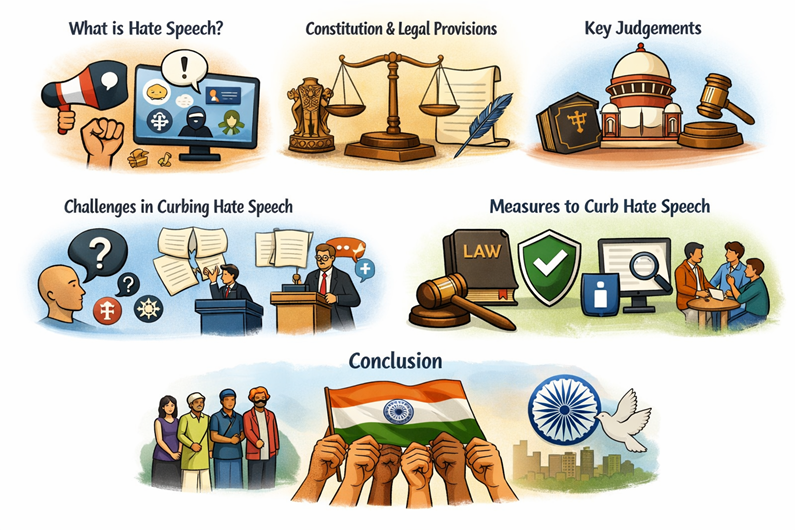
Introduction
While “Hate Speech” is not explicitly defined in the Indian Constitution or the BNS, legal and international bodies provide the following frameworks:
- Law Commission of India (267th Report): Defined as an incitement to hatred primarily against a group of persons defined in terms of race, ethnicity, gender, sexual orientation, religious belief, and the like.
Legal and Constitutional Provisions on Hate Speech
Constitutional Framework
- Article 19(1)(a): Guarantees Freedom of Speech and Expression.
- Article 19(2): Imposes “Reasonable Restrictions” on grounds of:
- Sovereignty and integrity of India.
- Security of the State.
- Public Order, Decency, or Morality.
- Incitement to an offence.
- Preamble: The values of Fraternity and Dignity act as the guiding spirit to curb speech that creates communal rifts.
Statutory Provisions (Bharatiya Nyaya Sanhita, 2023)
The BNS has replaced the IPC, bringing in specific sections to deal with hate-related offences:
- Section 196 (formerly 153A IPC): Penalizes promoting enmity between different groups on grounds of religion, race, place of birth, residence, language, etc.
- Section 299 (formerly 295A IPC): Punishes deliberate and malicious acts intended to outrage religious feelings.
- Section 353 (New): Targets the publication or circulation of “false or misleading information” that may jeopardize national sovereignty or create communal discord.
- Section 103(2): Specifically addresses Mob Lynching (murder by a group of five or more on grounds of race, caste, or community).
Other Laws
- Representation of People Act (RPA), 1951: Section 123(3A) and 125 bar the promotion of hatred for electoral gains, classifying it as a “corrupt practice.”
- SC/ST (Prevention of Atrocities) Act, 1989: Prohibits speech intended to humiliate members of the SC/ST community in public view.
Key Judicial Judgements
- Shreya Singhal v. Union of India (2015): Struck down Section 66A of the IT Act for being “vague” and “overbroad.” It distinguished between Discussion, Advocacy, and Incitement, holding that only “incitement” can be restricted.
- Tehseen Poonawalla v. Union of India (2018): Issued “preventive, remedial, and punitive” guidelines to tackle lynching and mob violence fueled by hate speech.
- Shaheen Abdulla v. Union of India (2022/23): The SC directed all States/UTs to register suo motu FIRs in hate speech cases without waiting for a formal complaint, irrespective of the religion of the maker.
Challenges in Curbing Hate Speech
1. Legal & Definitional Ambiguity
- Lack of Specific Definition: Neither the Constitution nor the Bharatiya Nyaya Sanhita (BNS) explicitly defines “Hate Speech.” This leads to subjective interpretation by law enforcement, often resulting in either over-regulation or inaction.
- The “Speech vs. Incitement” Divide: As held in Shreya Singhal (2015), the law only restricts “incitement.” Distinguishing between offensive advocacy (protected) and actual incitement to violence (prohibited) remains a legal gray area.
2. Digital & Technological Hurdles
- The “Viral Velocity”: On platforms like X (formerly Twitter) and WhatsApp, hate speech spreads faster than fact-checking or legal takedown notices can act.
- Anonymity & Encryption: End-to-end encryption (WhatsApp) makes it difficult to trace the “first originator” of hate speech, while VPNs allow users to bypass territorial laws.
- Algorithmic Bias: Recommendation engines often prioritize “high-engagement” (inflammatory) content to maximize watch time, inadvertently amplifying extremist views.
3. Institutional & Enforcement Gaps
- Low Conviction Rates: Proving “malicious intent” under Section 196 or 299 of BNS is difficult. Cases often linger for years, losing their deterrent effect.
- Political Interference: Hate speech is frequently used as a tool for electoral mobilization. Law enforcement agencies often face pressure when the speaker is politically influential.
- Burden on Judiciary: The Supreme Court is increasingly overwhelmed, leading to the decentralization of these cases to High Courts, which may lead to inconsistent rulings across different states.
4. Socio-Political Challenges
- The “Chilling Effect”: Vague laws are often misused to target journalists, activists, or comedians, creating a climate of self-censorship and weakening Article 19(1)(a).
- Normalisation of Hate: When hate speech becomes part of the “mainstream” public discourse, social sanction disappears, making legal intervention appear as “state high-handedness” to certain sections of the public.
Measures to Curb Hate Speech
1. Legislative Measures: Plugging Legal Gaps
- Specific Definition: Introduce a standalone definition of “Hate Speech” in the Bharatiya Nyaya Sanhita (BNS) to reduce police subjectivity.
- New Penal Sections: Implement the Viswanathan Committee recommendations to insert:
- Section 153C: Specifically targeting “incitement to hatred” on grounds of religion, race, caste, sex, or gender.
- Section 505A: Penalizing “causing fear, alarm, or provocation of violence” through derogatory words or display.
- Tiered Punishment: Move away from “one-size-fits-all” sentencing to a tiered system (e.g., fines for first-time offensive speech vs. 5–10 years for incitement to genocide).
2. Administrative & Executive Measures
- Suo Motu FIRs: Rigorous enforcement of the SC directive (Shaheen Abdulla Case) requiring police to register cases immediately without a formal complaint, treating delays as Contempt of Court.
- District Nodal Officers: As per the Tehseen Poonawalla (2018) guidelines, designate a senior police officer in every district to monitor and prevent communal flare-ups fueled by hate speech.
- 24-Hour Digital Takedowns: Under the IT Rules 2026, mandate social media platforms to remove “virally contagious” hate content within 24 hours of notification by a designated authority.
3. Judicial Measures: Ensuring Deterrence
- Special Fast-Track Courts: Establish dedicated benches to conclude hate speech and mob-lynching trials within 6 months to ensure the deterrent effect isn’t lost in pendency.
- Three-Part Test: Adopt the international standard (Rabat Plan of Action) to judge speech based on:
- Context
- Speaker’s intent
- Imminence of harm
- Restorative Justice: For non-violent but prejudicial speech, the judiciary can mandate public apologies and community service, as observed in recent rulings.
4. Social & Technological Measures
- Media Literacy: Integrate “Digital Citizenship” into school curricula to help students identify misinformation and polarized narratives (e.g., the Karnataka Model of awareness).
- Counter-Speech Strategy: Promoting “positive speech” and community-led narratives to drown out extremist voices rather than relying solely on censorship.
- AI for Detection: Deploy Safe & Trusted AI (India AI Impact Summit 2026) to detect “organized hate” patterns in regional languages before they result in on-ground violence.
Conclusion
Curbing hate speech requires balancing Article 19(1)(a) with the Preamble’s Fraternity. Future-proofing India’s social fabric necessitates BNS-aligned legal clarity, AI-driven moderation under IT Rules 2026, and fostering a resilient, media-literate digital citizenry.