Context :- At the IBSA (India–Brazil–South Africa) Leaders’ Summit, the Indian Prime Minister emphasised that UNSC reform is now a necessity, not a choice.
Mandate and Composition
- Apex Authority: The UNSC is the primary organ responsible for maintaining international peace and security, possessing the unique authority to issue binding resolutions.
- Membership Structure:
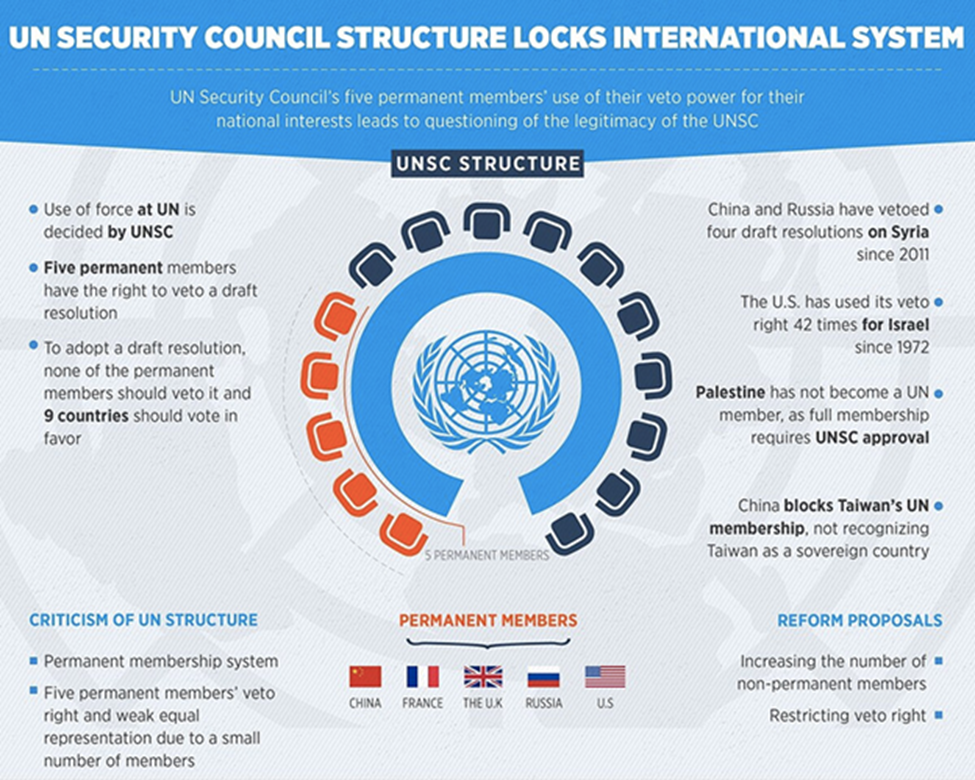
- Permanent Members (P5): China, France, Russia, UK, and US. They possess veto power, allowing a single nation to block resolutions regardless of majority support.
- Non-Permanent Members: Ten members elected by the UN General Assembly (UNGA) for two-year terms on a regional basis. They lack veto power but may hold the rotating monthly Presidency and head various committees.
Historical Evolution vs. Current Reality:
Diminishing Representation:
- 1945: 11 Council members represented 51 UN states (approx. 22% representation).
- 1965: The only structural expansion occurred, increasing membership to 15.
- Present: 15 Council members represent 193 UN states (under 8% representation), creating a significant legitimacy deficit.
- India’s Engagement: India asserts that expansion is vital for the representation of developing nations. It has served eight terms as a non-permanent member, most recently elected in 2021.
Systemic Deficiencies
- Geopolitical Anachronism: The Council reflects the power dynamics of 1945 rather than the contemporary world order. Major regions like Africa, South America, and Asia (excluding China) lack permanent representation.
Dysfunctional Veto Mechanism:
- The veto privileges the P5 over the collective will of the remaining 188 member states.
- Recent conflicts (e.g., Ukraine crisis) highlight the Council’s paralysis, as P5 members (specifically Russia) can veto resolutions addressing their own aggressive actions.
Barriers to Reformation
- High Procedural Thresholds: Amending the UN Charter requires a two-thirds majority in the UNGA and ratification by two-thirds of member states, including the unanimous agreement of the P5.
Diplomatic Deadlocks and Alliances:
- G4 Group (India, Brazil, Germany, Japan): Mutually support each other’s bids for permanent seats and advocate for African representation.
- L.69 Group: A coalition of developing nations demanding expansion and better representation for the Global South and Small Island Developing States (SIDS).
- The Coffee Club (Uniting for Consensus): A 40-member group opposing the G4. Specific rivalries include Pakistan opposing India, and Italy/Spain opposing Germany.
- The China Factor: China remains the only P5 member officially opposing India’s permanent membership, neutralizing support from other P5 nations.
Conclusion: The Imperative for Change
- Legitimacy Crisis: Without structural reform to include emerging powers and the Global South, the UNSC risks losing its relevance and effectiveness.
- Stagnant Negotiations: Despite the 2008 authorization for Intergovernmental Negotiations (IGN) on equitable representation, tangible progress remains elusive.