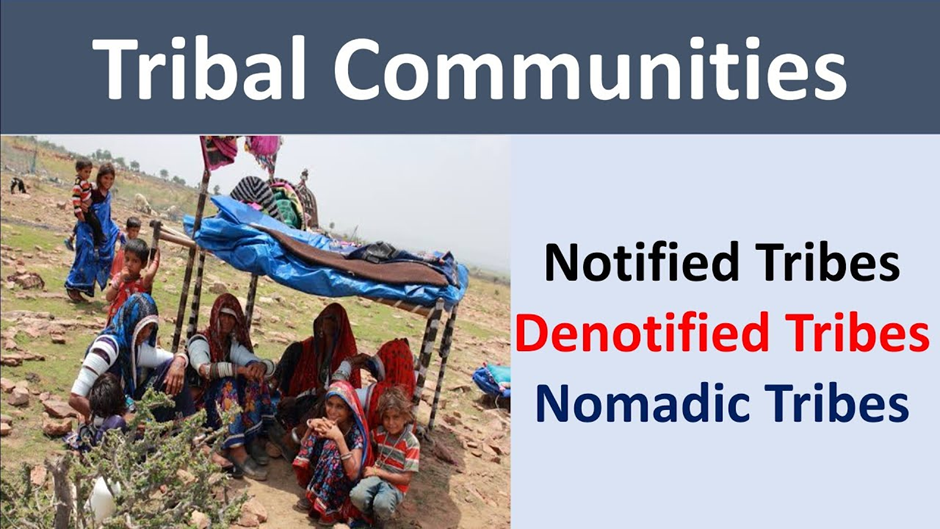
The Union Government has clarified in Parliament that there is no proposal under consideration to freshly classify Denotified, Nomadic, and Semi-Nomadic Tribes (DNTs) into Scheduled Caste (SC), Scheduled Tribe (ST), or Other Backward Class (OBC) categories.
Who are the Denotified, Nomadic, and Semi-Nomadic Tribes?
- Denotified Tribes (DNTs): Communities that were notified as being ‘born criminal’ during the British regime under the Criminal Tribes Act of 1871. This Act was repealed in 1952, and they were “De-Notified”.
- Nomadic/Semi-Nomadic: Communities who move from one place to another rather than living in one place comfortably.
- Current Status: These groups are the most marginalized, often falling outside the safety net of SC/ST/OBC reservations due to a lack of specific documentation or classification.
What is the Institutional Framework?
To address the specific grievances of these groups, the government has established several bodies over the years:
- Idate Commission (2017): Headed by Bhiku Ramji Idate, it flagged the urgent need for proper classification of these communities into SC, ST, or OBC lists.
- DWBDNC (2019): Following the Idate report, the government constituted the Development Welfare Board for Denotified, Nomadic, and Semi-Nomadic Communities.
- NITI Aayog Panel: Entrusted with the task of classification, it commissioned the Anthropological Survey of India (AnSI) to conduct an ethnographic study.
About SEED scheme ?
- Launch & Nodal Agency: Launched in February 2022 by the Ministry of Social Justice & Empowerment.
- Primary Objective: To facilitate the economic empowerment of Denotified (DNT), Nomadic (NT), and Semi-Nomadic (SNT) tribes, historically the most marginalized communities.
II. What are the Four Pillars of Implementation?
The scheme focuses on holistic development through four key components:
- Educational Support: Provision of free coaching for Civil Services and professional courses (Medicine, Engineering, MBA).
- Healthcare Security: Health insurance coverage extended through the National Health Authority’s PMJAY (Ayushman Bharat).
- Livelihood Enhancement: Income generation support through community-level clusters.
- Housing Assistance: Financial aid for housing construction via PMAY (Pradhan Mantri Awas Yojana) or IAY.
III. How is the Scheme Administered?
- Implementing Body: The Development and Welfare Board for De-notified, Nomadic and Semi-Nomadic Communities (DWBDNC).
- Fiscal Outlay: A corpus of ₹200 crore approved for the five-year period starting 2021-22.
- Technological Integration: An online portal acts as a central repository for beneficiary data and ensures seamless registration.
The Policy Trajectory: Evolution of DNT Welfare
I. How did the Institutional Framework Evolve?
- Renke Commission (2006):
- Headed by Balkrishna Sidram Renke; report submitted in 2008.
- Key Observation: Noted that DNTs were deprived of Constitutional support available to SCs/STs.
- Population Estimate: Approx. 10.74 crores (based on Census 2001).
- Idate Commission (2015):
- Headed by Shri Bhiku Ramji Idate.
- Mandate: To identify and list DNT communities and evaluate development progress.
- Outcome: Recommendations led to the establishment of the DWBDNC in 2019.
II. What Other Initiatives Support DNTs?
- Dr. Ambedkar Pre-Matric and Post-Matric Scholarship: A Centrally Sponsored Scheme (w.e.f. 2014-15) specifically for DNT students not covered under SC, ST, or OBC categories.
- Nanaji Deshmukh Scheme of Construction of Hostels: Provides hostel facilities for DNT boys and girls; implemented via State Governments and Central Universities (w.e.f. 2014-15).