Established: June 2020 (Operationalized 2021)
Status: Autonomous, Single-Window, Nodal Agency under the Department of Space (DoS).
Mandate: To promote, authorize, and supervise space activities of Non-Governmental Entities (NGEs).
Governance: Headed by a Chairman (currently Dr. Pawan Goenka). It has its own directorates for Technical, Legal, Safety, and Monitoring.
Key Functions:
1. The Single-Window Regulator
- Authorization: It is the “Traffic Controller” for private players. No private rocket can launch or satellite can be deployed without IN-SPACe authorization.
- Supervision: It ensures that private space activities comply with international treaties (like the Outer Space Treaty) and national safety standards.
2. Bridge between ISRO and Industry
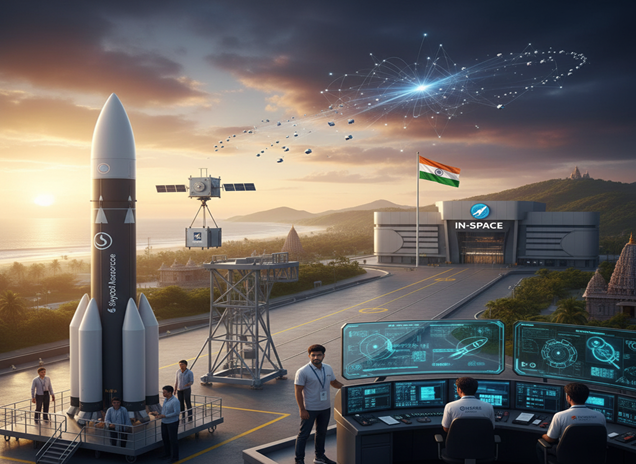
- Infrastructure Sharing: It facilitates the sharing of ISRO’s world-class facilities (launch pads, tracking centers, and test labs) with private startups like Skyroot Aerospace and Agnikul Cosmos on a nominal “user charge” basis.
- Technology Transfer: It acts as the nodal agency to transfer ISRO-developed mature technologies to the private sector.
3. Promotion & Hand-holding
- Space Ecosystem: It manages the ₹1,000 Crore Venture Capital (VC) Fund (approved in 2024-25) to accelerate space-tech startups.
- Educational Support: Promotes space tourism and student-led satellite projects (e.g., AzaadiSAT).
Strategic Distinction: IN-SPACe vs. ISRO vs. NSIL
- ISRO (The R&D Hub): Focuses on “cutting-edge” research, deep-space exploration (Gaganyaan, Chandrayaan), and national missions.
- IN-SPACe (The Regulator): The “interface” that opens the door for private players to enter the sector.
- NSIL (The Commercial Arm): A PSU that handles the commercial side of ISRO—selling launch services and building satellites on a “Demand-Driven” model.
Latest Developments
- Indian Space Policy 2023: This foundational document formally recognized IN-SPACe as the primary agency to create a level playing field for NGEs.
- FDI Reforms (2024): * 100% FDI allowed in manufacturing satellite components.
- 74% FDI (Automatic) for Satellite Manufacturing & Operations.
- 49% FDI (Automatic) for Launch Vehicles and Spaceports.
- Dec 2025 Milestone: IN-SPACe successfully authorized the first private commercial satellite launch from the new SSLV Launch Complex in Kulasekarapattinam.
- Space Vision 2047: IN-SPACe is tasked with growing India’s share in the global space economy from 2% to 10% by 2030.
Q. With reference to the Indian National Space Promotion and Authorization Centre (IN-SPACe), consider the following statements:
I. It is a statutory body established under the Space Act of 2020.
II. It serves as a single-window nodal agency for the participation of private entities in the space sector.
III. It is responsible for the commercial exploitation of products and services emanating from the Indian space programme.
How many of the above statements are correct?
A) Only one
B) Only two
C) All three
D) None

Answer: A) Only one.

Reasoning:
Statement I is Incorrect because IN-SPACe is an executive body (Autonomous agency under DoS), not statutory.
Statement II is Correct.
Statement III is Incorrect because that is the primary mandate of NSIL (NewSpace India Limited), not IN-SPACe.