By reading this article you can solve the below UPSC Mains PYQ
How does India see its place in the economic space of rising natural resource rich Africa? (GS-2 International Relation)
Context
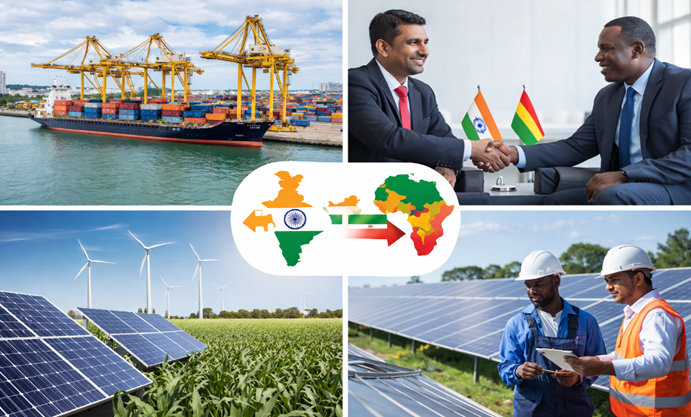
India–Africa economic partnership today represents one of the most dynamic South–South growth corridors, crucial for India’s Global South diplomacy and Africa’s development agenda. 20th CII India-Africa Business Conclave (August 2025) highlights India’s strategic push to double bilateral trade to $200 billion by 2030, leveraging the African Continental Free Trade Area (AfCFTA) and the African Union’s entry into the G20 to deepen economic, digital, and energy partnerships.
Significance of India-Africa Relationship
The significance of the India-Africa economic relationship transcends mere trade figures. It represents a strategic pillar for India’s global ambitions, energy security, and its identity as the “Voice of the Global South.”
1. Strategic and Geopolitical Significance
- Global South Leadership: By championing the African Union’s (AU) permanent membership in the G20 (2023), India has cemented its role as a bridge between the developed world and emerging economies.
- Reforming Multilateralism: Africa’s 54 votes are crucial for India’s bid for a permanent seat on the UN Security Council and for advocating reforms in the WTO and IMF.
- Maritime Security (SAGAR Vision): Africa’s eastern seaboard is vital for the security of the Western Indian Ocean. Initiatives like AIKEYME 2025 (Africa-India Key Maritime Engagement) focus on anti-piracy and securing Sea Lines of Communication (SLOCs).
2. Energy and Resource Security
- Critical Minerals for Green Transition: Africa holds 30% of global mineral reserves. India is actively securing “Critical Mineral Partnership Agreements” for Lithium, Cobalt (DRC/Zambia), and Manganese, which are essential for India’s EV and semiconductor missions.
- Hydrocarbon Security: Africa provides nearly 15-20% of India’s crude oil imports (Nigeria, Angola), helping diversify supply away from the volatile Middle East.
- Food Security: India is investing in African “breadbaskets” (e.g., Ethiopia, Sudan) for pulses and oilseeds to stabilize domestic food inflation.
3. Economic and Demographic Synergy
- Alternative to China: Unlike the “Debt Trap” model often associated with other players, India’s “Kampala Principles” focus on local capacity building, transparency, and “co-development.”
- The AfCFTA Factor: The African Continental Free Trade Area creates a $3.4 trillion unified market. For Indian MSMEs and automobile giants, this provides a massive export frontier as Africa’s population is set to reach 2.5 billion by 2050.
- “Pharmacy of the World”: Indian generics account for roughly 80% of ARVs used in Africa to fight HIV/AIDS, making India indispensable to African public health.
4. Digital and Technological Partnership
- Exporting DPI (Digital Public Infrastructure): Africa is the primary testing ground for the internationalization of the India Stack.
- Financial Inclusion: UPI-style systems in Ghana and Namibia.
- Digital Identity: MOSIP (Aadhaar-based) implementation in Togo and Ethiopia.
- Bridging the Digital Divide: Through the Pan-African e-Network, India provides low-cost tele-education and tele-medicine, building high-value soft power.
More about Current State of Economic Engagement:
1. Trade Trajectory: The $100 Billion Milestone
- Total Volume: In FY 2024-25, bilateral trade officially crossed the $103 billion mark, representing a 17% year-on-year growth.
- Trade Balance: India currently faces a trade deficit (Exports: ~$45bn; Imports: ~$58bn), primarily due to high-value imports of energy and raw materials.
- The 2030 Target: The Government of India has set an ambitious target to reach $200 billion in trade by 2030.
- DFTP Scheme: India’s Duty-Free Tariff Preference (DFTP) scheme now provides non-reciprocal market access to 34 African Least Developed Countries (LDCs), covering 98% of tariff lines.
2. Investment: Top-Tier Global Player
- Cumulative FDI: India is one of the top five investors in Africa with a cumulative investment of $75–100 billion.
- Focus Sectors: Investment has matured beyond mining. It is now concentrated in:
- Telecom: (e.g., Airtel’s $200m+ AI-infrastructure push in Nigeria).
- Healthcare: 20% of India’s pharma exports go to Africa; Indian firms are now setting up local manufacturing hubs in Egypt and South Africa.
- Automobiles: India is the leading supplier of two-wheelers and three-wheelers across the continent.
3. The New Pillars: Digital & Green Energy
- The Digital Compact:
- UPI Expansion: Namibia and Ghana have integrated UPI-style payment systems in 2024-25.
- Digital ID: Togo and Ethiopia are implementing MOSIP (India’s open-source Aadhaar-style platform).
- Critical Mineral Diplomacy: India has signed MoUs with Zambia and DRC for the joint exploration of Lithium and Cobalt—essential for India’s National E-Mobility Mission.
- Green Hydrogen: Joint ventures are emerging in Namibia and Morocco to leverage Africa’s solar potential for Green Hydrogen production.
4. Development Finance (The Concessional Model)
- Lines of Credit (LoC): India has extended over $12.37 billion through EXIM Bank, funding 200+ projects in 43 countries.
- Human Capital: The ITEC program and ICCR scholarships have trained over 40,000 African professionals, creating a “Human Bridge” in policy and governance.
Key Challenges in India–Africa Economic Ties
Despite reaching the $100 billion trade milestone, the India–Africa relationship faces structural and geopolitical hurdles that prevent it from reaching its full potential.
1. The “China Factor” & High-Volume Competition
- Scale Gap: While India–Africa trade is ~$103 billion, China–Africa trade exceeds $280 billion. China’s state-backed “Belt and Road Initiative” (BRI) allows for massive, high-visibility infrastructure projects (railways, ports, dams) that India’s private-sector-led model struggles to match in scale.
- Resource Dominance: China has already secured deep equity in African mines (Cobalt in DRC, Lithium in Zimbabwe), making it difficult for Indian firms to secure primary access to critical minerals for the green energy transition.
2. Financial and Implementation Bottlenecks
- “Strategic Inertia”: There has been a notable gap in high-level institutional engagement; the last India-Africa Forum Summit (IAFS) was in 2015. This has led to a perceived loss of diplomatic momentum compared to other players like Russia, Turkey, and the UAE.
- Line of Credit (LoC) Delays: Indian-funded projects often suffer from bureaucratic “red tape” and slow disbursement processes. On the ground, capacity constraints within African recipient agencies further delay project completion.
- Trade Imbalance: India’s trade is concentrated in a few commodities (oil, gold) and with a few countries (Nigeria, South Africa, Egypt). Diversifying trade to the other 50+ nations remains a challenge.
3. Political Instability and Security Risks
- The “Coup Belt”: Since 2020, Africa has seen 9 military coups (notably in the Sahel region—Mali, Niger, Burkina Faso). This political volatility threatens the safety of Indian investments and the Indian diaspora.
- Insurgency and Terrorism: Rising radicalization in the Horn of Africa and the Cabo Delgado region (Mozambique) directly affects Indian energy investments (like the $20 billion LNG project led by ONGC Videsh).
4. Logistics and Connectivity Gaps
- High Transaction Costs: A lack of direct shipping lines and limited air connectivity between Indian and African hubs increases the cost of goods.
- Fragmented Markets: While the AfCFTA aims to create a unified market, the actual implementation is slow. Indian exporters still have to navigate 54 different sets of regulations, standards, and customs duties.
5. Socio-Cultural Challenges
- Public Perception: Instances of discrimination and violence against African students in India have occasionally strained “soft power” ties. This “perception gap” can negatively impact people-to-people economic exchange.
- Low Branding: Unlike China’s high-profile stadiums and railways, India’s contributions (like tele-education or SME training) are less visible, leading to a “visibility deficit” in the African public eye.
Way forward
The Five-Point Strategy for India-Africa Economic Engagement
1. Trade for Development
- The Goal: Transitioning from the $100 billion milestone to a $200 billion bilateral trade target by 2030.
- Action: Strengthening the Duty-Free Tariff Preference (DFTP) scheme for African LDCs and deepening engagement with the African Continental Free Trade Area (AfCFTA) to treat Africa as a single, unified market.
- Shift: Moving away from being just a commodity importer to exporting high-value engineering goods, refined petroleum, and specialized textiles.
2. Digital Transformation & DPI Export
- The Goal: Establishing a “Digital Corridor” between India and Africa.
- Action: Scaling up the “India Stack” (DPI).
- Financials: Expanding UPI and RuPay systems (already active in Namibia and Ghana).
- Identity: Deploying MOSIP (Aadhaar-style ID) to formalize economies (e.g., Togo, Ethiopia).
- Soft Power: Leveraging the e-VidyaBharti and e-ArogyaBharti platforms for tele-education and tele-medicine.
3. Energy Transition & Critical Mineral Security
- The Goal: Mutual energy security through green and traditional channels.
- Action:
- Green Energy: Utilizing the International Solar Alliance (ISA) and Global Biofuels Alliance to help Africa overcome “energy poverty.”
- Critical Minerals: Securing “Joint Exploration Agreements” for Lithium, Cobalt, and Copper (specifically with the DRC, Zambia, and Namibia) to fuel India’s EV and semiconductor sectors.
4. Value-Added Manufacturing & MSME Collaboration
- The Goal: Moving from “Made in India” to “Made in Africa with India.”
- Action: Supporting African industrialization by setting up manufacturing units locally.
- MSME Integration: Promoting joint ventures between Indian and African MSMEs to build resilient supply chains.
- Pharma: Setting up generic drug manufacturing hubs in Africa to reduce their import dependency on the West.
5. Capacity Building & Human Capital Multiplier
- The Goal: Creating a skilled workforce for the future.
- Action:
- The “Skills Multiplier” Initiative: A 2025 target to train one million African trainers and professionals through ITEC and institutional setups like the IIT Zanzibar campus.
- Institutional Support: Helping African nations develop data centers, governance frameworks, and agricultural excellence centers.
Conclusion
“The future of India-Africa relations lies in shifting from a resource-extractive relationship to a shared-innovation model. By treating the African Union as a single economic bloc (AfCFTA) and positioning India as the primary provider of affordable technology and digital goods, India can create a ‘South-South’ success story that serves as a credible alternative to traditional Western or Chinese models.”