Context
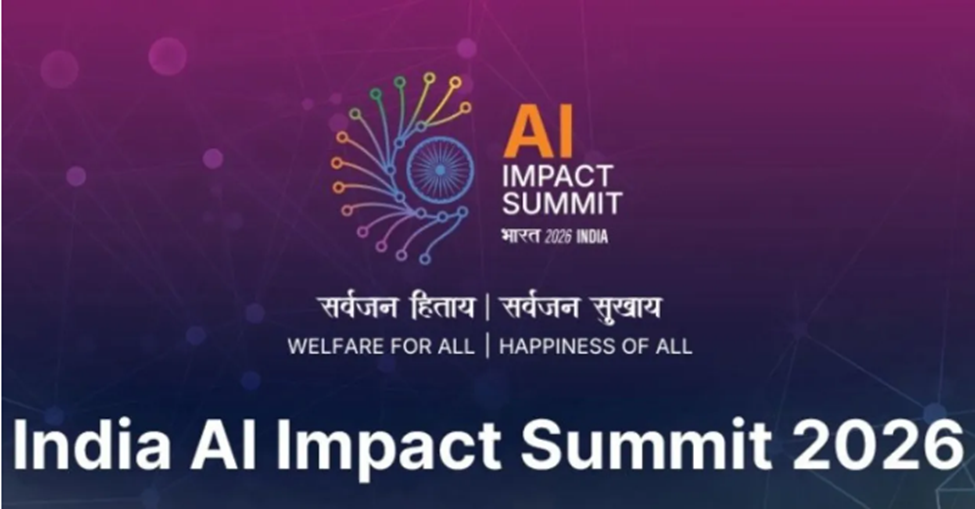
The fourth AI Impact Summit 2026 commenced at the Bharat Mandapam in New Delhi, marking a significant step in India’s leadership within the digital domain. Unlike developed nations that often focus primarily on regulatory frameworks, India is championing a “human-centric” approach that prioritizes “economic good” for all.
This summit serves as a platform for India to advocate for equitable access to AI resources and fair rule-making, particularly for developing economies in the Global South.
1. Core Pillars and Thematic Structure
- The Three “Chakras”: The summit is structured across three thematic pillars—People, Planet, and Progress.
- Scale of Participation: The event features over 3,000 speakers across 500 sessions, with participation from approximately 100 countries.
- India AI Expo: Prime Minister Narendra Modi inaugurated the “India AI Expo 2026,” showcasing AI technology demonstrations from start-ups and pavilions from 13 countries.


2. Strategic Diplomacy and Global Leadership
- Bilateral Engagements: The summit facilitates high-level diplomacy, including bilateral talks between Prime Minister Modi and French President Emmanuel Macron, as well as engagements with Brazilian President Luiz Inácio Lula da Silva.
- Tech Industry Collaboration: Global tech leaders, including Sundar Pichai (Google), Sam Altman (OpenAI), and Bill Gates, are expected to participate, highlighting the intersection of private tech innovation and public policy.
- UN Involvement: UN Secretary-General António Guterres is among the attendees, emphasizing the summit’s importance in the global governance of Artificial Intelligence.
3. Key Focus Areas for Prelims
- Venue: Bharat Mandapam, New Delhi (the same venue as the 2023 G-20 Summit).
- Event Frequency: This is the fourth AI Summit, following previous iterations held in the U.K., South Korea, and France.
- Inclusive Innovation: A notable feature is the scheduled “all-woman” hackathon aimed at fostering diversity in the AI development space.
- The AI for ALL Global Impact Challenge: It received over 1,350 applications from more than 60 countries, focusing on scalable AI solutions across healthcare, agriculture, climate resilience, governance, education, and financial inclusion.
- The AI by HER: It is Global Impact Challenge, which received over 800 applications from more than 50 countries, is dedicated to advancing women-led innovation in artificial intelligence.
- The YUVAi Global Youth Challenge: which received over 2,500 applications from 38 countries, showcases the innovation and problem-solving capabilities of young AI leaders aged 13 to 21.
With reference to the 'AI Impact Summit 2026' held in New Delhi, consider the following statements:
I. It is the fourth iteration of the global AI summit, following previous events held in the United Kingdom, South Korea, and France.
II. The summit is structured around three thematic pillars, referred to as "Chakras": People, Planet, and Progress.
III. Unlike developed nations' regulatory-first approach, India's stance at the summit emphasizes a "human-centric" model focused on "economic good" for all.
Which of the statements given above are correct?

(a) I and II only
(b) II and III only
(c) I and III only
(d) I, II and III
Answer: D
Explanation:
•  Statement I is Correct: The AI Impact Summit 2026 in New Delhi is indeed the fourth major milestone in the global AI safety and action sequence. It follows the Bletchley Park Summit (UK, 2023), the Seoul Summit (South Korea, 2024), and the AI Action Summit (France, 2025).
•  Statement II is Correct: The summit is uniquely organized around three thematic pillars known as "Chakras":
•	People: Focusing on inclusive skills and human rights.
•	Planet: Emphasizing sustainable, energy-efficient AI.
•	Progress: Using AI as an engine for global economic growth.
•  Statement III is Correct: A major diplomatic highlight of this summit is India’s push for a "Human-Centric" approach. While Western summits have prioritized "existential risks" and "strict regulation," India (as a leader of the Global South) emphasizes using AI to solve real-world problems in agriculture, healthcare, and education to ensure "economic good" for developing nations.