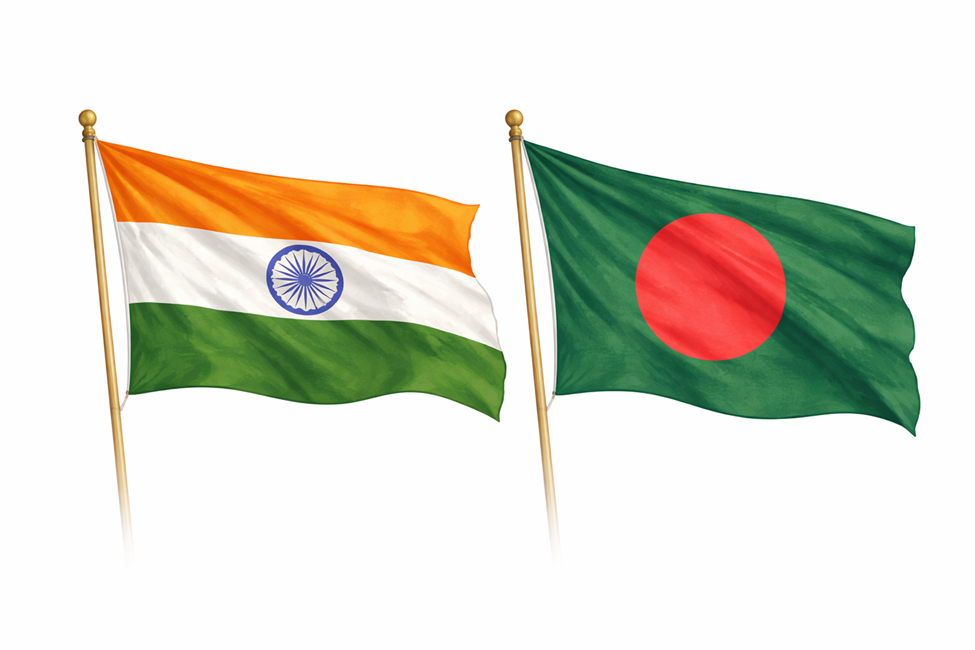
By reading this article you can solve the below UPSC Mains Model Question
The post-2024 political transition in Bangladesh marks a shift from legacy-based diplomacy to a period of 'strategic recalibration' for India. Critically analyze the emerging challenges to India's 'Neighborhood First' policy and suggest a pragmatic roadmap for future engagement. (GS-2 International Relation)
“We should not expect smooth sailing all the time with our neighbors; that never happens. But the logic every one of our neighbors must realize is that working with India gives you benefits, and not working with India has a cost.” External Affairs Minister S. Jaishankar
Context: The death of the Inqilab Mancha leader Hadi on December 18, 2025, triggered mob attacks on Indian missions and liberal media & on the other hand India on Sunday described the killing of a Hindu youth in Bangladesh as a “horrendous act”, and expressed “strong concern” about the safety of minority communities in the neighbouring country.
Historical Background: The Foundation of Ties
1. The 1971 Liberation War (The Genesis)
- Birth of a Nation: The relationship was forged in blood during the 1971 war. India provided sanctuary to nearly 10 million refugees and extended diplomatic and military support to the Mukti Bahini against West Pakistani atrocities (Operation Searchlight).
- Decisive Intervention: India’s military intervention led to the surrender of 93,000 Pakistani troops and the creation of Bangladesh. India was the first country to recognize Bangladesh as a sovereign state (Dec 6, 1971).
- Maitri Diwas: To honor this shared history, December 16 is celebrated as Vijay Diwas in India, and both nations commemorate December 6 as Maitri Diwas.
2. The Era of Foundation (1972–1975)
- Indira-Mujib Treaty (1972): A 25-year Treaty of Peace and Friendship was signed, laying the ground for cooperation in trade, flood control, and security.
- Land Boundary Agreement (1974): The foundational document intended to resolve complex border issues and enclaves (Chitmahals) left behind by the flawed 1947 Radcliffe line.
3. Period of Strategic Ambivalence (1975–2008)
- Post-Mujib Era: The assassination of Sheikh Mujibur Rahman in 1975 led to a series of military regimes. Ties became strained as Bangladesh moved toward a more “pro-Pakistan” or “Islamist” tilt, and insurgent groups from India’s Northeast found safe havens in Bangladesh.
- The Farakka Barrage Issue: Disagreements over the sharing of Ganga waters peaked during this time, though the Ganga Water Treaty (1996) under the I.K. Gujral doctrine eventually provided a 30-year roadmap.
4. The “Sonali Adhyay” or Golden Phase (2009–August 2024)
- Security Decoupling: Under the Awami League government, Bangladesh adopted a “zero-tolerance” policy toward anti-India insurgents (e.g., handing over ULFA leaders), which fundamentally transformed India’s internal security in the Northeast.
- LBA Ratification (2015): The 100th Constitutional Amendment Act in India finally ratified the 1974 Land Boundary Agreement, leading to a historic exchange of 162 enclaves and resolving a 41-year-old border dispute.
- Connectivity Revolution: Revival of pre-1965 rail links and the opening of transit/transshipment routes (Chittagong and Mongla ports) turned Bangladesh into India’s “Connectivity Gateway” to the East.
5. Recent Context (2024–2025)
The relationship has entered a “Reset Phase” following the August 2024 student-led uprising and the fall of the Sheikh Hasina government.
- Interim Government: India is now engaging with the Interim Government led by Nobel Laureate Muhammad Yunus.
- BIMSTEC Summit (April 2025): The first high-level meeting between PM Modi and Chief Adviser Yunus in Bangkok signaled a pragmatic shift toward maintaining stability.
- Diplomatic Sensitivity: The presence of Sheikh Hasina in India remains a friction point, with Dhaka seeking her extradition and New Delhi citing “humanitarian tradition.”
Strategic Significance of India-Bangladesh Relations
1. Security: The “Northeast Stabilizer”
- Neutralizing Insurgency: For over a decade, Bangladesh’s “Zero Tolerance” policy towards anti-India insurgents (ULFA, NSCN-K) provided a security dividend for India’s Northeast.
- The “Seven Sisters” Threat (2025 Context): Recent rhetoric from certain political groups in Dhaka (e.g., the National Citizen Party) threatening to shelter Northeast separatists underscores why a friendly Bangladesh is vital to prevent a revival of insurgency in the “Seven Sisters.”
- Chicken’s Neck Vulnerability: The Siliguri Corridor is only 22 km wide at its narrowest point. Strategic depth provided by Bangladesh is essential to secure this “Achilles’ heel” from potential encirclement by hostile powers.
2. Geopolitical: The “Counter-China” Buffer
- String of Pearls: Bangladesh is a key theatre in the Indo-Pacific. India’s recent win in gaining operational rights for the Mongla Port terminal (2024-25) is a significant move to counter Chinese maritime influence in the Bay of Bengal.
- Neighborhood First vs. BRI: Bangladesh is a major participant in China’s Belt and Road Initiative. India’s significance lies in offering an alternative based on connectivity and capacity building (like the $8bn Line of Credit) rather than debt-heavy infrastructure.
3. Connectivity: Gateway to the “Act East” Policy
- The “Connectivity Hub”: Bangladesh is not just a neighbor but a bridge to Southeast Asia.
- Transit and Transshipment: By allowing Indian cargo to move from Kolkata to the Northeast via Chattogram and Mongla ports, Bangladesh reduces travel distance by over 60% (from 1,600 km via the “Chicken’s Neck” to just 500 km).
- BIMSTEC & BBIN: Bangladesh is the literal geographic center of the Bay of Bengal Initiative (BIMSTEC), making it indispensable for any regional integration aimed at bypassing a dysfunctional SAARC.
4. Economic: Trade and Resource Security
- Trade Pillar: Bangladesh is India’s largest trading partner in South Asia (trade ~ $13-14 billion in 2024-25).
- Energy Integration: India supplies over 1,160 MW of power to Bangladesh. The India-Bangladesh Friendship Pipeline (diesel) and grid connectivity are blueprints for the “One Sun One World One Grid” (OSOWOG) vision.
- Medical and Education Tourism: Bangladeshis account for over 35% of India’s medical tourists, contributing significantly to India’s service sector economy.
5. Civilizational & Environmental Significance
- Linguistic Bond: The shared Bengali heritage (Tagore and Nazrul) is India’s strongest Soft Power asset.
- Ecological Interdependence: Both nations share the Sundarbans (the world’s largest mangrove forest) and 54 rivers. Cooperation is vital for climate resilience and disaster management in the face of rising sea levels.
Areas of Cooperation: The “Pillars of Partnership”
1. Economic & Trade Integration
- Largest Regional Partner: Bangladesh remains India’s largest trading partner in South Asia, with bilateral trade crossing $13 billion in FY 2024-25.
- CEPA Negotiations: Both nations are fast-tracking the Comprehensive Economic Partnership Agreement (CEPA) to ensure duty-free access continues even after Bangladesh graduates from the ‘Least Developed Country’ (LDC) status in 2026.
- Settlement in INR: To reduce dependence on the US Dollar and ease the forex crisis in Dhaka, trade settlements in Indian Rupees (INR) have gained momentum.
2. Connectivity: The “Northeast Gateway”
- Multimodal Infrastructure: * Railways: 5 out of 6 pre-1965 rail links are now operational. The Akhaura-Agartala link (operational 2024) has reduced travel time between Agartala and Kolkata from 31 hours to just 10 hours.
- Waterways: The Protocol on Inland Water Transit and Trade (PIWTT) allows Indian goods to reach the Northeast via Bangladeshi rivers.
- Port Access: India’s recent acquisition of terminal operations at Mongla Port (2024) is a strategic masterstroke to secure maritime logistics in the Bay of Bengal.
- BBIN MVA: Active cooperation under the Bhutan-Bangladesh-India-Nepal Motor Vehicles Agreement to create a seamless South Asian transport corridor.
3. Energy & Power Synergy
- “Energy Security Anchor”: Bangladesh currently imports over 1,160 MW of power from India via cross-border grids.
- Friendship Pipeline (IBFP): The 131-km pipeline (Siliguri to Parbatipur) now supplies 1 million metric tonnes of high-speed diesel annually to northern Bangladesh at a significantly lower cost.
- Maitree Thermal Power Plant: The 1320 MW joint venture in Rampal became a critical component of Bangladesh’s national grid in 2024-25.
- Nuclear & Clean Energy: India is assisting in the construction of the Rooppur Nuclear Power Plant (via technical support) and exploring tripartite power trade involving Nepal’s hydropower.
4. Defense & Security Cooperation
- Joint Military Exercises: Annual exercises like SAMPRITI (Army) and BONGOSAGAR (Navy) continue to enhance interoperability.
- Defense Credit: India has extended a $500 million Line of Credit (LoC) specifically for defense procurement, aimed at helping Bangladesh modernize its forces with Indian hardware (e.g., radars, patrolling vessels).
- Counter-Terrorism: Robust intelligence sharing persists to tackle radicalization and cross-border insurgent groups like the Kuki-Chin National Front (KNF).
5. Science, Space & Technology
- Space Partnership: ISRO and the Bangladesh Space Research and Remote Sensing Organization (SPARRSO) are collaborating on the joint development of a small satellite for Bangladesh.
- Digital Public Infrastructure (DPI): India is sharing its “India Stack” (UPI, CoWin, etc.) to help Bangladesh digitize its public service delivery.
6. People-to-People & Medical Tourism
- The “Medical Bridge”: Over 35% of all foreign medical tourists in India are from Bangladesh. In 2025, India introduced a “Simplified E-Medical Visa” for Bangladeshi citizens.
- Scholarships: The Muktijoddha Scholarship scheme and ICCR grants support thousands of Bangladeshi students in Indian universities.
Key Challenges in India-Bangladesh Relations
1. Political Transition and “Regime Change” Friction
- The “Hasina Factor”: The presence of ousted PM Sheikh Hasina in India remains the biggest diplomatic hurdle. Dhaka has formally sought her extradition (following a death sentence in absentia in Nov 2025), while New Delhi maintains its stance based on “humanitarian tradition.”
- Generational Shift: A “generational discontinuity” is visible. The new youth-led nationalism in Bangladesh often views India’s past support for the Awami League as interference in their domestic sovereignty.
2. Security & Radicalization Concerns
- Resurgence of Extremism: Since the August 2024 uprising, groups like Jamaat-e-Islami (reinstated) and Inqilab Mancha have gained political space. The looting of over 5,800 weapons from police stations during the unrest has created a “security vacuum” that extremist elements are exploiting.
- Northeast Vulnerability: Provocative rhetoric from new political actors (like the National Citizen Party) suggesting refuge for Northeast Indian separatists poses a direct threat to the stability of India’s “Seven Sisters.”
3. Minority Safety and Human Rights
- Attacks on Hindus: Persistent reports of violence against the Hindu minority in Bangladesh post-regime change have led to severe diplomatic friction. India has summoned the Bangladeshi envoy multiple times in late 2025 to express “grave concern” over these targeted attacks.
- The “Hadi Murder” Fallout: The killing of youth leader Sharif Osman Hadi in December 2025 triggered a fresh wave of anti-India sentiment in Dhaka, based on unverified rumors that the perpetrators fled to India.
4. Water Diplomacy & The 2026 Deadline
- Ganga Water Treaty (1996): This landmark treaty is set to expire in December 2026. While technical talks were held in March 2025, a final agreement is stalled due to the lack of high-level political trust.
- Teesta Deadlock: The Teesta River water-sharing remains unresolved. The potential involvement of China in the “Teesta River Management Project” is a major strategic “red line” for India.
5. The China-Pakistan “Strategic Prowess”
- Strategic Realignment: Under the Interim Government, Dhaka has shown an increased “warmth” toward Beijing and Islamabad.
- Infrastructure Encroachment: China’s $370 million expansion of Mongla Port (March 2025) and its role in developing the Lalmonirhat airbase are seen as attempts to shrink India’s strategic space.
Way Forward: Navigating the “New Normal”
1. Diversifying Political Engagement
- Beyond the Awami League: India must move away from the perception of being “all-in” with one party. The way forward involves building formal and informal channels with the Interim Government (Muhammad Yunus), the BNP, and even emerging student-led parties like the National Citizen Party (NCP).
- Engaging the “Gen-Z” Protesters: Indian diplomacy should focus on the youth who led the 2024 revolution. Initiatives like the “India-Bangladesh Youth Dialogue 2026” and targeted tech-internships can help bridge the current trust deficit.
2. Proactive Water and Climate Diplomacy
- The 2026 Deadline: The Ganga Water Treaty expires in December 2026. India should propose a renewal based on real-time hydrological data and “Ecological Flow” rather than fixed 10-day cycles. This shows India’s sensitivity to Bangladesh’s climate vulnerability.
- Teesta Management: India must find a middle ground with West Bengal to finalize a water-sharing framework, preventing Dhaka from turning to China for the $1 billion Teesta River Management Project.
3. Institutionalizing Security Cooperation
- Mechanism Reset: While high-level trust is low, technical-level cooperation between the BSF and Border Guard Bangladesh (BGB) must remain insulated from politics.
- Joint Investigation: In the wake of recent violence (e.g., the Sharif Osman Hadi case), India and Bangladesh should establish a Joint Fact-Finding Commission to debunk social media rumors and prevent “mob-driven” diplomacy.
4. Leveraging Digital Public Infrastructure (DPI)
- The “India Stack” as Soft Power: India can assist the Interim Government in stabilizing the economy by exporting its Digital Public Infrastructure (DPI).
- Direct Benefit Transfer (DBT): To help Dhaka reduce corruption in welfare.
- UPI-Style Payments: To facilitate remittances and formalize the economy, countering the ongoing forex crisis.
5. “Neighborhood First” 2.0: Border Management
- Zero Killings Policy: To counter anti-India sentiment, India must strictly implement “non-lethal” border management. Turning the 4,096 km border from a “security fence” into an “Economic Corridor” with more Border Haats (local markets) is the long-term solution.
- Completing Lines of Credit (LoC): Swiftly finishing the $8 billion worth of pending infrastructure projects to prove that India is a “delivery partner” and not just a “promise partner.”
Conclusion
The way forward for India-Bangladesh relations lies in recognizing that geography is destiny. While political regimes change, the shared 54 rivers and the 4,096 km border remain constant. India’s success will depend on its ability to respect Bangladesh’s new-found domestic sovereignty while demonstrating that it remains the most reliable partner for Bangladesh’s economic graduation in 2026.”