
Why in the News
Recently, India and Canada agreed to strengthen long-term supply chain partnerships in critical minerals and to expand bilateral cooperation in areas of trade, investment, aerospace, and dual-use capabilities. The decision was taken during the 7th India–Canada Ministerial Dialogue on Trade and Investment in New Delhi as part of the New Roadmap 2025.
Background and Context
- India and Canada share a complementary economic relationship, with Canada being a major source of critical minerals vital for technology and energy security.
- India’s focus on energy transition and green industries aligns with Canada’s resources and expertise.
- Stable supply chains in critical minerals are crucial for sustainable industrial growth and technological advancement.
- The ongoing cooperation reflects an emphasis on mutual respect, sustained dialogue, and forward-looking initiatives between both nations.
Key Highlights of the Visit
- The meeting was held between Union Minister for Commerce and Industry Piyush Goyal and Canada’s Minister of Export Promotion, International Trade, and Economic Development Maninder Sidhu.
- The visit of Mr. Sidhu took place at the invitation of Minister Piyush Goyal.
- A joint statement was issued by both ministers reaffirming commitment towards deepening bilateral economic cooperation.
Major Agreements and Collaborations
1. Critical Minerals and Clean Energy
- Both sides agreed to encourage long-term supply chain partnerships in critical minerals.
- Clean energy collaboration was emphasized as essential for energy transition and for the development of new-age industrial expansion.
2. Trade, Investment, and Industrial Partnerships
- The ministers agreed to identify and expand opportunities for investment and trade.
- Focus was placed on partnerships in aerospace and dual-use capabilities, signifying a move towards strategic and technology-linked industries.
Diplomatic and Political Context
Renewed Engagement
- Bilateral engagement has regained momentum following directions provided by Prime Ministers of both countries during their bilateral meeting on the sidelines of the G7 Summit in Kananaskis, Canada.
- The Foreign Ministers of India and Canada had issued a joint statement earlier aimed at renewing momentum towards a stronger partnership, underlining trade as the cornerstone of bilateral growth and resilience.
Ministerial Dialogue and Roadmap
- The dialogue formed part of the New Roadmap 2025, signifying a structured framework for economic cooperation over the next few years.
- The joint statement issued by trade ministers reaffirmed continuity and strength of the India–Canada economic partnership.
Significance of the Development for India
- Strengthened cooperation will support energy transition goals and reduce dependency on other major suppliers.
- Investment opportunities in aerospace and dual-use technologies will enhance industrial capabilities and defense-linked sectors.
- Reinvigorated diplomatic engagement will help India expand economic resilience and diversify strategic partnerships.
Conclusion
- The recent India–Canada Ministerial Dialogue reflects renewed political will and economic pragmatism to revitalize bilateral trade and investment.
- With an agreed focus on critical minerals, clean energy, and aerospace collaboration, the partnership is poised to become more strategic and technology-driven.
- Sustained engagement through the New Roadmap 2025 is expected to ensure long-term economic resilience, secure supply chains, and stronger bilateral growth anchored in trust and mutual benefit.
India–Canada Relations
India and Canada established diplomatic relations in 1947, shortly after India’s independence. The relationship between the two nations is anchored in shared democratic values, pluralism, Commonwealth traditions, and robust people-to-people connections. Over the past seven decades, bilateral ties have evolved through phases of cooperation and strain, reflecting convergence in economic interests, strategic priorities, and occasional divergence on security concerns.
With India being Canada’s seventh-largest trading partner and Canada hosting one of the largest Indian diasporas globally (approximately 1.6 million Indo-Canadians), the relationship holds significant potential for deepening engagement across trade, energy, technology, and strategic sectors
Historical Evolution of India–Canada Relations
| Phase | Time Period | Key Events |
| Early Cooperation | 1947–1974 | Diplomatic relations established (1947). Canada provided development aid (Colombo Plan) and the CIRUS research reactor (1956). |
| Strain & Tensions | 1974–1998 | Deterioration after India’s nuclear tests (Pokhran-I 1974, Pokhran-II 1998). Strain heightened by the Air India Flight 182 bombing (1985) and concerns over Khalistani extremism. |
| Renewed Strategic Ties | 2000–2018 | Relations improved, elevated to Strategic Partnership. Nuclear Cooperation Agreement (NCA) signed (2010), enabling uranium exports. PM Modi visited in 2015. |
| Diplomatic Crisis | 2023–2024 | Crisis began in September 2023 after PM Justin Trudeau alleged “credible allegations” linking Indian government agents to the assassination of Sikh separatist Hardeep Singh Nijjar (June 2023). Diplomats were expelled by both sides; India suspended visa services; trade talks (EPTA/CEPA) were suspended. |
| Diplomatic Reset | 2025 | PMs Modi and Carney agreed to normalize ties at the G7 Summit in Kananaskis (June 2025). High Commissioners were to return, and trade negotiations were to restart. The New Roadmap for India-Canada relations was agreed upon (October 2025). |
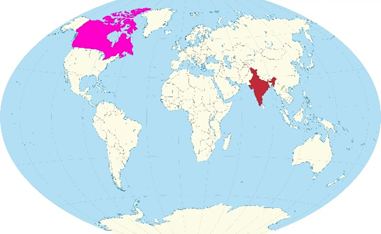
Significance of India–Canada Relations
India–Canada relations embody complementary economic models—India’s demographic and tech dynamism paired with Canada’s resource abundance—fostering mutual growth in a multipolar world. Their partnership amplifies influence in global forums, balancing economic complementarity with strategic alignment.
Economic and Trade Complementarities
- Bilateral trade in goods and services reached USD 23.66 billion in 2024, with merchandise trade valued at USD 8.98 billion, marking 10% year-on-year increase.
- India is Canada’s seventh-largest goods and services trading partner in 2024.
- Canada ranked as 17th largest foreign investor in India, with cumulative FDI of USD 3.9–4.17 billion from April 2000 to March 2025, constituting 0.57% of India’s total FDI inflows.
- Canadian portfolio investments in India estimated at over CAD 100 billion, demonstrating strong investor confidence.
- Over 600 Canadian companies operate in India, while growing presence of Indian firms in Canada supports tens of thousands of jobs in both economies.
- Canadian pension funds have cumulatively invested over CAD 75 billion in India across infrastructure, highways, clean energy, real estate, banking, and logistics sectors.
- Canada Pension Plan Investment Board (CPPIB) holds USD 22 billion (CAD 30 billion) in assets in India as of June 2025, tripling from CAD 10 billion in 2020.
- Major Canadian investments include Brookfield (largest global investor in India with USD 20 billion portfolio), Ontario Teachers’ Pension Plan, and CPPIB in National Highways Infrastructure Trust (NHIT).
Strategic and Security Dimensions
- Both countries support rules-based order in Indo-Pacific region, essential for regional security, peace, and trade.
- Canada’s Indo-Pacific Strategy (announced November 2022, updated 2025) recognizes India as critical partner, with funding commitment of CAD 1.7 billion over five years.
- Strategy aims to promote peace, expand trade, invest in people, build sustainable future, and position Canada as active partner in Indo-Pacific.
- Defence cooperation includes Memorandum of Understanding (MoU) between DRDO and Canadian Commercial Corporation (CCC), renewed in 2021 (signed 2016).
- Framework for Cooperation on Countering Terrorism and Violent Extremism was signed in 2018.
Civil Nuclear Cooperation
- Canada-India Nuclear Cooperation Agreement (NCA) came into force in September 2013, enabling uranium exports and technology transfer.
- Cameco (Canadian uranium company) signed long-term uranium supply contract with India’s Department of Atomic Energy (DAE) in 2015, covering period 2015–2020, supplying 7.1 million pounds of uranium concentrate worth CAD 350 million.
- Agreement launched “new era of bilateral nuclear cooperation” and reflected “new level of mutual trust and confidence“.
- Both countries share common reactor technology (Pressurized Heavy Water Reactors – PHWRs), enabling technology collaboration and regulatory best practices sharing.
People-to-People Ties and Diaspora
- Canada is home to approximately 1.6 million Indo-Canadians (around 4% of Canadian population), one of fastest-growing diasporas globally.
- Canada hosts approximately 770,000 Sikhs, representing largest Sikh community outside Punjab, India.
- India is Canada’s second-largest source of immigrants (approximately 40,000 in 2016).
- India is Canada’s 10th largest source of tourists, with 224,000 visits from India to Canada in 2016.
- Approximately 124,000 Indian students held permits to study in Canada for six months or more in 2017; Canada is second most popular destination for Indian students going abroad.
- Over 400 agreements exist between Canadian and Indian universities and colleges.
Commonwealth and Multilateral Engagement
- Both nations are members of Commonwealth of Nations, G20, and share federal structures and Westminster parliamentary traditions.
- Commonwealth advantage amplifies trade resilience and builds inclusive partnerships.
Relevance to Indo-Pacific Strategy
Indo-Pacific framework elevates India-Canada ties from bilateral to regional imperatives, addressing shared challenges like supply chain vulnerabilities and China’s assertiveness. Updated strategies in 2025 underscore India’s pivotal role.
Canada’s Indo-Pacific Engagement
- Canada’s Indo-Pacific Strategy (released November 2022) outlines five strategic objectives: promoting peace, resilience, and security; expanding trade, investment, and supply chain resilience; investing in and connecting people; building sustainable and green future; and being active and engaged partner.
- Strategy acknowledges China as “increasingly disruptive global power” and India as “critical partner“.
- Indo-Pacific region includes 6 of Canada’s top 13 trading partners (India, Japan, China, South Korea, Taiwan, Vietnam).
India’s Strategic Importance
- India’s growing strategic, economic, and demographic importance in Indo-Pacific makes it critical partner for Canada’s pursuit of objectives.
- Both countries share suspicion of China and are seeking to expand trade ties, improve supply chain resilience, and encourage greater people-to-people exchange.
- Canada seeks to grow economic ties through deeper trade and investment and build resilient supply chains.
- Canada aims to expand market access by concluding EPTA as step toward CEPA.
Security and Defense Cooperation
- Canada plans to open new opportunities for security cooperation, including through negotiation of General Security of Information Agreement with partners in region.
- Canada seeks to strengthen critical minerals, hydrogen, and clean energy sources, positioning itself as responsible and reliable energy security partner.
Economic Diversification
- Both countries eager to reduce trade dependency on United States in light of recent tariff announcements and shifting global alliances.
- Partnership offers opportunities for increased economic collaboration and helps alleviate vulnerabilities from changing geopolitical dynamics.
Major Challenges – India-Canada Relations
Despite renewal, India-Canada relations face entrenched obstacles, particularly around extremism and trust deficits, which could derail economic gains if unaddressed.
Khalistan Issue and Separatist Tensions
- Khalistani extremism remains the most significant challenge in bilateral relations. India views the Khalistan movement as a grave national security threat, while Canada emphasizes freedom of expression.
- The Nijjar assassination case (June 2023) intensified tensions, leading to diplomatic expulsions and stalled trade negotiations. Acts of violence and vandalism against Indian missions in Canada further strained trust.
Divergence on “Activism” vs. “Extremism”
- Fundamental disconnect exists: what India perceives as serious security threat, Canada views as activism protected by free speech.
- Canada has allowed Khalistanis to pursue their cause within borders in name of “free speech“.
- Unofficial referendum on forming independent Sikh state was held in Canada in 2023, viewed by India as attack on sovereignty.
- India expressed discontent over Canada permitting parade float depicting assassination of Indira Gandhi, viewing it as celebration of Sikh separatist violence.
Impact on People-to-People Ties
- The diplomatic strain has had a percolating effect on societal relations. Politicization of events such as Nijjar’s death has increased vulnerability for Sikh, Hindu, and other Indian communities in Canada and globally.
- Concerns include growing anti-immigrant sentiments, xenophobia, and racism, which can affect the safety and well-being of the Indian diaspora.
- Attacks on places of worship, such as the Hindu Sabha Mandir in Brampton, illustrate how diplomatic tensions can spill over into the community, emphasizing the importance of protective measures for all Indian immigrants.
Stalled Trade Negotiations
- The diplomatic crisis disrupted ongoing negotiations under the Early Progress Trade Agreement (EPTA) and Comprehensive Economic Partnership Agreement (CEPA).
- Although EPTA was formally relaunched in March 2022, discussions stalled due to political tensions.
- High-level trade missions, such as the visit by Canadian Trade Minister Mary Ng in September 2023, were postponed.
- These disruptions threaten the potential for economic gains and bilateral investment flows, highlighting the interconnected nature of security and economic dimensions in the relationship.
Trust Deficit and Evidence Sharing
- A major challenge remains the trust deficit between the two countries. India has claimed that Canada has not provided sufficient evidence linking Indian agencies to Nijjar’s death, whereas Canada contends that it acted on intelligence provided by US intelligence agencies.
- India has reiterated that it will act if Canada supplies specific, verifiable information. The lack of transparent evidence-sharing mechanisms complicates cooperation on security issues and slows resolution of conflicts.
Foreign Interference Allegations
- Canada has accused Indian diplomats of complicity in criminal activities, including intimidation, extortion, and even murder.
- Allegations of foreign interference in Canada’s political and electoral processes have also been raised, drawing criticism of Canada for its perceived leniency toward foreign operations on its soil.
- Conversely, India perceives Canada’s tolerance of such activities as a threat to its national security and sovereignty, further complicating bilateral engagement
Way Forward – India-Canada Relations
Navigating challenges requires calibrated diplomacy, prioritizing economic pragmatism while addressing security sensitivities. Structured mechanisms under New Roadmap 2025 can foster predictability and trust.
Political and Diplomatic Measures
- Both countries must maintain sustained dialogue at ministerial and official levels to rebuild trust and address concerns.
- Institutionalize reset by establishing predictable frameworks, including regular ‘2+2‘ or ‘3+3‘ ministerial meetings, national security dialogues, and law enforcement dialogues.
- Both sides should express concerns without disrupting status quo and pursue constructive and balanced partnership.
- Canada should address Canadian Khalistan supporters who act against Indian interests and extradite violent Khalistan supporters.
- India should demonstrate sensitivity towards Sikh communities domestically and abroad and resolve grievances amicably.
- India should cooperate with Canadian authorities during investigations.
- Indian side flagged concerns over activities of pro-Khalistan elements in Canada during ministerial meetings.
Economic and Trade Engagement
- Resume negotiations on EPTA and CEPA to rebuild economic ties, investment flows, and unlock market access.
- Maintain open, transparent, and predictable investment environment and explore avenues for deeper collaboration across priority and emerging sectors.
- Continue ministerial engagements with trade and investment community in both countries in early 2026.
- Leverage strong people-to-people connections as foundation for economic partnership.
- Diversify supply chains in critical sectors to support long-term economic stability.
Strategic Sector Cooperation
- Deepen long-term supply chain partnerships in critical minerals and clean energy for energy transition and industrial expansion.
- Expand investment and trading opportunities in aerospace and dual-use capabilities, leveraging complementary strengths.
- Develop Canada–India Energy and Critical Minerals Compact to connect capital, technology, and clean-energy innovation.
- Build critical minerals and clean energy linkages; develop bilateral green finance facility.
Technology and Innovation
- Deepen technology collaboration through joint AI research, semiconductor partnerships, and open-tech initiatives.
- AI Action Summit in Delhi in February 2026 offers important opportunity to engage at highest level.
- Relaunch Joint Science and Technology Cooperation Committee to strengthen ties in innovation and AI.
Security Cooperation
- Cooperate and collaborate on counter-terrorism and Khalistani extremism under Framework for Cooperation on Countering Terrorism and Violent Extremism (2018).
- Enhance military-to-military ties to ensure better bilateral relations.
Civil Nuclear and Energy Cooperation
- Re-establish Canada-India Ministerial Energy Dialogue (CIMED) at earliest, including Action Plan.
- Promote two-way trade for LNG & LPG and investment in oil and gas Exploration & Production sector.
- Collaborate on sustainable low-carbon fuels and technologies, including green hydrogen, biofuels, CCUS, and electric mobility.
People-to-People Engagement
- Constructively address capacity-related issues at Missions and Consulates to support expanding economic opportunities and people-to-people ties.
- Bolster visa-processing capacity in New Delhi and Chandigarh.
- Support academic, educational, cultural, youth, and research exchanges.
- Ensure adequate safety for Indian immigrants and diaspora in Canada.
Climate and Environmental Action
- Increase bilateral cooperation on climate action, environmental protection, and conservation.
- Exchange best practices on electricity system management to enhance grid safety, stability, and renewable integration.
- Advance global energy efficiency process, including through multilateral fora such as G20.
Conclusion
India–Canada relations are at a critical juncture, transitioning from diplomatic strain toward renewed engagement. While the Nijjar assassination and Khalistan issue exposed trust deficits, strong economic complementarities, diaspora connections, and shared democratic values provide a solid foundation for cooperation. The New Roadmap 2025, along with ministerial dialogues, sets a structured framework for collaboration in trade, critical minerals, clean energy, technology, and climate action.
For the partnership to realize its full potential, both nations must pursue sustained political dialogue, evidence-based security cooperation, and early conclusion of trade agreements, while ensuring the safety and inclusion of the Indian diaspora. With pragmatic diplomacy and institutionalized mechanisms, India–Canada ties can transform recent crises into a resilient, forward-looking, and mutually beneficial relationship, aligned with broader Indo-Pacific strategic objectives.