Context
India formally expressed “deep concern” over the growing loss of civilian lives in Lebanon following Israeli airstrikes on Beirut, the Lebanese capital. Speaking at a press briefing at the National Media Centre, New Delhi, the Official Spokesperson of the Ministry of External Affairs (MEA), Randhir Jaiswal, reiterated India’s respect for “sovereignty and territorial integrity” of all states as “essential”. The Lebanese Health Ministry reported the death toll rising to 1,223 people — with over 357 injured — within a single week. Israel struck targets in Beirut, claiming they were command centres of Hezbollah.
1. India’s Official Position on the Lebanon Conflict
- Deep Concern: India expressed serious concern over the large number of civilian casualties in Lebanon.
- Sovereignty & Territorial Integrity: India emphasised that respect for these principles within the international state system is essential — a consistent cornerstone of India’s foreign policy.
- Protection of Civilians: India has always prioritised civilian protection as the foremost concern in conflict situations.
- Indian Embassy in Beirut: The MEA confirmed it remains in close contact with the Indian community in Lebanon.
- Notable omission: India stopped short of directly mentioning Israel by name in its statement.
2. About Lebanon
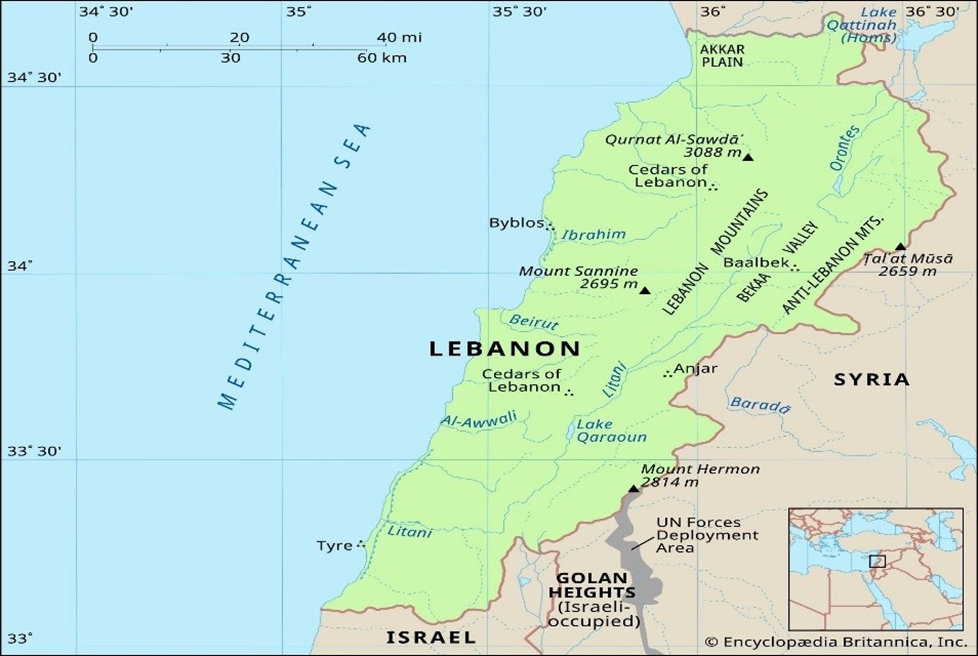
2.1 Geographic Profile
| Parameter | Details |
| Location | Eastern Mediterranean coast; West Asia (Middle East) |
| Borders | Syria (north & east), Israel (south), Mediterranean Sea (west) |
| Capital | Beirut |
| Area | ~10,452 sq km (one of the smallest countries in West Asia) |
| Official Language | Arabic (French also widely used) |
| Currency | Lebanese Pound (LBP) |
| UN Membership | Founding member of the United Nations (1945) |
2.2 Political System — Confessionalism
Lebanon follows a unique political system called confessionalism, where state power is formally distributed along religious/sectarian lines:
- There are 18 officially recognised religious communities in Lebanon.
- The Taif Agreement (1989) ended the Lebanese Civil War (1975–1990) and rebalanced power between Christians and Muslims.
2.3 Hezbollah
- Hezbollah (“Party of God”) is a Shia political party and militant organisation founded in 1982 with Iranian backing following Israel’s invasion of Lebanon.
- It operates a state-within-a-state in southern Lebanon and parts of Beirut — with its own army, hospitals, schools, and social services.
- Designated a terrorist organisation by the USA, EU, Gulf Cooperation Council (GCC), and several Arab states.
- Lebanon’s government has not designated Hezbollah as a terrorist organisation.
- Hezbollah has representation in the Lebanese Parliament and Cabinet.
- It fought a major war with Israel in 2006 (Second Lebanon War).
Its long-time Secretary-General, Hassan Nasrallah, was killed by an Israeli airstrike in 2024.
Q1. With reference to Lebanon's political system, consider the following statements:

1. The Lebanese system of governance, known as confessionalism, distributes political power along religious lines.

2. The Taif Agreement of 1989 established the rule that the President of Lebanon must be a Sunni Muslim.

3. Lebanon officially recognises 18 religious communities.

Which of the statements given above is/are correct?
(a)  1 only
(b)  1 and 2 only
(c)  1 and 3 only
(d)  1, 2 and 3

Answer: (c) — 1 and 3 only

Explanation:
• Statement 1 is correct — confessionalism distributes power along religious lines.

• Statement 2 is incorrect — under the National Pact (1943) and Taif Agreement (1989), the President must be a Maronite Christian, the PM a Sunni Muslim, and Speaker a Shia Muslim.

• Statement 3 is correct — Lebanon recognises 18 religious communities.