
After Reading This Article You Can Solve This UPSC Mains Model Questions:
Discuss the strategic significance of Israel in India’s foreign policy calculus. How has the relationship evolved from cautious engagement to an openly strategic partnership? 250 Words, 15 Marks (GS-2, International Relation)
Context
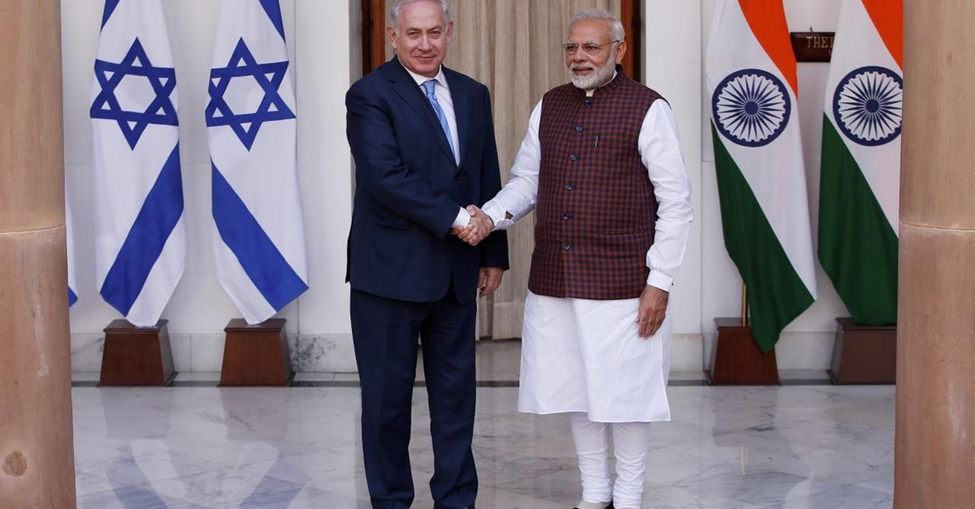
- Amidst significant geopolitical turbulence in West Asia—characterized by a massive American military presence in the Persian Gulf and a fragile ceasefire in Gaza—the Prime Minister of India is undertaking a high-profile, two-day standalone visit to Israel, solidifying India’s “de-hyphenation” strategy.
- This visit marks the second time an Indian Prime Minister has visited the nation, following the historic 2017 trip.
About India’s De-Hyphenation Policy Towards Israel
- Historical Background
- Creation of Israel: Israel was created in 1947 following the Balfour Declaration. The UN Partition Plan conceived two separate states — a Jewish State (Israel) and an Arab State (Palestine) — but its implementation led to the displacement of Palestinians and a protracted conflict.
- India’s Initial Hyphenated West Asia Policy: As a result of the regional conflict, India initially pursued a Hyphenated West Asia Policy, wherein Israel and Palestine were considered as one diplomatic block in foreign policy. Although Israel was recognized in 1950, the following approach was adopted:
- Full diplomatic relations were avoided for decades.
- Strong support was extended to the Palestinian cause, including the recognition of Palestine in 1988.
- The main problem with the hyphenation policy was that any growing closeness with Israel was perceived as abandonment of Palestine.
- Key Diplomatic Milestones Before De-Hyphenation
- Following support from Israel during the Kargil War, the Vajpayee Government sent the first-ever high-level Indian ministerial delegations to Israel in 2000, including:
- External Affairs Minister Jaswant Singh
- Home Minister L.K. Advani
- In 2003, Ariel Sharon was hosted in New Delhi, becoming the first Israeli Prime Minister to visit India.
- In October 2015, President Pranab Mukherjee became the first Indian Head of State to visit the region, and both Israel and Palestine were visited in the same trip, thereby continuing the hyphenated approach.
- What is the “De-Hyphenation” Policy?
- De-hyphenation means that relations with Israel and Palestine are treated as two completely separate tracks.
- Under this approach:
- Defence technology can be procured from Israel.
- Support for an independent Palestinian state can continue.
- Humanitarian aid can be sent to Gaza.
- One relationship is not allowed to dictate the other.
- For instance, in 2017, the first-ever standalone visit to Israel by an Indian Prime Minister was undertaken, thereby breaking the diplomatic hyphen.
- Previously, state dignitaries used to visit Israel and Palestine in the same trip, reflecting the hyphenated approach.
4. Evolution of India-Israel Relations
The bilateral trajectory is categorized into distinct chronological phases:
- The “Taboo” Phase (1950s – 1980s): Friendship with Israel was considered a “taboo” due to the Cold War and solidarity with Arab nations. During the 1967 Six-Day War, India strongly backed the Arab states.
- The “Cautious Stance” (1992): Full diplomatic relations were established. This was enabled by the Oslo Accords (Arab-Israeli peace process), allowing India to engage Israel without estranging Arab states.
- The “Strategic Dimension” (2014 – Present): The relationship became openly strategic. The 2026 visit marks only the second time an Indian PM has ever visited Israel.
5. Modern Dimensions of Cooperation
- Beyond Weapons to Water: India is currently Israel’s biggest defense customer, buying 34% of their arms exports. Cooperation also includes the establishment of 35 “Centers of Excellence” for advanced farming and water management technology.
- Recalibrated UN Voting: Historically, votes were cast against Israel. Recently, India has abstained from certain votes (such as calls for a truce) because the resolutions did not condemn the terrorism of Hamas attacks. India remains clear: support for Palestine is maintained, but terrorism is not accepted.
Why Israel is important for India
1. Critical Defence Support: Israel emerged as a reliable strategic partner when India faced international constraints during the Kargil conflict.
- Supplied laser-guided bombs (LGBs) that enabled precision strikes in high-altitude terrain
- Provided UAVs (Searcher, Heron) for real-time surveillance
- This timely assistance highlighted Israel’s value as a partner willing to support India during crises, unlike many Western suppliers.
2. Advanced Defence Technology and Joint Development: Israel is a major source of cutting-edge military technology for India. Key examples include:
- Barak-8 / MRSAM missile system (jointly developed with DRDO)
- Phalcon AWACS mounted on Indian aircraft
- Spike anti-tank guided missiles
- These systems significantly enhance India’s air defence, battlefield awareness, and strike capability.
3. Counter-Terrorism and Internal Security Expertise: Israel’s experience in combating terrorism has translated into cooperation in:
- Intelligence sharing
- Urban warfare tactics
- Homeland security and border management
- Technologies such as surveillance systems, electronic warfare equipment, and cyber-security tools are particularly relevant for India’s internal and border security challenges.
4. Agriculture and Water Management Technologies: Israel has contributed to India’s food and water security through technology transfer in:
- Drip irrigation and micro-irrigation
- Desert agriculture
- Water recycling and desalination techniques
Over 30 Indo-Israeli Centres of Excellence operate across Indian states, improving productivity in horticulture and dry-land farming.
5. Economic and Developmental Pillars: Beyond defense, the relationship is anchored in “soft” sectors that impact India’s internal development:
- Water and Agriculture: Israel’s MASHAV agency has facilitated over 35 Centres of Excellence in India. Technologies in drip irrigation, desalination, and dry-land farming are vital for India’s water-stressed regions like Rajasthan and Haryana.
- Trade and Investment: Bilateral trade reached $3.75 billion (FY2024-25). Current negotiations for a Free Trade Agreement (FTA) and the Bilateral Investment Agreement (signed Sept 2025) aim to diversify trade into electronics, medical equipment, and green energy.
- The IMEC Corridor: The visit seeks to revitalize the India-Middle East-Europe Economic Corridor. As a shorter, secure alternative to the Suez Canal, IMEC positions Israel (specifically Haifa Port) as a bridge for Indian goods entering Europe.
Regional Dynamics and the “Hexagonal Alliance” Proposal
Israeli Prime Minister Benjamin Netanyahu has proposed a “Hexagonal Alliance”—a six-sided partnership involving India, Greece, Cyprus, and Arab nations—to counter “radical axes” in the region. This presents a complex diplomatic landscape for India:
Geopolitical Challenges in the West Asian Matrix
Navigating the intricate web of rivalries in West Asia remains a primary challenge:
- The Iran Dilemma: Iran is deeply hostile to Israel and fosters the Palestinian cause. For India, Iran is vital for the Chabahar Port to reach Central Asia. Joining Israel’s proposed “hexagonal alliance” could severely damage ties with Tehran.
- The Turkey Factor: Turkey opposes Israel to claim leadership in the Islamic World. India must navigate this carefully, as Turkey also supports Pakistan on the Kashmir issue.
- Moderate Arab States: Today, India does massive business with Saudi Arabia, the UAE, and Oman. These nations are now largely comfortable with India talking to Israel, as seen in the I2U2 framework.
- The US Factor: In the past, India opposed America’s presence in the Middle East. Today, India and the US work closely together to bring stability to the region, creating partnerships like I2U2(India, Israel, the United Arab Emirates, and the United States) and the IMEC trade route.
Way Forward: Practicing “Principled Pragmatism“
India’s future trajectory in West Asia should be defined by a careful balance of national interest and ethical diplomacy:
- Preserving Strategic Autonomy: Netanyahu’s proposal for a “hexagonal alliance” should be politely declined. India’s long-standing policy of avoiding military alliances against third countries ensures it does not become a party to regional sectarian conflicts.
- Prioritizing Developmental Growth: The relationship with Israel must be leveraged primarily for its strengths in futuristic defense technology (Mission Sudarshan Chakra), advanced agriculture, and water management to support India’s domestic goals.
- Active Advocacy for Regional Stability: India should utilize its unique position—as a friend to both Israel and the Arab world—to advocate for a peaceful, two-state solution. Promoting stability is essential for the long-term viability of economic projects like the IMEC corridor.
- Leadership in the Global South: Ensure that while deepening ties with Tel Aviv, India continues to advocate for humanitarian stability in Gaza to maintain its moral standing among developing nations.
Conclusion
The visit reflects the consolidation of a mature, interest-driven partnership between India and Israel. While defence cooperation remains central, the relationship has expanded into technology, agriculture, innovation, and connectivity. However, engagement must be carefully calibrated within the complex geopolitics of West Asia.
A policy of “Principled Pragmatism” — combining strategic autonomy, economic cooperation, and commitment to peace — would enable India to safeguard its national interests while contributing constructively to regional stability.