Context
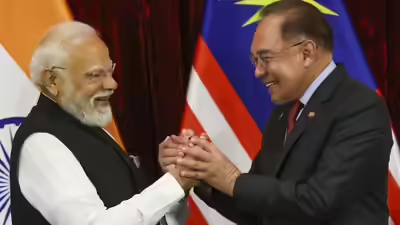
Recently, Prime Minister Narendra Modi concluded a high-profile two-day official visit to Malaysia (February 7–8, 2026), marking his first foreign visit of the year. During this visit, India and Malaysia reaffirmed their Comprehensive Strategic Partnership (CSP)—originally elevated in August 2024—and signed 11 landmark agreements spanning semiconductors, digital technologies, and defense.
The visit was characterized by a “special” strategic alignment, with both nations agreeing to promote trade settlement in local currencies (Indian Rupee and Malaysian Ringgit) and formalizing a framework for semiconductor supply chain resilience.
1. Political and Strategic Framework
- Comprehensive Strategic Partnership (CSP): Elevated from a “Enhanced Strategic Partnership” in 2024, focusing on high-tech sectors and maritime security.
- ASEAN Centrality: Malaysia is a founding member of ASEAN and will hold the ASEAN Chairmanship in 2025, making it a vital partner for India’s Act East Policy.
- Global Platforms: Both nations collaborate in the United Nations (UN), East Asia Summit (EAS), and the Indian Ocean Rim Association (IORA). Notably, Malaysia has expressed support for India’s permanent membership in a reformed UNSC.
2. Economic and Trade Relations
- Trade Volume: Malaysia is India’s 3rd largest trading partner within ASEAN. Bilateral trade stood at approximately $19.86 billion in 2024-25.
- Trade Agreements: Economic ties are governed by the Malaysia-India Comprehensive Economic Cooperation Agreement (MICECA) and the ASEAN-India Trade in Goods Agreement (AITIGA), the latter currently being reviewed to reduce trade deficits.
- Local Currency Settlement: To reduce dependence on the US Dollar, both countries have operationalized mechanisms to settle trade in INR and Ringgit.
- Palm Oil: India remains the world’s largest importer of vegetable oils, and Malaysia is its primary source of palm oil alongside Indonesia
3. Technology and Digital Cooperation
- Semiconductors: Malaysia is the world’s 6th largest semiconductor exporter. A new MoU focuses on R&D, assembly, and testing (OSAT), with major Indian firms like Tata Electronics exploring investment.
- Digital Payments: Integration between India’s UPI (via NIPL) and Malaysia’s PayNet was prioritized to facilitate low-cost cross-border remittances.
- Energy: Collaborative efforts in Green Hydrogen and Green Ammonia are being led by companies like PETRONAS and Gentari.
4. Defense and Security
- Military Exercises:
- Exercise Harimau Shakti: A bilateral joint army exercise (5th edition held in Rajasthan, Dec 2025).
- Exercise Samudra Laksamana: A bilateral naval exercise.
- Strategic Platforms: Cooperation via the ADMM-Plus (ASEAN Defence Ministers’ Meeting Plus) and the co-chairing of the Counter-Terrorism Working Group (2024-2027).
- Defense Industry: India has offered maintenance and life-extension programs for Malaysia’s Su-30 aircraft fleet, given the commonality of the platform.
5. Cultural and Diaspora Links
- The “Living Bridge”: Malaysia hosts the second-largest Indian diaspora (approx. 3 million people, largely of Tamil origin).
- Institutional Links: Establishment of the Thiruvalluvar Chair at the University of Malaya and the announcement of a new Indian Consulate General in Sabah.
6. Malaysia: Key Map Points
| Located in Southeast Asia, near the Equator. Divided into two parts: Peninsular Malaysia & East Malaysia (on Borneo Island), separated by the South China Sea. Strait of Malacca lies on its west → major global maritime chokepoint. Neighbours Thailand (north, land)Singapore (south, across strait/causeway)Indonesia (maritime + Borneo land border)Brunei (on Borneo, surrounded by Malaysia)Philippines (maritime, northeast) Seas around: South China Sea, Sulu Sea, Celebes Sea Highest peak: Mount Kinabalu (Sabah, Borneo) States on Borneo: Sabah & Sarawak Capital: Kuala Lumpur Administrative capital: Putrajaya |
Q. With reference to India-Malaysia bilateral relations, consider the following statements:

I. Malaysia is currently India's largest trading partner among all ASEAN member nations.
II. The two countries have agreed to establish a framework for settling bilateral trade in their respective local   currencies.
III. ‘Exercise Harimau Shakti’ is a bilateral naval exercise conducted annually between the two nations.

Which of the statements given above is/are correct?
A) I and II only
B) II only
C) II and III only
D) I, II, and III

Solution: B

• STATEMENT I INCORRECT: Malaysia is India's 3rd largest trading partner in ASEAN; Singapore and Indonesia traditionally hold higher ranks in trade volume.
• STATEMENT II CORRECT: In 2024-2026, both nations formally agreed and operationalized mechanisms to promote trade settlement in the Indian Rupee (INR) and Malaysian Ringgit (MYR).
• STATEMENT III INCORRECT: ‘Exercise Harimau Shakti’ is a bilateral Army/Military exercise, not a naval exercise. The bilateral naval exercise is ‘Exercise Samudra Laksamana’.