After Reading This Article You Can Solve This UPSC Mains Model Question:
"While Artificial Intelligence (AI) is touted as a tool for achieving Sustainable Development Goals, its own environmental footprint is a cause for concern. Critically analyze this statement in the Indian context." (250 words) (GS-3 Science & Technology)
Context:
As India positions itself as a leader in the Global South—hosting the India-AI Impact Summit 2026—a critical contradiction has emerged. While AI is a “force multiplier” for development, its physical infrastructure is becoming a significant ecological burden.
- Economic Growth vs. Ecology: AI is projected to add $1.7 trillion to India’s economy by 2035, but current data centers contribute significantly to carbon footprints.
- The India-AI Impact Summit (2026) is centered on three Sutras: People, Planet, and Progress.
What is Artificial Intelligence (AI)?
Artificial Intelligence (AI) involves creating computer systems capable of imitating human intellectual abilities. These systems can carry out functions such as learning from experience, logical reasoning, solving complex problems, interpreting sensory information, and making decisions.
AI Market:
The worldwide AI industry is currently valued at around USD 200 billion and is projected to add nearly USD 15.7 trillion to the global economy by 2030, highlighting its transformative economic potential.
Environmental Impact of AI:
1. Energy Intensity and Carbon Footprint
The most visible impact is the massive surge in electricity demand. AI models are far more energy-hungry than traditional computing.
- Prompt vs. Search: A standard generative AI query (e.g., ChatGPT/Gemini) consumes approximately 10x to 30x more electricity than a traditional Google search (roughly 2.9 Wh vs. 0.3 Wh).
- Training Emissions: Training a single large language model (LLM) like GPT-3 can emit over 550 tonnes of CO2. For perspective, that is equivalent to the annual emissions of dozens of gasoline cars.
- The “Rebound Effect” (Jevons Paradox): As AI makes processes more efficient, the cost of using AI drops, which leads to a massive surge in total usage. This paradox means that “efficient” AI often leads to higher net energy consumption.
2. The “Thirst” of AI: Water Consumption
Data centers are not just energy-intensive; they are remarkably “thirsty.” Water is the primary medium for cooling the high-performance GPUs (Graphics Processing Units) that run AI.
- Direct Consumption: Cooling a data center can require millions of liters of water daily. Experts estimate that a 100-word AI prompt “consumes” roughly 500ml of water (the size of a standard water bottle) through evaporation in cooling towers.
- Indirect Water Footprint: This is often overlooked. Most electricity comes from thermoelectric plants that use vast amounts of water for steam and cooling.Including this, AI’s water demand is projected to hit 6.6 billion cubic meters by 2027.
- Localized Stress: In India, data centers are often built near urban hubs like Chennai or Mumbai, which already face seasonal water scarcity, leading to a “Data vs. Drinking Water” conflict.
3. The E-Waste and Material Crisis
AI hardware has a significantly shorter lifecycle than traditional server hardware because of the rapid pace of innovation.
- Toxic E-Waste: Discarded GPUs and high-density servers contain hazardous substances like lead, mercury, and cadmium. Generative AI alone is projected to contribute 5 million metric tons of e-waste by 2030.
- Rare Earth Mining: AI chips rely heavily on Rare Earth Elements (REEs) and minerals like Lithium and Cobalt. Mining these materials often involves:
- Deforestation and habitat loss.
- Acid Mine Drainage which poisons local water tables.
- High Embodied Carbon: Over 75% of a computer’s total lifecycle carbon footprint occurs during the manufacturing phase, not the usage phase.
Short Code:




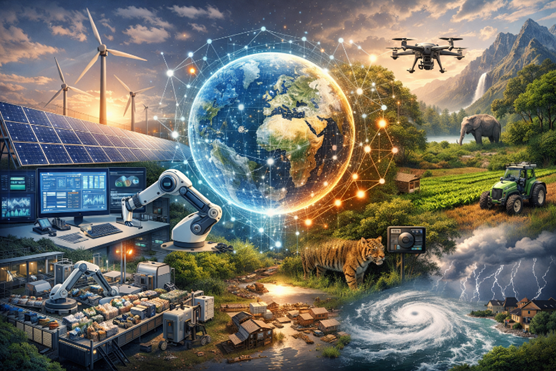
AI as an Environmental Solution
1. Energy Transition and Grid Management
As India pursues its goal of 500 GW of non-fossil energy by 2030, AI acts as the “brain” of the new power grid.
- Renewable Forecasting: AI algorithms analyze satellite imagery and weather data to predict wind and solar output with 30% higher accuracy. This reduces reliance on coal-based “backup” plants.
- Smart Grids: AI manages “Demand-Response” systems, automatically shifting heavy industrial loads to times when renewable energy is most abundant.
- Transmission Loss Reduction: AI identifies leakage and theft in real-time, helping India tackle its high Aggregate Technical & Commercial (AT&C) losses.
2. Agriculture: The “AI-Kisan” Revolution
In the context of the Pradhan Mantri Fasal Bima Yojana (PMFBY), AI is optimizing resource use:
- Precision Farming: AI-powered drones and IoT sensors monitor soil moisture and nitrogen levels, ensuring that water and fertilizers are used only where needed—reducing chemical runoff into water bodies.
- Pest Prediction: AI models can predict locust swarms or fungal outbreaks weeks in advance, allowing for localized, minimal pesticide use rather than blanket spraying.
3. Circular Economy and Waste Management
- Automated Sorting: AI-driven robotic arms in recycling plants can identify and sort up to 100 different types of plastics and metals—far exceeding human capability and increasing the purity of recycled materials.
- Digital Twins for Cities: AI creates “Digital Twins” of urban centers (like the Gati Shakti platform) to optimize waste collection routes, reducing fuel consumption and emissions from municipal trucks.
4. Climate Modeling and Disaster Resilience
- Early Warning Systems: AI processes vast amounts of oceanic and atmospheric data to provide hyper-local warnings for Cyclones and Flash Floods, essential for India’s vulnerable coastline.
- Ocean Cleanup: AI-powered autonomous “Interceptors” (like those used by The Ocean Cleanup) identify and gather plastic waste in river mouths before it reaches the open sea.
5.Biodiversity & Conservation
- AI processes satellite imagery and camera-trap data to track deforestation, wildlife movement, and poaching.
- Enables early warning systems for forest fires and habitat degradation. Example: AI used to monitor illegal mining and forest loss.
Key Gaps in India’s Framework:
1. Regulatory Gaps: The “Green Blind Spot”
- Absence of Mandatory Climate Reporting: Unlike the EU AI Act, India’s current guidelines are largely voluntary. There is no mandatory requirement for AI developers to disclose the energy consumption or water footprint of their Large Language Models (LLMs).
- “Innovation over Restraint” Paradox: The framework explicitly prioritizes innovation over restraint. While this helps the tech economy, critics argue it “hollows out” safeguards, allowing companies to bypass environmental audits in the race to deploy products.
- Legislative Fragmentation: AI governance is currently managed through the DPDP Act 2023 (Privacy) and the IT Act 2000 (Cybersecurity). Neither law was designed to handle Algorithmic Environmental Impact Assessments (A-EIA).
2. Infrastructure & Resource Gaps
- The Energy-Grid Conflict: India plans to deploy 10,000+ GPUs under the IndiaAI Mission. However, roughly 64% of the power grid still relies on fossil fuels. Without a “Green Compute” mandate, the mission directly contradicts India’s Net Zero 2070 goals.
- Water Transparency: Over 50% of India’s data centers are located in water-stressed regions (e.g., Chennai, Mumbai). Current rules do not require these centers to report their water-usage efficiency (WUE) or implement mandatory water recycling.
- The “GPU Bottleneck”: India holds less than 2% of global computing power. The rush to build domestic capacity often leads to the use of older, less energy-efficient hardware because of global supply chain shortages.
3. E-Waste & Circular Economy Gaps
- Obsolete E-Waste Rules: The E-Waste (Management) Rules, 2022 do not have specific categories for high-end AI hardware (TPUs/H100 GPUs), which have much shorter lifecycles (2–3 years) and higher toxic mineral density than standard consumer electronics.
- Informal Sector Dominance: Over 90% of e-waste collection in India is handled by the informal sector. These workers lack the technology to safely extract Rare Earth Elements (REEs) from complex AI chips, leading to significant toxic leakage and resource loss.
Government Initiatives:
1. The India-AI Impact Summit 2026
This is the most recent and significant development (2026, New Delhi). It marks India’s lead as the first Global South nation to host a global AI summit focused on sustainability.
- The Three Sutras: The summit is anchored on People (Inclusion), Planet (Sustainability), and Progress (Economic Growth).
- The Planet Sutra: Specifically mandates that AI development must be resource-efficient and accelerate climate resilience.
- The Seven Chakras: These are thematic working groups. One of them, “Resilience, Innovation & Efficiency,” is dedicated to promoting frugal, energy-efficient AI solutions suited for resource-constrained environments.
2. IndiaAI Mission
With a budget of over ₹10,300 crore, the mission has specific “Green” components:
- IndiaAI Application Development Initiative: Focuses on developing AI for “India-specific challenges,” with Climate Change listed as a priority sector alongside healthcare and agriculture.
- IndiaAI Compute Pillar: While it aims to provide 10,000+ GPUs, there is an increasing push for “Green Compute”—incentivizing data centers that use renewable energy.
- BharatGen: A government-funded initiative to build multimodal Large Language Models (LLMs) that are “frugal by design,” meaning they require less compute power than Western counterparts like GPT-4.
3. The Seven “Sutras” of AI Governance (MeitY, 2025-26)
Unveiled by the Ministry of Electronics & IT, these guidelines provide the philosophical and regulatory backbone for AI in India:
- Trust is the Foundation
- People First
- Innovation over Restraint
- Fairness & Equity
- Accountability
- Understandable by Design
- Safety, Resilience & Sustainability — This 7th Sutra specifically requires AI systems to ensure long-term environmental sustainability.
4. Institutional Mechanisms
- IndiaAI Safety Institute (AISI): Established in Jan 2025 to perform risk assessments, which now include “Environmental Risk” (energy/water consumption) alongside security risks.
- Anusandhan National Research Foundation (ANRF): Launched “MISSION AI for Science and Engineering” to fund research into “resource-efficient” AI architectures.
- IndiaAI & GSI Hackathon: A unique collaboration between IndiaAI and the Geological Survey of India to use AI for mineral targeting, specifically for critical minerals like Lithium and Cobalt needed for the green energy transition.
Way Forward: The “Green AI” Strategy:
1. Regulatory “Green-by-Design” Framework
India should transition from a “voluntary” to a “mandatory” sustainability regime:
- Algorithmic Environmental Impact Assessment (A-EIA): Similar to physical projects, large-scale AI models (above a certain compute threshold) must undergo an environmental audit before deployment.
- Carbon Labeling for AI: Models should carry “Carbon Scores” (energy per query), allowing users and enterprises to choose the most efficient tools.
- Expansion of the Energy Conservation Act (2001): Bring AI data centers under the PAT (Perform, Achieve, and Trade) scheme to incentivize energy savings.
2. Infrastructure: The “Sovereign Green Compute”
- Net-Zero Data Centers: Mandate that all data centers under the IndiaAI Mission be powered by 100% renewable energy by 2030.
- Geographic Load Balancing: Direct new AI infrastructure to states with high renewable penetration (like Rajasthan for solar or Tamil Nadu for wind) to avoid straining coal-heavy grids in the north.
- Liquid Cooling Standards: Phase out water-intensive air cooling for data centers in favor of “closed-loop” liquid cooling systems to conserve local water tables.
3. Promoting “Frugal AI” (Small Language Models)
Instead of competing with Silicon Valley on model size (parameters), India should lead in efficiency:
- Task-Specific Models: Incentivize “Small Language Models” (SLMs) that are optimized for specific tasks (e.g., judicial searches or medical diagnosis) which require 90% less energy than General-Purpose LLMs.
- Knowledge Distillation: Use large “Teacher” models to train smaller, more efficient “Student” models, reducing the cumulative carbon footprint.
4. E-Waste & Mineral Security
- EPR+ (Extended Producer Responsibility Plus): Update the 2022 rules to include specific mandates for the recovery of Rare Earth Elements (REEs) and Gallium from high-performance GPUs.
- Urban Mining: Establish state-backed facilities for “Urban Mining” to extract minerals from old AI hardware, reducing the need for destructive primary mining.
Conclusion:
Artificial Intelligence will define the next phase of human and environmental progress. If aligned with sustainability, ethics, and inclusivity, AI can transform climate action, governance, and economic growth. For India, embedding “green and responsible AI” into national policy will ensure technological leadership while safeguarding ecological balance and intergenerational equity.
Short Code: