After reading this article you can solve this UPSC Mains Model question
“The India–New Zealand Free Trade Agreement (FTA) reflects India’s shift towards calibrated trade liberalisation in a changing global trade order.”Discuss thestrategic significance, economic impacts, and key challenges of the agreement. Suggest a way forward to ensure that its benefits are inclusive and sustainable. (GS-3 Economy)
Context:
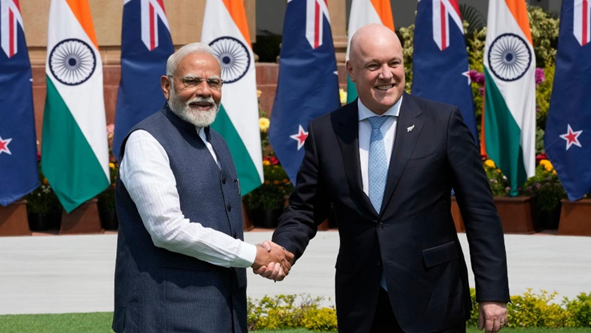
- India and New Zealand concluded negotiations for a comprehensive Free Trade Agreement (FTA) in December 2025 after about nine months of talks.
- The deal is positioned as a “new-generation” trade pact — not just about tariff cuts but a broader economic partnership covering trade in goods & services, investment, mobility and cooperation.
- Signing is expected in early 2026, followed by ratification and implementation.
- This FTA reflects a more calibrated Indian trade strategy, prioritizing targeted liberalization while protecting sensitive sectors.
Main Features of the Agreement:
1. Tariff & Market Access
- Zero-duty access for Indian exports:
New Zealand will provide 100 % duty-free access to all Indian tariff lines, eliminating previously applied tariffs and promoting competitiveness for Indian goods. - Indian tariff concessions:
India will offer liberalization in approx 70 % of its tariff lines covering about 95 % of bilateral trade value.
Remaining tariff lines are carefully calibrated to protect sensitive sectors (e.g., certain agricultural products).
2. Investment & Economic Cooperation
- New Zealand Investment Pledge:
NZ has committed to facilitate USD 20 billion in investments into India over the next 15 years, supporting sectors like manufacturing, services, infrastructure and innovation. - The agreement also includes frameworks for cooperation on agricultural productivity, MSME development, and technical collaboration.
3. Services & Skilled Mobility
- Mobility Provisions:
Unlike many traditional FTAs, this pact incorporates enhanced people-centric measures:- Indian professionals can access temporary employment visas (quota pathways).
- Uncapped pathways for Indian students with guaranteed part-time work and extended post-study work options.
- This reflects an emphasis on skills mobility & human capital integration, beyond tariff cuts.
4. Trade Facilitation & Standards
- Includes cooperation on customs procedures, sanitary & phytosanitary measures (SPS), rules of origin, and regulatory harmonization to streamline trade and reduce non-tariff barriers.
Strategic Significance of the India–New Zealand FTA:
1. Strengthening India’s Indo-Pacific Economic Strategy
- The FTA deepens India’s engagement in the Indo-Pacific, complementing its Act East and Indo-Pacific Oceans Initiative.
- By partnering with New Zealand, India expands its economic footprint in Oceania, balancing China-centric supply chains and reinforcing a rules-based regional order.
2. Diversification of Trade Partnerships
- India seeks to reduce over-dependence on a few markets (US, EU, China).
- The FTA aligns with India’s recent new-generation FTAs (e.g., with UAE, Australia, EFTA), enabling market diversification and resilience against global protectionism.
3. Gateway to the Pacific and CPTPP Ecosystem
- New Zealand is a member of the Comprehensive and Progressive Agreement for Trans-Pacific Partnership (CPTPP).
- Though India is not part of CPTPP, this FTA provides indirect integration with high-standard trade norms in the Pacific region, enhancing India’s preparedness for future mega-trade frameworks.
4. Shift to a Calibrated, Interest-Sensitive Trade Policy
- India has moved away from blanket liberalisation (as seen in RCEP withdrawal) towards selective tariff opening.
- Sensitive sectors, especially agriculture and dairy, are protected while export-competitive sectors gain access—reflecting a balanced trade strategy.
5. Emphasis on Services, Mobility and Human Capital
- Unlike traditional goods-centric FTAs, this agreement prioritises:
- Services trade
- Skilled mobility
- Education and student pathways
- This aligns with India’s comparative advantage in IT, healthcare, education, and professional services, and supports India’s demographic dividend.
6. Investment and Technology Collaboration
- New Zealand’s long-term investment commitment strengthens India’s goals of:
- Make in India
- Atmanirbhar Bharat
- MSME integration into global value chains
- Cooperation in agri-technology, clean energy, food processing and innovation enhances technology diffusion rather than mere trade flows.
7. Strategic Signalling in a Fragmenting Global Trade Order
- At a time when the World Trade Organization (WTO) faces gridlock, the FTA signals India’s preference for bilateral and plurilateral solutions.
- It projects India as a credible, rule-compliant trade partner, strengthening its global economic diplomacy.
8. People-to-People and Diaspora Linkages
- Enhanced mobility provisions strengthen cultural and social ties, reinforcing the India–New Zealand relationship beyond trade.
- Such linkages provide long-term strategic stability and trust—often missing in purely commercial agreements.
Economic Impacts & Expectations:
1. Trade Volume Targets
- Bilateral Trade Goal: The agreement aims to double bilateral trade (goods and services) from the current ~$2.4 billion to $5 billion within the next five years.
- Export Growth: New Zealand’s exports to India are projected to increase by $1.1 billion to $1.3 billion annually over the next two decades.
2. Investment & The “Clawback” Mechanism
- $20 Billion Commitment: New Zealand has pledged $20 billion in FDI into India over the next 15 years, targeting manufacturing, infrastructure, and green energy.
- Binding Nature: Similar to the India-EFTA deal, this includes a rebalancing/clawback mechanism. If the investment targets are not met, India reserve the right to suspend or withdraw certain tariff concessions. This shifts the FTA from a simple “trade in goods” pact to a “trade and investment” partnership.
3. Sector-Specific Economic Shifts
- Manufacturing & MSMEs: Zero-duty access for 100% of Indian exports is expected to provide a massive fillip to labor-intensive sectors (Textiles, Leather, Gems & Jewellery). This is projected to create thousands of new jobs in Indian MSMEs.
- Agriculture (The Strategic Balance):
- Safeguards: India has strictly protected its dairy sector (no duty cuts) to prevent the displacement of millions of local farmers.
- Productivity Gains: Instead of just trade, the focus is on “Agricultural Productivity Partnerships.” New Zealand will provide technology and expertise via Centres of Excellence for apples, kiwifruit, and honey to help Indian farmers improve yields.
- Pharma & Med-Tech: The agreement allows for the acceptance of global inspection reports (US FDA, EMA). This reduces duplicative testing, lowers compliance costs, and accelerates the entry of Indian medicines into the New Zealand market.
4. Services & Remittances
- Workforce Mobility: By securing 5,000 professional visas and a “Work-and-Holiday” framework, India expects a steady rise in remittance flows and global exposure for its skilled youth (IT, Healthcare, AYUSH).
- Education Hub: With uncapped entry for Indian students and guaranteed 20-hour weekly work rights, New Zealand is positioned as a key destination for Indian human capital, creating a long-term “knowledge economy” bridge.
Challenges of the India–New Zealand FTA:
1. Domestic Political Opposition (New Zealand)
- The “Neither Free nor Fair” Critique: New Zealand’s Foreign Minister, Winston Peters, has publicly criticized the deal, arguing it “gives too much away” on immigration while failing to secure market access for New Zealand’s crown jewel—the dairy sector.
- Ratification Risk: There are concerns regarding whether the agreement will face a smooth passage in the New Zealand Parliament given the opposition from coalition partners who view the immigration concessions (5,000 professional visas) as too high relative to the trade gains.
2. The Dairy Deadlock
- Exclusion of the Core Sector: Dairy accounts for nearly 30% of New Zealand’s total exports ($24 billion globally). By keeping dairy in the “Exclusion List” to protect 80 million Indian dairy farmers, the FTA excludes the very area where New Zealand has the highest comparative advantage.
- Limited Liberalization: New Zealand’s industry bodies (like DCANZ) have expressed disappointment that the deal only covers minor protein products for re-export rather than broad market access.
3. Non-Tariff Barriers (NTBs) & Standards
- Regulatory Divergence: Even with zero duties, Indian exporters (especially in Pharma and Agri-processing) face stringent Sanitary and Phytosanitary (SPS) measures and Technical Barriers to Trade (TBT) in New Zealand.
- Mutual Recognition: The real challenge lies in the Mutual Recognition Agreements (MRAs) for professional qualifications. Without these, the 5,000 visas for doctors and engineers may remain underutilized due to licensing hurdles.
4. Internal Resistance in India
- Horticulture Concerns: While dairy is protected, India has reduced duties on apples (from 50% to 25%) and Kiwifruit. This has sparked protests among apple growers in Himachal Pradesh and Kashmir, who fear that cheaper, high-quality “Kiwi apples” will undercut local prices.
- MSME Preparedness: Historical data shows Indian MSMEs often have low FTA utilization rates (approx. 25%) due to complex “Rules of Origin” documentation and a lack of awareness.
5. Strategic “Low Base” Challenge
- Volume vs. Value: Current bilateral trade is modest (~$2.4 billion). Critics argue that even doubling this to $5 billion is a small fraction of India’s total trade, making the “economic needle” move very slowly compared to the diplomatic effort involved.
Way Forward:
1. Institutionalizing the “Agricultural Productivity Partnership”
- Centres of Excellence: Establishing the proposed hubs for apples, kiwifruit, and honey is crucial to help Indian farmers adopt New Zealand’s high-yield techniques.
- Processing for Re-export: A key middle-ground strategy is allowing New Zealand dairy companies to set up processing units in India strictly for re-exporting to the wider Indo-Pacific region, utilizing India as a manufacturing hub.
2. Overcoming Non-Tariff Barriers (NTBs)
- Mutual Recognition Agreements (MRAs): The next step is for both nations to recognize each other’s professional qualifications. Without this, the quota of 5,000 professional visas for doctors and engineers will remain underutilized.
- Sanitary & Phytosanitary (SPS) Harmonization: Regular joint working group meetings are needed to align standards on food safety and pest control to ensure Indian organic products find a smooth market in New Zealand.
3. Leveraging the “Investment Clawback”
- Project Monitoring: India must actively pitch projects in green hydrogen, renewable energy, and infrastructure to New Zealand’s sovereign and pension funds to meet the $20 billion investment target.
- Accountability: Ensuring the “clawback mechanism” (rebalancing) remains a deterrent against investment stagnation while maintaining a stable business environment.
4. MSME Integration & Awareness
- FTA Utilization Clinics: The Ministry of Commerce should launch awareness campaigns to help small exporters understand the Rules of Origin (RoO). Currently, Indian MSMEs have a low FTA utilization rate; improving this is vital for the deal to impact the grassroots economy.
- Digital Trade: Utilizing the “Financial Services Annex” to integrate UPI and real-time payment systems, making it easier for small businesses to transact across borders.
5. Strategic Positioning in the Indo-Pacific
- Beyond Bilateralism: India should use this FTA as a template to build a “Bilateral RCEP”—a network of high-quality trade deals with Australia, UAE, and now New Zealand—to integrate into global supply chains without joining China-centric blocs.
Conclusion
The India–New Zealand FTA is strategically significant not merely as a trade agreement, but as a tool of Indo-Pacific economic diplomacy, trade diversification, and human-capital-driven growth, reflecting India’s evolved, pragmatic approach to globalization in an era of geopolitical uncertainty.