Why in the News?
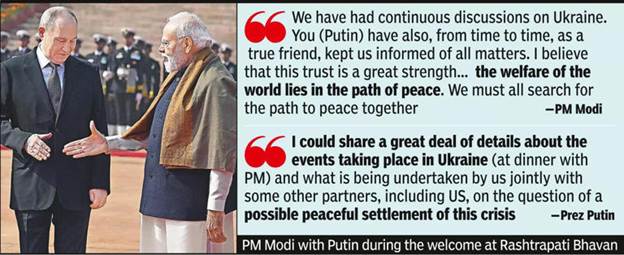
The Russian President visited India for a two-day state visit, holding bilateral discussions with the Indian Prime Minister. Sixteen agreements were signed covering energy, economic cooperation, and labour mobility. PM highlighted that India–Russia friendship remains steady like the pole star, underscoring the continuity of this long-standing strategic partnership despite global tensions.
Historical Evolution of India–Russia Relations
| Phase | Key Features | Significance |
| 1950s–1991 (India–USSR period) | Support during Indo-Pak wars, strong defence ties, technology sharing, nuclear cooperation | Foundational trust and geopolitical alignment |
| 1991–2010s (Post-Soviet transition) | New agreements, diversification of trade, continuation of defence procurement | Transition without disruption |
| 2010s–Present (Multipolar world) | BRICS/SCO cooperation, energy partnership, new economic formats, Russia’s pivot to Asia | Strategic autonomy and balanced global engagement |
Throughout these phases, stability has remained the defining feature of the relationship
Pillars of India–Russia Partnership
1️⃣ Defence Cooperation
- Russia remains a major defence supplier for India
- Collaboration in:
- Nuclear submarines leasing
- S-400 missile systems
- Joint production (e.g., BrahMos)
- Ensures strategic deterrence and technological edge
Continuity despite global sanctions pressures reflects the depth of security trust.
2️⃣ Energy and Natural Resources
- Russia is a key source of:
- Crude oil, natural gas and LNG
- Nuclear energy technology (Kudankulam plant)
- Helps India secure affordable and long-term energy supplies
Recent agreements deepen this vital pillar at a time of global energy uncertainty.
3️⃣ Economic and Trade Linkages
Though currently below full potential, both nations aim for expansion through:
- Diversified trade structure (pharma, agriculture, machinery)
- Improving connectivity and financial settlements
- Greater role for private sector and technology
The goal is to shift from commodity-centric trade to high-value cooperation.
4️⃣ Space, Nuclear and Technology Collaboration
- Civil nuclear energy projects
- Satellite and space science cooperation
- Prospects in AI, cyber security, quantum, aviation
Science & technology is emerging as a future-oriented growth sector.
5️⃣ People-to-People and Labour Mobility
- New agreements aim to enhance the placement of:
- Skilled and semi-skilled workers in Russia
- Contributes to employment opportunities and cultural engagement
A modern dimension enriching bilateral ties beyond traditional sectors.
Key Outcomes from the Recent Visit
- 16 agreements signed
- Focus on:
- Energy security
- Worker mobility
- Long-term economic cooperation
Signals intent to institutionalize the partnership till 2030 and beyond.
Current Geopolitical Context
- The Russia–Ukraine conflict and global polarisation create external pressure
- India’s stance remains independent, balanced, and interest-based
- Engagement with Russia complements India’s global outreach to:
- USA, EU, Japan
- Global South and emerging multipolar frameworks
India follows a multi-alignment strategy, avoiding binary geopolitical choices.
Challenges in the Relationship
- Payment and sanction-related disruptions
- Defence modernisation tied to Russian systems
- Russia’s increasing alignment with China
- Shifting global supply chains and technology controls
These require careful diplomacy and diversification without weakening core trust.
The Road Ahead: Way Forward
- Expand joint technology development in defence and innovation sectors
- Broaden energy collaboration including nuclear, hydrogen and renewables
- Secure safe migration systems for workers
- Strengthen connectivity corridors (Arctic, INSTC)
- Continue commitment to peaceful resolution of global conflicts
The aim is to evolve into a future-ready, economically stronger partnership.
Conclusion
The latest visit reaffirms that India–Russia relations remain grounded in mutual trust, strategic relevance, and long-term national interests. Despite global turbulence, the partnership continues to adapt, with deeper cooperation in energy, labour mobility, and diversified trade shaping the next phase of engagement. The metaphor of the pole star aptly captures a relationship that has stayed steady through decades of geopolitical change — and appears set to remain a stable pillar of India’s foreign policy.
Source: India-Russia friendship remains steady like the pole star, says PM – The Hindu
UPSC CSE PYQ
| Year | Question |
| 2023 | Arms trade, economic ties and congruent geo-political interests are no longer the three pillars of India–Russia relationship in the emerging strategic context. Comment. |
| 2022 | While GS2 2022 covered international relations broadly, no PYQ explicitly titled “India–Russia relations”. |
| 2020 | What is the significance of Indo-US defence deals over Indo-Russian defence deals? Discuss with reference to stability in the Indo-Pacific region. |