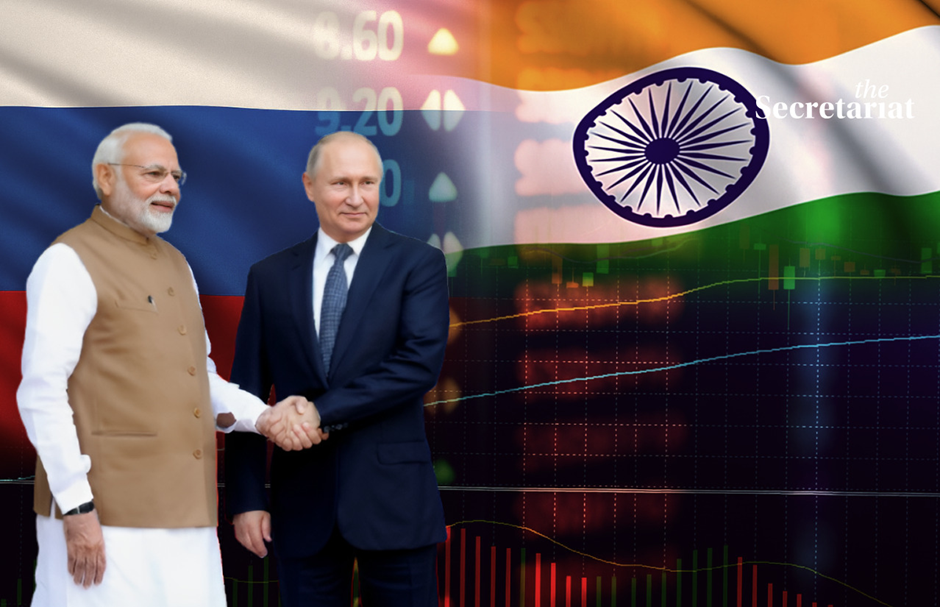
The recent India-Russia Summit has broadened the scope of the “Special and Privileged Strategic Partnership,” moving beyond traditional defense ties to focus on the Arctic region, nuclear energy security, and outer space collaboration.
Why is the Arctic Focus Significant?
- Northern Sea Route (NSR): Both nations have committed to progress on the Northern Sea Route. For India, this is a strategic alternative trade corridor connecting Europe and Asia, offering shorter transit times compared to the Suez Canal.
- Bilateral Consultations: A mechanism for “regular bilateral consultations” on Arctic-related issues has been established to streamline cooperation.
- Historical Context (Svalbard Treaty): India’s engagement with the Arctic dates back to the British Raj era.
- The Treaty: The Svalbard Treaty of 1920 granted Norway sovereignty over the Svalbard archipelago.
- India’s Rights: As a signatory (originally through the British Empire), India possesses equal rights to conduct non-military commercial and scientific activities, such as mining and fishing, in the region.
How is Nuclear Cooperation Evolving?
- Kudankulam Nuclear Power Project (KKNPP):
- Fuel Supply: The nuclear fuel division of Rosatom has commenced the delivery of advanced nuclear fuel for Unit 3 of the KKNPP in Tamil Nadu.
- Lifecycle Support: A critical pact signed in 2024 ensures fuel supply for Units 3 and 4 for their entire service life, starting from the initial loading.
- Technology Transfer: Discussions are being accelerated regarding VVER (Vodo-Vodyanoi Energetichesky Reaktor) technology. These are pressurized water reactors used in Russian designs for joint development and research.
- Future Expansion: India has committed to “strive to” allot a second site for a new Russian-assisted nuclear power plant, reinforcing the expansion of civil nuclear cooperation beyond Kudankulam.
India–Russia Far East Cooperation Programme (2024–29)
- Mandate: An institutional mechanism to operationalize India’s ‘Act Far East’ policy, enhancing trade and investment in the resource-rich Russian Far East and Arctic zone.
- Key Pillars: Focuses on critical sectors like energy (coking coal, oil), connectivity (Chennai-Vladivostok Maritime Corridor), and a new ‘Skilled Migration Corridor’ for Indian workforce mobility.
- Strategic Goal: Aims to diversify engagement beyond defense, addressing the trade deficit to achieve the $100 billion bilateral trade target by 2030.
What are the Developments in Space?
- ISRO-Roscosmos Partnership: The summit welcomed the “enhanced partnership” between the Indian Space Research Organisation (ISRO) and Roscosmos (Russian State Space Corporation).
- Objective: The collaboration focuses strictly on the use of outer space for peaceful purposes, potentially including satellite navigation and human spaceflight programs (Gaganyaan).