Why in the News
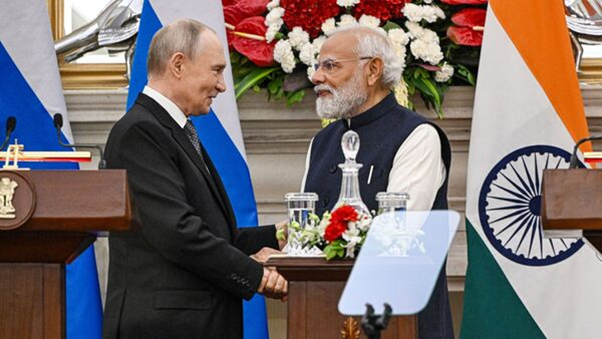
- Recently, President Vladimir Putin undertook a state visit to New Delhi, marking his first visit to India since Russia’s 2022 invasion of Ukraine.
- This visit assumes significance as it represents a deliberate diplomatic assertion by Prime Minister Narendra Modi regarding India’s independent foreign policy stance, particularly in a geopolitical environment where Western powers maintain stringent opposition to Moscow’s military actions and hold international isolation efforts against Russian leadership.
Background and Context
Historical Foundation of India-Russia Partnership
The India-Russia relationship extends across several decades, with the formalization of strategic partnership and institutionalization of annual summits marking 25 years of structured engagement in the current year. This enduring partnership has served as cornerstone of India’s non-aligned foreign policy tradition and continues to remain significant for India’s strategic interests in regional and global domains.
Current Geopolitical Complexities
Russia’s military aggression in Ukraine has fundamentally altered the international strategic landscape, precipitating:
- Western isolation of Moscow: Entire Western alliance has ranged against Russia through multiple mechanisms including economic sanctions, diplomatic isolation, and military support to Ukraine.
- International legal dimensions: International Criminal Court (ICC) has issued warrant against President Putin, constraining his international movement and diplomatic engagement.
- Escalating military tensions: Russia has stepped up attacks into Ukraine with intensified operational tempo, further heightening tensions across European theatre and global strategic environment.
- Recent Russian position: Putin has indicated explicit rejection of U.S. peace proposals without substantial modifications, demonstrating inflexibility in ongoing conflict resolution attempts.
Significance of Modi-Putin Meeting: Messages and Strategic Implications
First-Time State Visit Protocol
Decision to receive Putin with state visit ceremonial protocols for first time in current tenure carries multifaceted diplomatic messaging:
- Symbolic Assertions to Moscow:
- Putin remains trusted partner: Invitation during period of Western isolation signifies that India maintains relationship continuity with Russia irrespective of international pressure.
- Rejection of Western pressure: Government’s action demonstrates refusal to be coerced into Russia criticism despite Western attempts at isolating Moscow.
- Reaffirmation of independent foreign policy: India’s decision reflects commitment to strategic autonomy and non-alignment principles, not submitting to external pressure for policy realignment.
- Messaging to Western Capitals:
- Maintained negotiation channels: Despite strategic partnership with Russia, India preserves diplomatic channels with Western powers, signaling non-exclusive alignment.
- Pragmatic balancing: Government’s approach indicates that while maintaining Russia ties, New Delhi remains engaged with Western capitals on multiple bilateral issues.
Economic Imperatives Behind State Visit
Officials highlighted several agreements and frameworks during the visit:
- Announced Economic Agreements and Understandings:
- Labour mobility agreement: Facilitating movement of skilled and unskilled workers between nations, addressing manpower requirements and remittance flows.
- Joint urea plant establishment: Memorandum of Understanding for jointly setting up fertiliser production facility in Russian territory, addressing India’s agricultural input requirements despite sanctions pressure.
- Economic roadmap operationalization: Government adopted economic road map originally launched during Modi’s 2024 Moscow visit, representing continuity in economic engagement strategy.
- Economic Roadmap Components:
- Enhanced bilateral trade promotion: Mechanisms and frameworks designed to augment trade volumes between nations despite international sanctions regime.
- Maritime corridor development: Connectivity infrastructure through sea routes designed to circumvent land-based sanction restrictions and enable smoother commerce.
- Currency payment mechanisms: National currency payment systems being established to bypass international sanctions targeting both Russian and Indian economic entities, particularly oil sector companies.
Oil Trade Dynamics and Strategic Restraint
Notable absence of expanded oil import commitments despite Putin’s offer of “uninterrupted” supplies represents calculated strategic decision:
- Sanctions pressure: Stringent international sanctions targeting Russian oil companies and Indian entities engaged in energy trade create significant operational and financial constraints.
- U.S. tariff surcharge implications: Additional 25% tariff surcharge imposed by United States on various commodity imports creates economic burden on India’s import bill.
- Strategic reluctance to escalate: Despite economic benefits of expanded oil procurement, India has deliberately avoided announcing increased import plans, signaling awareness of Western sensitivities.
- Trade target complications: Ambitious bilateral trade target of $100 billion by 2030 becomes increasingly challenging without substantial expansion in high-volume energy sector trade.
Strategic Restraint in Defence and Nuclear Cooperation
Absence of Defence and Strategic Agreements
Critical observation involves notable omission of strategic sector announcements:
- Sectors Without New Announcements:
- Defence hardware procurement: No new defence equipment or military hardware agreements announced, despite Russia being traditional defence supplier to India.
- Nuclear power projects: No expansion or new nuclear cooperation initiatives announced.
- Space collaboration: No new space sector cooperation agreements disclosed.
- Strategic Implications of These Omissions:
- Western sensitivity awareness: Government remains cognisant of heightened Western concerns regarding India-Russia strategic deepening.
- Negotiation protection: Deliberate restraint in announcing strategic agreements protects ongoing negotiations with United States and European Union on critical issues including trade agreements and high-level diplomatic visits.
- Calibrated balancing approach: Modi’s reference to Russia ties as “Dhruv Tara (lode star)” affirms relationship importance while simultaneous restraint in strategic sectors demonstrates balanced positioning.
India’s Balancing Act: Autonomy Versus Alignment
The Complexity of Strategic Autonomy
New Delhi’s position between two sets of partners characterized by mutual hostility creates unprecedented diplomatic challenges:
- Dual Engagement Requirements:
- Russia engagement necessity: Historical partnership, energy security, defence cooperation legacy, and regional strategic interests make Russia engagement indispensable.
- Western engagement imperative: Economic interdependence, technology cooperation, security partnerships, and global institutional engagement make Western powers equally critical.
- Mutual antagonism reality: Russia and Western powers are fundamentally inimical to each other, precluding simultaneous strategic deepening with both.
- Pendulum Movement Versus Consistent Autonomy
Critical distinction exists between authentic strategic autonomy and pendulum movements:
- Pendulum Movement Characteristics:
- Oscillating between Russia and West based on immediate pressures.
- Inconsistent policy positions creating credibility deficits.
- Short-term tactical decisions without strategic coherence.
- Consistent Strategic Autonomy Requirements:
- Taking calculated steps with both partners: Requires consistent engagement frameworks with both Russia and Western powers.
- Policy coherence across time: Decisions should reflect strategic principles rather than reactive positioning.
- Clear articulation of interests: India’s foreign policy must reflect genuine national interests rather than external pressure responsiveness.
Way Forward
- Effective navigation of contemporary geopolitical environment requires India to institutionalise strategic autonomy through multifaceted approaches rather than oscillatory diplomacy.
- Structured engagement with Russia to be continued through economic cooperation mechanisms including trade diversification, currency payment systems bypassing sanctions, and technological collaboration in non-sensitive sectors while simultaneously deepening ties with Western powers through trade negotiations, defence cooperation, and institutional partnerships.
- Sustained assertion of independent foreign policy must manifest through consistent decision-making frameworks reflecting India’s genuine strategic interests, including energy security, defence modernisation, technological advancement, and regional stability, without allowing temporary geopolitical pressures to determine policy direction.
- Transparent communication of India’s strategic rationale to both Russia and Western capitals becomes essential for maintaining credibility and preventing misinterpretation of India’s balanced positioning.
Conclusion
- The visit of President Putin to India recently underscores India’s commitment to maintaining long-term strategic partnership with Russia, even amid Western pressures and global tensions.
- By emphasizing economic and diplomatic engagement while omitting sensitive strategic agreements, India demonstrates a pragmatic approach to strategic autonomy, balancing relations with both Russia and Western nations.
- This approach signals a careful, deliberate foreign policy, positioning India as a credible global actor capable of navigating complex geopolitical landscapes.
UPSC MAINS PYQs
- What is the significance of Indo-US deals over Indo-Russian defence deals? Discuss with reference to stability in the Indo-Pacific region. (UPSC Mains 2020)