Context
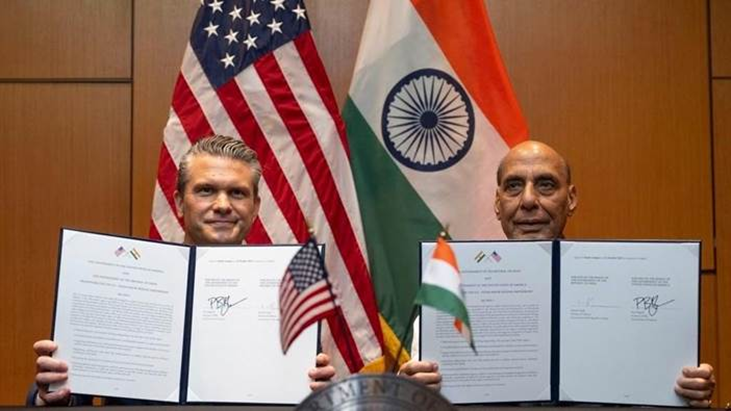
Recently, the strategic partnership between India and the United States has gained significant momentum following the signing of a landmark 10-year Defence Framework Agreement (2025–2035) and a major Interim Trade Deal in early 2026.
This progress is built upon the successful operationalization of the four “Foundational Agreements”—GSOMIA, LEMOA, COMCASA, and BECA—which have institutionalized military interoperability, secure communication, and real-time intelligence sharing between the two nations, particularly in the context of maintaining a free and open Indo-Pacific.
Foundational Agreements: An Overview
The U.S. signs these “foundational” or “enabling” agreements with its close partners to facilitate military cooperation. For India, these were modified into “India-specific” versions to address concerns regarding sovereignty and strategic autonomy.
1. GSOMIA (General Security of Military Information Agreement)
- Signed: 2002 (Extended by the Industrial Security Annex/ISA in 2019).
- Function: It allows the two militaries to share intelligence gathered by them.
- Impact: It provides a framework for the exchange of classified military information between the governments and, with the ISA, it now includes private sector defense manufacturers.
2. LEMOA (Logistics Exchange Memorandum of Agreement)
- Signed: 2016.
- Function: It provides a framework for mutual logistical support, allowing the militaries to use each other’s bases for replenishment and refueling.
- Key Point: It is purely a logistical arrangement and does not involve the stationing of U.S. troops on Indian soil. It is particularly vital for Navy-to-Navy cooperation in the Indo-Pacific.
3. COMCASA (Communications Compatibility and Security Agreement)
- Signed: 2018 (India-specific version of CISMOA).
- Function: It allows the transfer of encrypted communication equipment so that Indian and U.S. military commanders, ships, and aircraft can communicate through secure, specialized networks.
- Impact: It ensures “interoperability” during joint exercises or disaster relief operations, preventing the interception of data by third parties.
4. BECA (Basic Exchange and Cooperation Agreement)
- Signed: 2020.
- Function: It facilitates the exchange of geospatial intelligence, including high-resolution maps, nautical/aeronautical charts, and satellite imagery.
- Impact: It significantly enhances the accuracy of Indian automated hardware and weapons systems, such as cruise missiles and armed drones, by providing high-quality GPS and topographical data.
5. Strategic Significance
- Interoperability: These agreements allow the two militaries to “talk” to each other and “act” together seamlessly.
- Countering Regional Threats: The pacts provide India with a technological edge, especially in monitoring movements in the Indian Ocean and along the Line of Actual Control (LAC).
- Shift in Policy: Moving from “Strategic Autonomy” in a traditional sense to “Strategic Convergence” with the U.S. without entering a formal military alliance.
Q. With reference to the foundational defense agreements between India and the USA, consider the following statements:

1. The Logistics Exchange Memorandum of Agreement (LEMOA) facilitates the permanent stationing of foreign troops in India for joint counter-terrorism operations.

2. The Basic Exchange and Cooperation Agreement (BECA) primarily focuses on the transfer of satellite data to enhance the precision of long-range missiles.

3. The correct chronological order of the signing of these agreements is: GSOMIA → LEMOA → COMCASA → BECA.

How many of the statements given above are correct?
A) Only one
B) Only two
C) All three
D) None

Solution: B (Only two)

•	STATEMENT 1 IS INCORRECT: LEMOA is a logistical pact for refueling and replenishment; it does not mandate or allow the permanent stationing of U.S. troops or bases on Indian soil.
•	STATEMENT 2 IS CORRECT: BECA allows for the sharing of geospatial intelligence (maps and satellite data), which is critical for the accuracy of missiles and drones.
•	STATEMENT 3 IS CORRECT: The chronological order is GSOMIA (2002), LEMOA (2016), COMCASA (2018), and BECA (2020).