Recently, India and the United States have been in the news due to the pending Bilateral Trade Agreement (BTA). The agreement is critical as it sets the framework for tariff rates, market access, and trade regulations between the two countries.
Exporters in leather goods, garments, and footwear—sectors that are employment-intensive—are particularly affected due to high tariffs on Indian products (up to 50%) compared to 15–20% tariffs from rival countries.
Many Indian exporters, heavily reliant on the US market, are offering discounts and lower margins to stay competitive. Some US buyers are exploring alternative markets due to uncertainty over the trade deal.
Officials have confirmed that US negotiators have reviewed India’s proposals, but the deal has not yet been finalised, leaving exporters to manage ongoing uncertainty.
India–US Trade Deal: Concept and Framework
A Bilateral Trade Agreement (BTA) aims to reduce trade barriers, enhance market access, and address non-tariff issues between two countries.
The Terms of Reference (ToR) set the negotiation framework, priority sectors, and high-level approval process before finalisation.
The goal is to boost bilateral trade in goods and services between India and the United States to USD 500 billion by 2030, up from the current level of approximately USD 191 billion.
Trade Data and Recent Developments: India–US
Bilateral Trade Volume: The United States remains India’s largest trading partner for the fourth consecutive year.
Total bilateral goods trade reached approximately USD 131.84 billion in FY 2024–25, up from USD 129.2 billion in 2024 and USD 118.2 billion in FY 2023–24.
Trade Surplus: India maintained a trade surplus of around USD 41.18 billion in FY 2024–25, which helps offset deficits with other major partners.
Consequently, the US goods trade deficit with India stood at USD 45.7 billion, reflecting a 5.4% rise (approximately USD 2.4 billion) from the prior year.
India’s trade surplus with the US helps offset deficits with other major partners, particularly China.
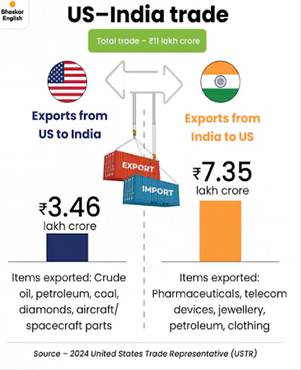
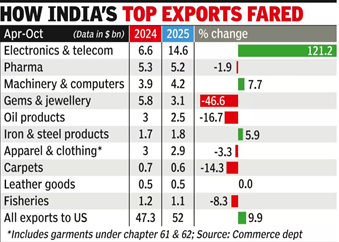
India’s Exports to the US: India’s exports to the United States rose from USD 77.51 billion in FY24 to USD 86.51 billion in FY25, reflecting a significant expansion in trade volume. During FY25, India exported a total of 7,174 distinct commodities to the US.
Keyexport items included: engineering goods, electronic goods, gems and jewellery, pharmaceuticals, petroleum products and light crude oil, footwear and textiles and electrical equipment including machinery.
The major export datas for 2024-25:
Export Item
Value (USD Billion)
Electrical machinery and equipment, including parts
15.89
Natural or cultured pearls, precious and semi-precious stones, and pre-metals clad with precious metals
9.97
Pharmaceutical products
9.78
Nuclear reactors, boilers, machinery, and mechanical appliances
6.69
Mineral fuels, mineral oils, and their refined products
4.20
Articles of iron and steel
3.11
US Exports to India: In 2024, the United States exported goods worth USD 41.18 billion to India, marking an increase of 3.4% (approximately USD 1.4 billion) compared to the previous year.
During the same period, the US imported goods valued at USD 87.4 billion from India, which represents a 4.5% growth (around USD 3.7 billion) over 2023.
US Export Items to India (India’s Imports from the US) primarily include: agricultural commodities, aircraft and defence equipment, medical devices, technology-intensive goods, crude oil, petroleum products, coal, coke and gold.
India’s major imports from the United States for FY25 included:
Import Item
Value (USD Billion)
Crude oil
4.5
Petroleum products
3.6
Coal and coke
3.4
Cut and polished diamonds
2.6
Electrical machinery
1.4
Aircraft, spacecraft, and components
1.3
Gold
1.3
Foreign Direct Investment (FDI): The US remains a major investor in India: 3rd largest source of FDI for India.
FDI inflows were USD 4.99 billion in FY 2023–24.
Cumulative FDI from the US from April 2000-March 2025 is approximately USD 70.65 billion, making it India’s third-largest FDI source.
Sectoral Cooperation: In 2024, India and the US signed a Memorandum of Understanding (MoU) to promote Small and Medium Enterprises (SMEs), fostering innovation, industrial growth, and bilateral collaboration in strategic sectors.
Global Energy Context: According to the Centre for Research on Energy and Clean Air, between December 2022 and June 2025, the EU purchased 51% of Russian liquefied natural gas (LNG) and 37% of pipeline gas, while China imported 47% of Russia’s crude oil.
India followed with 38% of Russian crude exports, highlighting India’s strategic role as a major energy importer. The EU and Turkey accounted for 6% each of Russian crude exports.
Strategic Friction Points-India-US Trade Deal
Despite a strong economic partnership, the United States Trade Representative (USTR) has raised several concerns regarding India’s trade policies, highlighting non-tariff barriers and regulatory hurdles:
Genetically Modified (GM) Crops: The US advocates for market access for GM agricultural products, while India maintains strict regulations to protect biodiversity, safeguard farmer interests, and preserve GM-free export markets, treating this as a non-negotiable issue.
Dairy Imports: Indian laws mandate that dairy products must come from animals not fed animal by-products, reflecting cultural and religious sensitivities, which the US considers a market restriction.
Pharmaceutical Regulations: US firms are concerned about price caps on essential medical devices and patent restrictions, whereas India prioritises affordable healthcare and public welfare.
Agriculture and Non-Tariff Barriers: India enforces sanitary and phytosanitary (SPS) regulations to ensure consumer safety and protect domestic producers, which the US perceives as trade barriers.
Data Localisation: The Reserve Bank of India (RBI) mandates that electronic payment data of Indian citizens be stored locally. India argues this ensures financial security and fraud prevention, while the US views it as a constraint on global operations and foreign firms.
Intellectual Property Rights (IPR): The US flags issues such as delays in patent approvals, weak protection of trade secrets, and anti-evergreening measures under India’s patent law as points of concern.
Significance of the India-US Trade Deal
Economic: Provides market access for exports, attracts investment, and supports industrial growth.
Strategic: Strengthens India’s economic partnership with the US while balancing relations with other major trade partners.
Policy Alignment: Supports Make in India, Atmanirbhar Bharat, and export-led growth strategy.
Negotiation Leverage: India can use services trade surplus and digital services revenue in negotiations to maintain strategic autonomy.
Consider the following statements regarding the India–US Bilateral Trade Agreement (BTA):
1.	A BTA aims to reduce trade barriers and enhance market access between two countries.
2.	India treats genetically modified (GM) crops as a non-negotiable issue in trade negotiations.
3.	India maintains sanitary and phytosanitary (SPS) regulations to protect consumers and domestic producers.
Which of the above statements is/are correct?
(a) 1 only
(b) 1 and 2 only
(c) 1, 2 and 3
(d) 2 and 3 only
Answer: (c) 1, 2 and 3
Explanation:
•	Statement 1 is correct. The primary objective of a BTA is to reduce trade barriers and enhance market access.
•	Statement 2 is correct. India considers GM crop regulations essential for biodiversity, farmer protection, and maintaining GM-free export markets, treating this as a non-negotiable issue.
•	Statement 3 is correct. India enforces sanitary and phytosanitary (SPS) regulations to ensure consumer safety and protect domestic agricultural producers.