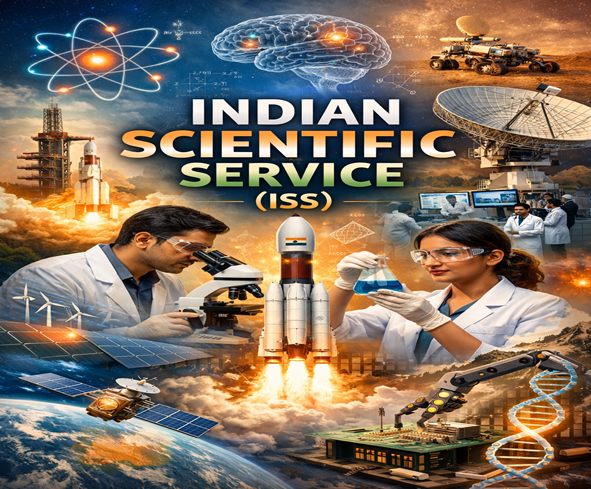
After Reading This Article You Can Solve This UPSC Model Question:
“The growing complexity of governance in the 21st century necessitates deeper integration of scientific expertise into policymaking.”In this context, critically examine the need for establishing an Indian Scientific Service (ISS). Discuss its potential merits, challenges, and the way forward for institutionalizing science-based governance in India. 250 words ( GS- 2 Science and Technology)
Introduction
The Indian Scientific Service (ISS) is a proposed All-India Service designed to bridge the gap between technical expertise and governance. By institutionalizing “Scientist-Administrators,” it aims to professionalize R&D management and ensure evidence-based policymaking for a technologically advanced India.
Reasons for Establishing the ISS
- Technical Policy Expertise: Provides deep domain knowledge for regulating complex emerging sectors like AI, semiconductors, and genomics, where generalist training is insufficient.
- Evidence-Based Governance: Ensures national policies are driven by rigorous scientific data and technical feasibility rather than mere administrative or political convenience.
- Crossing the “Valley of Death”: Empowers Techno-Managers to bridge the gap between lab research (TRL 3) and commercial industrial products (TRL 9), enhancing India’s innovation output.
- Strategic Mission Leadership: Prevents fragmented oversight and delays in large-scale national projects (e.g., Green Hydrogen or Space missions) through dedicated scientific continuity.
- Scientific Integrity & Autonomy: Creates a legal framework allowing scientists to offer unbiased technical warnings (e.g., climate or ecological risks) without the constraints of traditional bureaucratic conduct rules.
- Global Tech-Diplomacy: Develops a cadre of “Scientist-Diplomats” to negotiate international standards, IP rights, and strategic resource treaties (e.g., Rare Earths) from a position of technical strength.
Significance of Establishing an ISS
1. Unified Science Administration
- Currently, India’s scientific departments (DST, DBT, CSIR, ISRO, DRDO) operate in silos. An ISS would:
- Create a Centralized Pool: Develop a dedicated cadre of “scientist-administrators” who understand both research nuances and bureaucratic processes.
- Standardize Recruitment: Streamline entry requirements, ensuring high-caliber talent enters the government’s scientific fold through a competitive process.
2. Evidence-Based Policy Making
- Science is increasingly at the heart of governance (e.g., climate change, pandemics, AI ethics).
- Technical Literacy in Power: ISS officers could provide specialized advice to ministries, reducing the “knowledge gap” often found in generalist-led departments.
- Strategic Planning: Enhance India’s ability to forecast technological trends and align them with national security and economic goals.
3. Career Progression and Retention
- Brain Drain Mitigation: By offering a prestigious, structured career path with clear promotions, the government can retain top-tier Indian researchers who might otherwise move abroad or to the private sector.
- Leadership Stability: It would provide a steady pipeline of experts ready to lead national laboratories and missions, reducing reliance on ad-hoc appointments.
4. Global Scientific Diplomacy
- International Representation: ISS officers would be better equipped to represent India in global forums like the IPCC, WHO, or CERN, blending diplomatic tact with technical expertise.
- Tech Transfer: Facilitate smoother negotiations for international technology transfers and collaborative research projects.
Government Initiatives Taken So Far
- STIP 2020 (Draft): The latest Science, Technology, and Innovation Policy explicitly proposes the creation of a specialized “Science Administration” cadre. It aims to institutionalize “Science Policy Fellows” and “Scientist-Administrators” to manage R&D ecosystems.
- NITI Aayog’s 3-Year Action Agenda: Recommended Lateral Entry at middle and senior management levels (Joint Secretary and Director) specifically for sectors requiring high technical expertise, like Biotechnology, Renewable Energy, and Aviation.
- Anusandhan National Research Foundation (ANRF): Established under the ANRF Act (2023), this apex body aims to provide high-level strategic direction to scientific research. It is designed to be led by scientists, reflecting a shift toward “specialist-led” governance.
- Empowered Technology Group (ETG): Formed to advise the government on technology trajectories and procurement, ensuring that technical expertise is integrated into the highest levels of cabinet decision-making.
- UPSC Lateral Entry: Since 2018, the government has recruited domain experts from the private sector and academia into ministries like Civil Aviation, Environment, and Electronics. This serves as a “pilot” for what a permanent ISS might look like.
- Mission Karmayogi: A national program for civil service capacity building that includes specialized modules for generalist officers to handle technical departments more effectively.
Global Practices and Lessons
1. United States- (Senior Executive Service (SES) – Technical Track)- A dual-career ladder system that allows scientists to rise to the highest administrative ranks without abandoning their technical expertise.
2. United Kingdom- [Government Science & Engineering (GSE)]- ProfessionA dedicated cadre of over 10,000 specialists. Every major ministry has a Chief Scientific Adviser (CSA) supported by this structured team.
3. China- (“Technocratic” Cadre System)- High emphasis on meritocratic recruitment of engineers and scientists into the civil service.
4. Germany- (Research-Admin Hybrid)- Deep integration between federal research institutes and ministries, where staff rotate between active research and policy-drafting roles.
Challenges in Establishing ISS
1. The “Generalist vs. Specialist” Friction
The Indian bureaucracy has historically followed the Macaulayian model, which favors “generalist” administrators (IAS) over “specialists” (scientists/engineers).
- Power Dynamics: There is significant resistance from the existing All-India Services to share top policy-making positions (Secretary level) with a new cadre.
- Perceived Limitations: Critics argue that scientists might have “tunnel vision” (high depth, low breadth), making them less effective at handling the multi-faceted political and social pressures of district or state administration.




2. Federal and Constitutional Hurdles
- Article 312 Requirements: Creating a new All-India Service requires a resolution in the Rajya Sabha supported by not less than two-thirds of the members present and voting.
- State Autonomy: States often view new All-India Services as a form of “Central overreach.” Since most states have their own scientific departments, they may resist a central cadre managing their local research ecosystems.
3. Administrative and Skill Gaps
- Management Training: Scientists are trained in “precision and inquiry,” while administration requires “tact, negotiation, and speed.” Transitioning a researcher into a bureaucrat requires a massive, currently non-existent training infrastructure.
- Conflict of Interest: In current setups, scientists often hold administrative power over the same institutions where they conduct research. Transitioning to a formal ISS would require a clean “separation of powers” that many senior scientist-administrators might resist.
4. Legal and Career Mobility
- CCS Conduct Rules: Existing Civil Service (Conduct) Rules can be restrictive for scientists. For example, official rules often penalize government employees for publicizing findings that contradict state policy—a direct conflict with the Scientific Temper and transparency required for research.
- Brain Drain vs. Pay Parity: To attract top scientists to the ISS, the government would need to offer pay and perks competitive with global R&D firms or top-tier universities, which could cause a “parity crisis” with other civil services.
Way Forward
- Mission-Mode Pilot: Launch the ISS initially in high-tech departments like MeitY and Biotechnology to test the model before a pan-India rollout.
- Science-Policy Framework: Integrate specialized modules into Mission Karmayogi to ensure generalist officers are “science-literate” while the dedicated ISS cadre is being built.
- Constitutional Pathway: Use Article 312 (Rajya Sabha resolution) to establish the ISS as an All-India Service, providing the legal prestige to operate across Central and State levels.
- Dual-Track Career Model: Adopt a “fluid” system allowing officers to switch between active research and policy management without losing seniority or career progression.
- Formalized Lateral Entry: Institutionalize fixed 3–5 year tenures for experts from academia and the private sector to keep the government updated on frontier technologies like AI and Quantum Computing.
- ANRF-Led Governance: Designate the Anusandhan National Research Foundation (ANRF) as the cadre-controlling authority to ensure merit-based recruitment and implement market-linked pay scales for high-demand fields.
Conclusion
The Indian Scientific Service (ISS) is the essential bridge to a “Viksit Bharat,” transforming India into a global technocracy. By integrating specialized expertise into governance via Article 312, it ensures evidence-based policy-making and strategic leadership in frontier technologies.