Context
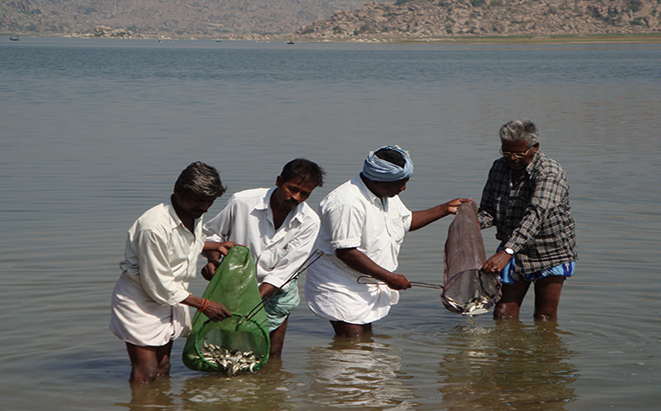
The Union Budget 2026-27 emphasizes the integrated development of fisheries in 500 reservoirs and Amrit Sarovars to enhance the income of fish farmers and strengthen market access through cooperatives and Fish Farmer-Producer Organisations (FFPOs). This initiative aligns with the Blue Revolution and Viksit Bharat@2047 vision.
1. India’s Global Position and Production Trends
- Rank: India is the second-largest fish producer in the world and the second-largest globally in aquaculture production.
- Growth: National fish production witnessed a 106% increase since 2013-14.
- Total production ≈ 197.75 lakh tonnes (2024–25).
- Sectoral Share: 75% of India’s fish production comes from inland fisheries (freshwater, brackish, and saline water resources).
- Productivity: Fish productivity in reservoirs has increased from 50 kg per hectare (2006) to 100 kg per hectare today. ICAR-CIFRI suggests a potential of up to 300 kg per hectare.
2. Geographical Distribution in India
- Maximum Area under Reservoirs: Rajasthan topped the list of Indian states by reservoir area, followed by Madhya Pradesh, which ranked second.
- Highest Number of Reservoirs: Tamil Nadu (over 8,000).
- Regional Significance: Reservoirs are primarily located in eastern, central, and peninsular regions, serving as lifelines for economically backward and water-scarce areas.
3. Technological Interventions: Cage Culture
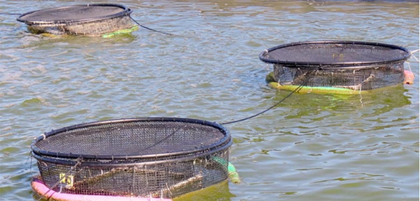
- Mechanism: Floating or stationary cages made of synthetic netting/mesh. They allow natural water flow, ensuring oxygen and nutrient exchange.
- Advantages: Facilitates easier feeding, monitoring, and disease management.
- Species Focus:
- Indian Major Carps: Catla, Rohu, Mrigal (core species).
- Additional Species: Tilapia, Pangasius.
- Ornamental Fish: Stocking in specific projects like Amrit Sarovars in Arunachal Pradesh.
4. Government Initiatives on India’s Fisheries Sector
- Pradhan Mantri Matsya Sampada Yojana (PMMSY): A flagship scheme providing budgetary support for cage culture and quality seed stocking.
- National Fisheries Development Board (NFDB): Implementing a cluster-based strategy to enhance competitiveness.
- Reservoir Clusters: Announced for Halali and Indra Sagar dams in Madhya Pradesh to address sectoral gaps and enhance economies of scale.
- Blue Revolution 2.0: Focuses on the “Integrated Development and Management of Fisheries.”
- Kisan Credit Card (KCC) Extension: The government extended KCC facilities to fishers and fish farmers.
- Mission Amrit Sarovar: Focuses on conserving surface and groundwater in district ponds.
- Standard: Each Sarovar has a minimum pondage area of one acre with a capacity of 10,000 cubic metres.
With reference to the integrated development of fisheries in reservoirs, consider the following statements:

1. India is currently the second-largest producer of fish in the world and ranks second globally in aquaculture production.

2. Inland fisheries, which include freshwater, brackish, and saline water resources, account for 75% of India's total fish production.

3. Under the cluster-based strategy for reservoir ecosystems, Tamil Nadu has the maximum area under reservoirs in India.

Which of the statements given above are correct?
(a) 1 and 2 only
(b) 2 and 3 only
(c) 1 and 3 only
(d) 1, 2 and 3

Correct Answer: (a)

Explanation:
Statement 1 is Correct: India is among the top global fish producers and ranks second in aquaculture production after China.

Statement 2 is Correct: Inland fisheries (mainly freshwater, along with brackish water systems) contribute about 75% of India’s total fish production.

Statement 3 is Incorrect: The largest reservoir area is not in Tamil Nadu; states like Rajasthan, Madhya Pradesh, Telangana, and Karnataka have significantly larger reservoir resources under the cluster-based strategy.