After Reading This Article You Can Solve This UPSC Mains Model Question:
India’s Global Capability Centres (GCCs) have transitioned from cost-arbitrage units to strategic innovation hubs. Discuss the factors responsible for this transformation and examine their implications for India’s economic growth. (250 words, GS-3 Economy)
Context
The Union Budget 2026-27 and the India AI Impact Summit (held at Bharat Mandapam) have signaled a shift toward “Tech Sovereignty.” GCCs are no longer just supporting global HQs; they are where the world’s most complex Engineering Research & Development (ER&D) and Generative AI (GenAI) models are being built.
About India’s Global Capability Centers (GCCs)
Definition: A Global Capability Center is a captive, fully owned offshore unit of a multinational corporation (MNC) that handles specialized functions like IT, Finance, R&D, and Analytics.
Current Landscape
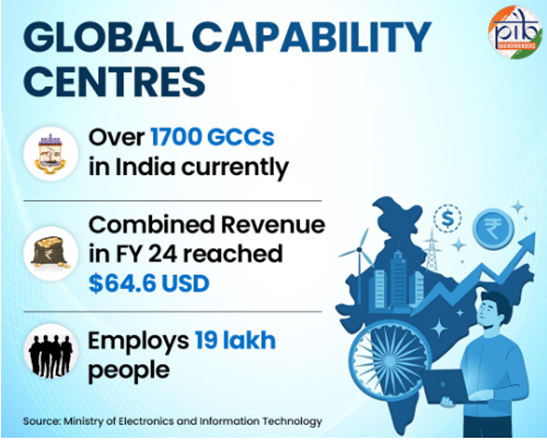
- Scale: India hosts 1,800+ GCCs, accounting for nearly 50% of the world’s total.
- Employment: Employs over 1.9 million professionals directly; supporting a total ecosystem of 10.4 million jobs.
- Specialization: Over 500 GCCs are now exclusively focused on Artificial Intelligence (AI) and Advanced Analytics.
Significance of Global Capability Centers (GCCs) for India
1. Economic Engine
- GDP Contribution: Adds $68 billion to the economy; projected to reach $105 billion by 2030.
- Service Exports: Accounts for ~20% of India’s total service exports, providing a critical cushion against the Current Account Deficit (CAD).
- Direct Investment: Moving from “Foreign Direct Investment” (FDI) to “Human Capital Investment,” where MNCs invest in Indian high-end talent.
2. The ‘Brain-Gain’ Shift
- End-to-End Ownership: Indian GCCs now own global products from ideation to delivery, shedding the “back-office” tag.
- Innovation Hubs: Over 1,800 GCCs nearly 50% of the world’s total. Make India the world’s largest laboratory for Generative AI, Semiconductors, and Cybersecurity.
- IP Creation: Increasing share of global patents being filed from Indian soil by MNC units.
3. Employment & Urbanization
- High-Value Jobs: Employs 1.9 million highly skilled professionals with salaries significantly higher than the IT services average.
- Tier-II/III Expansion: The “Hub-and-Spoke” model is decentralizing growth, creating “Mini-Silicon Valleys” in cities like Ahmedabad, Indore, and Kochi.
- Ecosystem Multiplier: Every 1 job in a GCC creates roughly 3-4 indirect jobs in hospitality, real estate, and transport.
4. Strategic & Diplomatic Leverage
- Tech-Sovereignty: Hosting the core tech of Fortune 500 companies integrates India deeply into the global supply chain, making the world “dependent” on India’s stability.
- Standard Setting: As GCCs build AI models (like BharatGen) on Indian data, India helps set global benchmarks for Responsible AI.
Key Challenges for India’s Global Capability Centers (GCCs)
1. The Talent & Skill Paradox
- Skill Gaps: High volume of engineers but a shortage of “Super-Specialists” in Quantum Computing, Cybersecurity-by-Design, and VLSI Design.
- Wage Inflation: Fierce “Poaching Wars” between GCCs and well-funded Deep-Tech startups are driving up operational costs, threatening the traditional cost-advantage.
- Employability: Only ~45-50% of Indian engineering graduates are considered “industry-ready” for high-end R&D roles without significant retraining.
2. Regulatory & Legal Hurdles
- Data Sovereignty: Navigating the Digital Personal Data Protection (DPDP) Act while maintaining seamless global data flows remains a compliance challenge.
- Tax Litigation: Complexity in Transfer Pricing (how MNCs charge their Indian units) often leads to long-drawn legal battles with tax authorities.
- IP Ownership: Ambiguity in Intellectual Property (IP) laws regarding “Inventions made in India for Global Parents” can deter high-stakes R&D investments.
3. Infrastructure & Concentration Risks
- Tier-I Saturation: Over-reliance on Bengaluru, Hyderabad, and Pune has led to crumbling urban infrastructure, high rentals, and extreme traffic congestion.
- Tier-II Readiness: While “Hub-and-Spoke” is the goal, smaller cities often lack consistent high-speed power, Grade-A office spaces, and international air connectivity.
4. Geopolitical & Macro Risks
- Protectionism: Increasing “Onshoring” sentiments in the US and Europe (e.g., US AI Executive Orders) could pressure MNCs to move critical R&D back to their home countries.
- Cyber Vulnerability: As GCCs become “Nerve Centers,” they become prime targets for State-sponsored cyber-espionage, necessitating massive investments in sovereign cloud security.
Government Initiatives for Global Capability Centers (GCCs)
1. Fiscal & Tax Reforms (The “Ease of Business” Pillar)
- Tax Holiday 2047: Zero tax for foreign firms using Indian Data Centers for AI/Cloud workloads (promotes “Data Residency”).
- Advance Pricing Agreements (APA): Up to 9 years of tax certainty through fast-tracked Advance Pricing Agreements.
2. Infrastructure & Digital Sovereignty
- IndiaAI Mission (GPU-on-Tap): The government is deploying 38,000+ GPUs of compute capacity. This allows GCCs to build Large Language Models (LLMs) like BharatGen using local infrastructure rather than relying on US-based cloud clusters.
- City Economic Regions (CERs): A ₹5,000 crore allocation to develop cities like Patna, Kochi, and Chandigarh into specialized GCC hubs under a “challenge mode,” providing plug-and-play office spaces.
- India Semiconductor Mission (ISM 2.0): An allocation of ₹1,000 crore for FY 2026-27 to support ER&D GCCs in chip design and semiconductor equipment manufacturing.
3. Skill & Talent Development
- FutureSkills Prime (MeitY & NASSCOM): A digital platform that has certified over 1.9 million professionals in “GCC-critical” skills like Cybersecurity, AI Engineering, and Cloud Architecture.
- GENESIS (Gen-Next Support for Innovative Startups): A ₹490 crore scheme to build a “feeder ecosystem,” where local startups act as vendors or innovation partners for larger GCCs.
- YUVAi & AI Tinkerpreneur: Programs launched at the AI Impact Summit 2026 to build a talent pipeline starting from schools, ensuring long-term human capital for the sector.
4. Policy Frameworks
- National GCC Framework: MeitY is formulating a guidance framework for States to create their own GCC Policies (similar to Bihar’s 2026 IT/GCC policy) to attract investments into non-metro regions.
- DPDP Rules 2025: Providing clear “Explanatory Notes” for data processing, giving MNCs the confidence to move global datasets to India for AI training.
Way Forward
1. Human Capital Transformation
- Curriculum Reboot: Shift academic focus from “Service-based coding” to “Product Engineering” and “Systems Thinking” through Industry-Academia partnerships.
- Finishing Schools: Scale FutureSkills Prime to create “Ready-to-Deploy” specialists in niche areas like GenAI, Quantum, and Space-tech.
2. Regional Diversification (Beyond Metros)
- The 100-City Plan: Leverage City Economic Regions (CERs) to move GCCs into Tier-II/III cities. This reduces urban congestion and lowers operational costs by 25-30%.
- Infrastructure Parity: Ensure high-speed 6G/Satellite-link connectivity and 24/7 green power in emerging hubs like Kochi, Indore, and Jaipur.
3. Intellectual Property (IP) & Sovereignty
- “In-India for Global” IP: Incentivize MNCs to file patents in India by streamlining the Indian Patent Office and offering “IP-linked” tax credits.
- Data-Compute Independence: Utilize the IndiaAI Mission’s GPU clusters to ensure GCCs train AI on Indian soil, preventing “Data Colonization.”
4. Regulatory Agility
- Stable Tax Regime: Avoid “Tax Terrorism” by sticking to the 15.5% Safe Harbour margin and fast-tracking Advance Pricing Agreements (APAs).
- Green GCCs: Link future incentives to ESG goals, encouraging GCCs to run on renewable energy and contribute to India’s Net-Zero 2070 target.
Conclusion
The evolution of GCCs from “Cost Centers” to “Global Innovation Engines” is central to India’s $5 Trillion economy goal. By bridging the skill gap and ensuring regulatory stability, India can transition from the world’s “Back Office” to its “Front Office of Innovation,” fulfilling the vision of Viksit Bharat @ 2047.