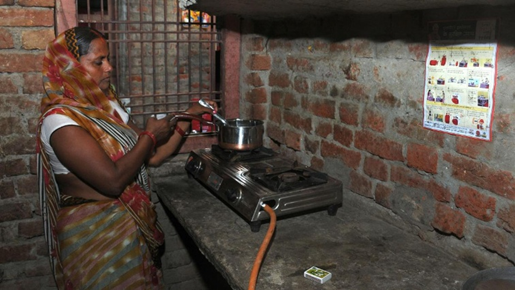
After Reading This Article You Can Solve This UPSC Mains Model Question:
Critically examine how India’s clean cooking push under PMUY has exposed vulnerabilities in energy supply chains amid global disruptions. Suggest a resilient way forward. 15 Marks (GS-3, Economy)
Introduction
- India has expanded clean cooking access to about 33 crore households, mainly through LPG, but a recent crisis caused by the West Asia conflict and disruption in the Strait of Hormuz has exposed high import dependence and weak storage capacity.
- It is now being revealed that the transition, meant for women empowerment and welfare, is built on fragile global markets instead of secure, state-managed supply systems.
Background: From Kerosene to LPG
1. Kerosene Era – State‑Controlled Welfare
- For decades, kerosene was the main cooking fuel for millions, supplied through the Public Distribution System (PDS) using ration cards.
- The state maintained physical stocks in local depots, managed the entire supply chain, and insulated households from international price shocks.
- However, burning kerosene and biomass caused severe indoor air pollution, contributing to respiratory diseases and premature deaths, especially among women and children.
2. Shift to LPG – Modern Energy Upgrade
- Since 2016, the government launched a major push to replace kerosene with LPG, especially under Pradhan Mantri Ujjwala Yojana (PMUY).
- By 2024, 13 States and Union Territories were declared “kerosene‑free”, marking a major shift in energy policy.
- LPG offers much higher calorific value than kerosene, leading to faster, cleaner, and more efficient cooking and reduced time burden on women.
3. Changing Role of the State
- Earlier, the state directly controlled the fuel (kerosene).
- Now, with LPG, the state’s role has shifted from direct control of stocks to subsidy management and market regulation.
- This has withdrawn the state’s physical responsibility for maintaining large reserves, leaving households exposed to global price and supply shocks.
Current LPG Crisis in India: Rising Imports, Supply Disruptions, and Storage Shortfalls
1. Rising Import Dependence
- India’s LPG consumption has surged to about 31–33 million tonnes per year (FY‑25 and FY‑26 projections).
- Imports now meet about 60–65% of domestic demand (up from 47% in 2015), meaning more than half of India’s LPG is imported.
- In 2024–25 alone, imports reached roughly 20 million tonnes, a threefold increase over the last decade.
2. Reliance on West Asia and Hormuz
- About 90% of India’s LPG imports come from West Asia, mainly from the UAE, Qatar, Saudi Arabia, and Kuwait.
- Over 85–90% of these imports pass through the Strait of Hormuz, a narrow, conflict‑prone waterway.
- When war and blockades in West Asia disrupt shipping, nearly half of India’s LPG supply chain is directly affected.
3. Storage Gap and Strategic Imbalance
- Monthly LPG consumption in India is about 3 million tonnes (roughly 80,000 tonnes per day).
- Total existing underground storage capacity (Mangaluru + Visakhapatnam) is only about 1.4 lakh tonnes, which is less than two days of national consumption.
- In contrast, India’s strategic crude oil reserves cover about 60 days of consumption, highlighting a strategic imbalance in energy security planning.
4. Short‑Term Impact of the Crisis
- Preliminary data for March 2026 shows LPG consumption fell by around 17–18% in the first half of the month due to supply disruptions.
- The government has been forced to prioritize household supplies and cut allocations to commercial and industrial users (hotels, restaurants, industries) to protect PMUY households.
Understanding LPG, LNG, and PNG
1. Liquefied Petroleum Gas (LPG) – Cooking Gas for Households
- Chemical composition: A mixture of propane and butane.
- State and storage: Liquefied under moderate pressure at ambient temperature, stored in steel cylinders; easy to transport and ideal for rural and remote areas.
- Source: By‑product of natural gas processing and oil refining.
- Logistics in India: 60–65% imported via sea tankers, then moved by rail and road to dealers.
- Key use: Main fuel for household cooking under PMUY.
2. Liquefied Natural Gas (LNG) – Bulk Transport for Power and Industry
- Chemical composition: Mostly methane (CH₄) with small amounts of ethane, propane, and butane.
- State and storage: Natural gas cooled to –162°C (cryogenic state), shrinking its volume by about 600 times, enabling long‑distance sea transport.
- Logistics: Requires specialized cryogenic tankers and regasification terminals (e.g., Dahej, Kochi, Mundra) to convert LNG back to gas for pipelines.
- Key use:
- Feedstock for fertilizer plants.
- Power generation and heavy‑duty transport (ships, trucks) as a “bridge fuel” toward cleaner energy.
3. Piped Natural Gas (PNG) – Piped Gas for Cities
- Chemical composition: Like LNG, mainly methane (CH₄).
- State and distribution: Delivered in gaseous form through City Gas Distribution (CGD) pipelines at low pressure (<1 bar) for safety.
- Logistics: Needs dense pipeline network, so it is mainly urban and peri‑urban.
- Key use: Uninterrupted household cooking and Small‑scale industrial heating.
Significance of Clean Cooking Welfare
1. Scale and Reach
- Total domestic LPG connections have risen to around 33 crore, more than doubling coverage in a decade.
- PMUY alone has provided over 10.33 crore connections to women from Below Poverty Line (BPL) and economically weaker sections.
- This has made India the second‑largest LPG consumer globally, after the USA.
2. Health and Time‑Saving Benefits
- Studies (e.g., by the International Institute for Sustainable Development – IISD) show that households switching from biomass (wood, dung) to LPG save about 1 hour per day in fuel‑collection and cooking time.
- LPG use reduces exposure to indoor air pollution, which is linked to respiratory diseases, eye problems, and low‑birth‑weight babies.
- Evidence from panel‑data studies suggests significant health improvements for women, who spend more time indoors.
3. Social and Governance Significance
- The scheme is branded as a visible state welfare programme: cylinders carry government logos, and subsidies are paid as Direct Benefit Transfer (DBT) to bank accounts.
- This has increased women’s agency in household energy decisions and reduced dependence on polluting fuels.
Government Schemes for Clean Cooking and Gas‑Based Energy
1. Pradhan Mantri Ujjwala Yojana (PMUY)
- Launched in 2016 to provide free LPG connections to BPL women.
- Milestones:
- Over 10 crore connections by 2022.
- Total PMUY connections now exceed 10.33 crore under PMUY 1.0, 2.0, and 3.0.
- Support: Cash assistance for cylinder, regulator, and safety equipment; subsidies for refills (around ₹300 per refill under certain schemes).
2. GOBARdhan Scheme
- Full name: Galvanising Organic Bio‑Agro Resources Dhan.
- Objective: Convert cattle dung and organic waste into biogas and compost, reducing dependence on LPG and improving rural sanitation.
- Broad idea: Each biogas plant can serve 5–10 households, especially in village clusters.
- However, many earlier biogas plants remain dormant due to poor maintenance and lack of technical support.
3. Strategic Petroleum Reserves (SPR)
- India has strategic storage for crude oil (about 60 days of consumption) to act as a buffer against global oil shocks.
- There is no equivalent large‑scale strategic LPG reserve, although underground caverns at Mangaluru and Visakhapatnam hold only 1.4 lakh tonnes – less than two days of supply.
Key Challenges and Structural Gaps in India’s LPG‑Based Welfare System
1. Economic Barriers to Refills
- Although initial connections are free or highly subsidized, refill prices often exceed ₹800–₹1,000 in many markets.
- One in four PMUY beneficiaries reportedly cannot afford even a single refill during normal times, leading to “connection without usage”.
- Refill subsidies are inadequate for many poor households, especially in rural and remote areas.
2. Logistical and Supply‑Chain Gaps
- Rural areas often face mandatory booking gaps of 45 days or more, even before the crisis.
- With supply tightening, waiting time increases and cylinders may be diverted away from poorer areas.
- The lack of pipeline infrastructure (PNG) in villages means cylinders are the only option, which depend on road and rail logistics.
3. Social Inequities and Access Issues
- Studies and field reports indicate that caste and social hierarchies influence gas‑distribution networks at the village level.
- Scheduled Caste and Tribal households often report lower priority in cylinder allocation and difficulty in booking refills.
- Women, though nominal beneficiaries, have little control over pricing, booking, and delivery, which remain in the hands of dealers and intermediaries.
4. Gendered Burden Returns in Crisis
- When LPG becomes scarce or unaffordable, women are forced back to biomass (firewood, dung cakes).
- This increases time burden, health risks, and physical strain, reversing gains made through PMUY.
- The energy‑transition remains incomplete for many households, especially in drought‑prone and remote forested regions.
5. Misalignment Between Policy Goals and Infrastructure
- The policy goal is universal clean cooking access, but physical infrastructure (storage, pipelines, alternative fuels) has not kept pace with the expansion of connections.
- The state has treated LPG mainly as a “connection‑centric subsidy programme” rather than a comprehensive energy‑security system, so strategic storage, diversified routes, and local alternatives were not prioritized.
- This mismatch creates a “welfare‑without‑security” trap: the state can distribute cylinder connections widely, but cannot guarantee a continuous, affordable physical supply during global crises, leaving the most vulnerable back to the smoke of biomass stoves.
Way Forward: Building Redundancy and Resilience
1. Expand Strategic Storage for LPG
- India needs a minimum strategic LPG buffer covering 45–60 days of consumption, similar to crude oil reserves.
- Underground storage options include:
- Salt caverns in Rajasthan (Bikaner‑Barmer region) – naturally impermeable, low cost, and suitable for rapid withdrawal.
- Rock‑cavern projects in stable granite/gneiss formations of the Peninsular Shield.
- Depleted gas fields in the KG Basin and Cambay could be repurposed for large‑scale gas storage.
2. Diversify Supply Sources and Routes
- Current dependence on West Asia is risky. New and expanded long‑term contracts with the USA, Australia, and Africa (e.g., Angola) can reduce over‑concentration.
- A statutory minimum of LPG imports should be routed through alternative sea lanes and non‑Hormuz paths (e.g., via the western coast of India and longer routes).
- Transit‑time buffer: Supplies from the USA take about 45 days, compared to shorter routes from the Gulf, so strong storage buffers are essential.
3. Adopt Global Best Practices
- The European Union requires member countries to maintain at least 90% filling of gas storage before winter and high‑demand seasons.
- India can adopt a similar rule for LPG storage before winter and festival seasons (Diwali, weddings, etc.), when demand spikes.
- Transparent norms for prioritizing households, hospitals, and essential services during crises should be publicly notified.
4. Revive and Scale Alternative Fuels
- Biogas through GOBARdhan should be revived and expanded:
- Proposals suggest a ₹10,000 revival subsidy per unit to repair and reactivate around 50 lakh dormant biogas plants.
- This can provide local, decentralized cooking fuel and reduce pressure on LPG cylinders.
- Promote improved biomass stoves (smokeless or low‑emission) in areas where LPG is not yet reliable, to minimize health damage.
5. Accelerate PNG and City‑Gas Infrastructure
- Piped Natural Gas (PNG) in urban and semi‑urban areas can steady supply and eliminate cylinder‑delivery problems.
- The Petroleum and Natural Gas Regulatory Board (PNGRB) can fast‑track new CGD networks and expand coverage to 100+ cities by 2027.
- Closed‑loop digital systems can track refill demand and route PNG to high‑density areas, reducing dependence on LPG cylinders.
6. Strengthen Crisis Protocols and Governance
- The government must publish clear triage rules for fuel allocation during emergencies:
- Priority: Households, especially women‑headed, SC/ST, and rural homes.
- Second priority: Hospitals, schools, and essential services.
- Lower priority: Large commercial users and export‑oriented industries.
- A real‑time monitoring system (dashboard at state and district level) can track connections, refills, and gaps to prevent misuse and ensure equitable distribution.
Conclusion
India’s LPG‑driven clean‑cooking welfare has expanded access to millions but remains vulnerable due to heavy dependence on global markets, weak strategic storage, and gaps in last‑mile delivery and affordability. To make this welfare durable, the state must build supply security—through diversified imports, large‑scale storage, stronger PNG networks, and revived local alternatives—so that global crises do not push the poorest back to the smoke of biomass stoves.