After Reading This Article You Can Solve This UPSC Mains Model Question:
India’s clean energy transition has transformed critical minerals into strategic assets. Discuss how targeted bilateral partnerships can enhance India’s mineral security. Examine the challenges in translating these partnerships into long-term value-chain resilience. (250 words) (GS-3 Economy)
Context:
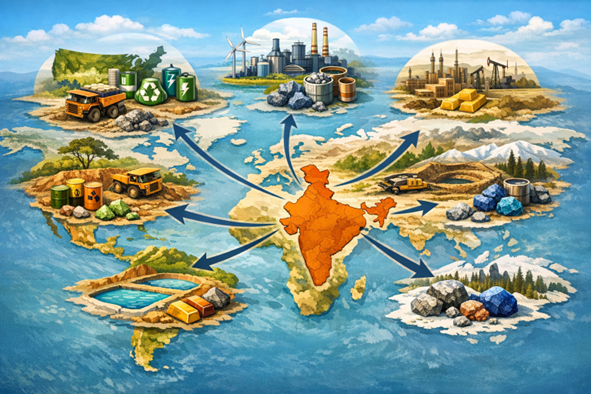
In the wake of China’s recent export restrictions on rare earth magnets and the U.S.-hosted G7 Critical Minerals Ministerial Meeting, India has shifted from a passive consumer to a proactive diplomatic actor. The core objective is to secure the 30 minerals identified as “critical” to power India’s 500 GW renewable energy target and the $10 billion semiconductor mission.
Multilateral Strategic Alliances – Background
- G7 and the “Pax Silica”: India was invited as a strategic partner to the G7 meet in Washington (2026). Discussions focused on the Pax Silica initiative—an exclusive grouping aiming to create a “China-free” supply chain for semiconductors and high-tech minerals.
- Minerals Security Partnership (MSP): India’s 2023 entry into this 14-nation bloc has matured. It now focuses on joint co-investment in refining and processing, moving beyond mere extraction.
- The Quad Factor: The Quad’s Critical Minerals Initiative (2025) leverages Australian mining, Japanese technology, and Indian manufacturing.
Key Bilateral Partnerships
A. Latin America-The “Resource Hub”: Focuses on the Lithium Triangle (Argentina, Chile, Bolivia) to secure battery-grade minerals.
- Argentina: The “flagship” partner. KABIL is currently operational in the Catamarca province, exploring 15,000 hectares across five brine blocks.
- Chile: Primarily a copper partner, but negotiations are ongoing to allow Indian PSUs to bid for lithium blocks under a “Preferred Strategic Partner” status.
- Key Challenge: Social and environmental resistance in the Andes regarding water-intensive extraction.
B. Australia & Oceania-The “Strategic Anchor”: Australia is India’s most mature bilateral mineral partner, providing a stable alternative to the South China Sea routes.
- Co-Investment Model: India and Australia have moved from MoUs to joint project funding. They have identified five target projects (2 Lithium, 3 Cobalt) where India provides capital, and Australia provides the extraction expertise.
- Trade Benefits: Under the ECTA (Economic Cooperation and Trade Agreement), customs duties on critical minerals have been eliminated, making Australian ore significantly cheaper for Indian refiners.
C. Africa-The “Frontier of Cooperation”: India’s approach in Africa is “collaborative, not extractive,” emphasizing local value addition.
- Zambia & Namibia: Zambia for Cobalt and Copper and Namibia for lithium, rare earths and uranium. India has committed to setting up local processing plants in these nations to generate local employment—a direct “soft-power” counter to China’s “resource-for-infrastructure” model.
- Trilateral Cooperation: India-Australia-Africa trilateral talks, where Australian mining firms and Indian processors jointly invest in African mines to share risk.
D. Central Asia: The “Rare Earth Corridor”: Rich in Rare Earth Elements (REEs) and Uranium, this region is vital for India’s high-tech and nuclear sectors.
- Kazakhstan & Uzbekistan: Through the India-Central Asia Rare Earth Forum, India is pursuing joint exploration for 17 heavy rare earth elements.
- Logistics hurdle: Heavy reliance on the INSTC (International North-South Transport Corridor) and Chabahar Port to bypass land-locked transit issues.
E. European Union (EU)- The “Green Tech & Standards” Partner: The India-EU partnership has transitioned from theoretical discussions to a “standards-driven” alliance. The focus here is on the mid-stream (refining) and down-stream (recycling) segments.
- Critical Raw Materials Act (CRMA) Convergence: The EU’s CRMA (2026) has identified India as a primary partner for de-risking supply chains.
- The “Germany First” Momentum: German Chancellor Friedrich Merz’s visit (2026) resulted in a binding MoU on Critical Minerals. Germany provides the green refining technology required to process ores without high environmental costs—a key hurdle for Indian mining.
- Joint Implementation Committee: A new body was formed (2026) to oversee the recycling of rare earths. This “Urban Mining” initiative aims to recover lithium and cobalt from spent batteries using European circular economy models.




F. Japan-The “Resilient Technology” Anchor: Japan is India’s most mature partner in this sector, driven by a shared history of Chinese export shocks.
- Rare Earth Magnet Production: Japan’s Ministry of Economy, Trade and Industry (METI) and India’s Indian Rare Earths Limited (IREL) are currently setting up a joint facility in Odisha for producing neodymium-iron-boron (NdFeB) magnets. These are critical for India’s domestic EV motor manufacturing.
- Pax Silica & Semiconductors: India was formally invited into the Pax Silica initiative in 2026, a U.S.-Japan led group. This ensures India gets priority access to the high-purity minerals required for the India Semiconductor Mission.
- Investment Pipeline: Japan has committed a portion of its 5 trillion-yen investment target (2022-2027) specifically for “Mineral Security” projects in India’s eastern corridor.
G. West Asia (GCC)-The “Capital & Corridor” Powerhouse: The Gulf countries, particularly Saudi Arabia and the UAE, are shifting from being “Oil Giants” to “Mineral Investors.”
- Future Minerals Forum (2026): At this summit, India and Saudi Arabia discussed a $100 billion investment framework, a large portion of which is earmarked for joint mining ventures in Africa and Central Asia.
- IMEC Integration: The India-Middle East-Europe Economic Corridor (IMEC) is being reimagined as a “Mineral Silk Road.”The goal is to transport African ores to Indian ports for refining and then ship processed materials to European markets through the Middle East.
- UAE’s CEPA Advantage: Under the Comprehensive Economic Partnership Agreement, UAE-based sovereign wealth funds are now investing in Indian “Critical Mineral Startups” focused on lithium-ion battery alternatives (like Sodium-ion).
H. Canada- Target Minerals & “Market-Plus” Partnership: India and Canada have 23 common critical minerals on their priority lists.
- The Big Four: Cooperation is currently centered on Lithium, Nickel, Copper, and Rare Earth Elements (REEs).
- Uranium Security: Canada, already a top uranium supplier to India, is expanding its supply agreements to support India’s Small Modular Reactor (SMR) ambitions.
- “Market-Plus” Model: The strategy is to combine Canadian upstream production (extraction) with Indian midstream processing and high-scale manufacturing.
Institutional Vehicles in India’s Minerals Diplomacy
A. Khanij Bidesh India Ltd. (KABIL): The flagship “Special Purpose Vehicle” (SPV) is formed to secure minerals overseas.
- Composition: A Joint Venture of NALCO (40%), Hindustan Copper (30%), and MECL (30%).
- Operational Pivot: KABIL has shifted from “exploration-only” to “Equity & Off-take” models.
- In Argentina: It now holds exclusivity rights for five lithium blocks in Catamarca. KABIL has signed a exploration and development agreement with Argentina.
- In Australia: It is conducting joint due diligence with the Australian Critical Minerals Office (CMO) for long-term project investments.
- Expansion: KABIL signed a non-exclusive MoU with Oil India Limited (OIL) and ONGC Videsh to leverage their global deep-sea and cross-border exploration expertise.
B. National Critical Mineral Mission (NCMM): The Cabinet recently approved a ₹1,500 crore incentive scheme under NCMM specifically to boost Critical Mineral Recycling (Urban Mining) to reduce import dependency by 15% by 2030.
- Dual Focus:
- Domestic: Streamlining the auction of 24 strategic minerals (like Lithium, Graphite, and Potash).
- Global: Setting a target to acquire 50 overseas mineral assets by 2031.
C. IREL (India) Limited: Formerly Indian Rare Earths Limited, this body handles the most sensitive part of the mineral chain.
- Odisha Hub: The OSCOM (Odisha Sand Complex) is now the focal point for rare-earth extraction from monazite sands.
- Strategic Magnet Plant: In collaboration with Japan, IREL is scaling up the Rare Earth Permanent Magnet (REPM) plant in Visakhapatnam. This is vital for the “Make in India” EV motor supply chain.
D. Financial & Regulatory Enablers
- MMDR Act Amendments (2025): The law now allows the National Mineral Exploration Trust (NMET) to fund KABIL’s overseas acquisitions—a significant shift in using domestic exploration funds for global security.
- MSP Finance Network: India formally connected its financial institutions (like EXIM Bank) to the Minerals Security Partnership (MSP) finance network, allowing Indian firms to co-finance projects alongside G7 nations.
Key Challenges in India’s Minerals Diplomacy
1. Strategic & Geopolitical Challenges
- The “Midstream” Monopoly: While countries like Australia and Chile mine the ore, China still controls close to 90% of the global processing capacity for lithium, cobalt, and rare earths. India faces the risk of “locked-in dependence” where it might buy raw ore from partners but still rely on China for refining it into battery-grade material.
- Weaponization of Supply: China transitioned silver exports to a license-based system and maintained strict curbs on rare-earth magnets. Such “Resource Weaponization” creates price volatility and supply shocks that threaten India’s EV and semiconductor timelines.
- The “Club” Dilemma: Within “Critical Mineral Clubs” (like the MSP), there is a fear that developed nations may limit Technology Transfer. India risks being relegated to the “lower-value” ends of the chain (mining and transport) while the West retains high-value refining and IP.
2. Domestic & Structural Bottlenecks
- Underdeveloped Refining Ecosystem: India lacks advanced metallurgical facilities. For instance, the lithium discovered in Reasi (J&K) is in a complex clay form; India currently lacks the cost-effective domestic technology to extract it, making the “discovery” hard to monetize.
- Tepid Private Participation: Despite policy shifts, private sector interest in mineral auctions remains low. Only about 48% of auctioned blocks attracted serious bidders due to high capital risks and a lack of detailed “pre-exploration” data from the government.
- ESG and Social Friction: Many of India’s critical mineral reserves are located in ecologically sensitive or tribal-dominated regions. Meeting global Environmental, Social, and Governance (ESG) standards while avoiding local displacement conflicts remains a major hurdle for fast-tracking projects.
3. Economic & Technical Gaps
- Price Volatility: Global lithium and cobalt prices have seen swings of over 400% in the last three years. Such fluctuations deter long-term private investment and complicate the budgeting for India’s PLI (Production Linked Incentive) schemes.
- Human Capital Deficit: India has significantly fewer specialized geologists and metallurgists per million population compared to mining leaders like Australia (20 vs 140+). This “skill gap” slows down deep-seated mineral exploration.
Way Forward for India’s Minerals Diplomacy
1. Building a Strategic Mineral Reserve (SMR): Like India’s Strategic Petroleum Reserves, the government is moving toward a National Mineral Stockpile.
- Buffer Mechanism: Create a physical stockpile of minerals like Lithium, Cobalt, and Neodymium to insulate domestic industries from the type of 400% price swings seen in 2024–25.
- Market-Maker Role: The state can act as a “market-maker,” buying minerals during global gluts and releasing them during shortages to maintain price stability for EV manufacturers.
2. Accelerating “Urban Mining” & Circular Economy”: The ₹1,500 crore Recycling Incentive Scheme (launched late 2025) is the cornerstone of this pillar.
- Target: Achieve a 20% recovery rate of critical minerals from e-waste and spent batteries by 2030.
- Incentives: Provide 20% Capex subsidies to recyclers who achieve 99% purity in extracted minerals, turning India’s growing “battery graveyards” into domestic mines.
3. Scaling Domestic Processing Parks: Mining alone does not create prosperity; refining does.
- Critical Mineral Processing Parks: Establish dedicated hubs (modeled on the Pharma Cities) in coastal states like Odisha and Gujarat to leverage cheap logistics and green energy for high-heat smelting.
- Assured Offtake: Link these parks with the PLI (Production Linked Incentive) Schemes for Advanced Chemistry Cells (ACC), ensuring that refined minerals have a guaranteed domestic buyer.
4. “Mineral-Linked” Foreign Policy: India’s diplomats must now be trained in “resource realism.”
- Mineral Diplomacy Division: Permanent establishment of a specialized cell in the MEA to coordinate with KABIL and the Ministry of Mines.
- Equity-for-Infrastructure: Offer India’s “Digital Public Infrastructure” (UPI, ONDC) or space-launch services to mineral-rich African and Latin American nations in exchange for equity stakes in their mines.
5. R&D and “Deep-Seated” Exploration
- Centre of Excellence (CoE): The National Critical Mineral Mission (NCMM) has mandated the creation of 7 CoEs to focus on “clay-lithium” extraction and sodium-ion battery alternatives to reduce the lithium burden.
- Incentivizing Private Explorers: Introduce “tradable exploration licenses” (like Australia and Canada) to allow junior mining firms to raise capital on stock exchanges, bringing risk-taking private players into the field.
6. Expand but Prioritize Partnerships:
- While additional partners like South Korea and Indonesia offer potential, India must first solidify its existing partnerships and ensure they deliver tangible outcomes.
Conclusion
India’s mineral diplomacy is no longer just a trade policy; it is a national security imperative. To achieve the vision of Viksit Bharat @2047, India must balance its engagement with the Global North (for technology) and the Global South (for resources), ensuring that it evolves from a mineral importer to a global processing hub.