After Reading This Article You Can Solve This UPSC Mains PYQ:
The question of India’s Energy Security constitutes the most important part of India’s economic progress. Analyze India’s energy policy cooperation with West Asian Countries. 15 Marks (GS- 2, International Relations)
Introduction
West Asia (Middle East) is one of the most strategically important regions for India’s foreign policy due to its significance for energy security, trade, diaspora, and geopolitical stability. India considers West Asia as its “extended neighbourhood” and has gradually shifted from a passive diplomatic approach to active strategic engagement in the region.
About West Asia
West Asia refers to the region located between Europe, Africa, and South Asia, often overlapping with what is called the Middle East. It includes countries of the Arab world, Israel, Iran, and Turkey.
Key Elements of India’s West Asia Policy
1. The “De-Hyphenation” Strategy
India has successfully separated its bilateral ties with traditional rivals. It maintains a “Special Strategic Partnership” with Israel (focusing on defense and high-tech) while simultaneously engaging with the Iranian Interim Leadership Council for strategic connectivity. This allows India to pursue national interests without being forced to choose sides in regional sectarian or political conflicts.
2. Energy Security 2.0: Transition & Buffering
While the Gulf still provides ~55% of India’s crude, the agenda has shifted toward:
- Strategic Reserves: Speeding up the expansion of Strategic Petroleum Reserves (SPR) to create a 90-day supply buffer against shocks like the current Strait of Hormuz instability.
- Green Energy: Investing in Green Hydrogen and solar projects with the UAE and Saudi Arabia to ensure long-term energy synergy beyond fossil fuels.
3. “Net Security Provider” in Maritime Lanes
With the 2026 conflict threatening the Strait of Hormuz and the Red Sea, India has institutionalized Operation Sankalp. The Indian Navy now acts as a stabilizer, providing permanent maritime escorts for merchant vessels to protect trade routes and counter piracy or kinetic threats from non-state actors.
4. Connectivity: The “Two-Gateway” Approach
India is aggressively pursuing two distinct corridors to reduce dependency on traditional routes:
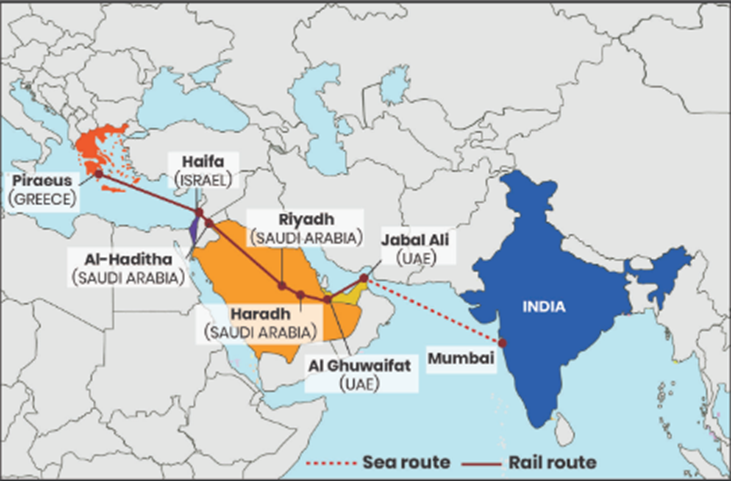
- IMEC (India-Middle East-Europe Economic Corridor): Using the Gulf (UAE/Saudi) and Israel as a bridge to Europe.
- INSTC & Chabahar: Developing Iran’s Chabahar Port as a vital gateway to Central Asia and Russia, ensuring India’s land-link despite the blockade of overland routes through Pakistan.
5. Diaspora Welfare & “Remittance Diplomacy”
Protecting the 9 million+ Indians in the Gulf is a top-tier security priority. The agenda includes:
- Crisis Response: Maintaining active evacuation protocols (like the 2026 Ministerial Committee led by the Home Minister).
- Economic Protection: Signing Migration and Mobility Partnerships to ensure job security and social protection for Indian workers during regional economic shifts.
6. Multilateralism & “Minilateralism”
India leverages new, flexible groupings to embed itself into the regional architecture:
- I2U2 (India, Israel, UAE, USA): Focusing on joint projects in food security, water, and space.
- BRICS+ Engagement: Utilizing the inclusion of Saudi Arabia, Iran, and the UAE into BRICS to coordinate on global financial architectures and “Rupee-Trade” settlements.
Advantages of India’s West Asia Policy
1. Energy Resilience & Price Stability
By cultivating deep ties with major producers like Saudi Arabia and the UAE, India secures preferential energy access. These partnerships also facilitate the development of Strategic Petroleum Reserves (SPR) within India, funded partly by Gulf investments.
2. Strategic “Bridging” Capability
India is one of the very few nations that can talk to Israel, Iran, and the Arab states simultaneously. This “strategic autonomy” allows India to:
- Act as a neutral mediator in regional crises.
- Protect its interests without being dragged into sectarian conflicts.
- Maintain defense ties with Israel while securing connectivity via Iran’s Chabahar Port.
3. Economic Windfall: Remittances & Investment
- Remittances: The 9 million-strong diaspora sends back over $120 billion annually (2025-26 estimates), providing a massive cushion for India’s Current Account Deficit (CAD).
- Sovereign Wealth Funds: India has become a primary destination for massive investments from the UAE’s ADIA and Saudi Arabia’s PIF in infrastructure, green energy, and digital startups.
4. Countering China’s “String of Pearls”
A proactive West Asia policy prevents the region from becoming a Chinese lake. By leading initiatives like the IMEC (India-Middle East-Europe Economic Corridor), India offers a transparent, debt-free alternative to China’s Belt and Road Initiative (BRI), ensuring the western flank of the Indian Ocean remains open and balanced.
5. Enhanced Maritime Security
Through Operation Sankalp and joint naval drills, India has gained “docking rights” and logistical access in places like Duqm (Oman). This extends the Indian Navy’s reach, allowing it to protect vital sea lanes of communication (SLOCs) from piracy and drone threats in the North Arabian Sea.
6. Food and Tech Security (Minilateralism)
Through the I2U2 Group, India leverages:
- Israeli Technology: For arid-land farming and water recycling.
- UAE Capital: To build “Food Parks” in India.
- Result: This ensures a steady food supply chain for the Middle East while boosting Indian farmers’ income and technological prowess.
Challenges of India’s West Asia Policy
1. The “Chokepoint” Paralysis: Over 40-50% of India’s crude oil and nearly 90% of its LPG imports pass through the Strait of Hormuz. With the current naval blockade and Iranian threats to close the waterway, India faces an existential energy threat.
2. Connectivity Under Fire (IMEC vs. Reality): The India-Middle East-Europe Economic Corridor (IMEC) is currently inoperable due to active conflict in Israel and the UAE. Failure of IMEC forces reliance on the Suez Canal (Houthi threat) or the costly Cape of Good Hope route.
3. The Diaspora Dilemma
With nearly 10 million Indians living in the Gulf, any major regional war is a logistical nightmare.
- Evacuation: While over 52,000 Indians were evacuated in early March, a total regional war would require a rescue operation exceeding the scale of Operation Rahat.
- Economic Shock: A decline in production in the Gulf directly hits the $120 billion+ annual remittance flow, threatening India’s foreign exchange stability.
4. Imported Inflation and Fiscal Strain: The spike in Brent crude (hitting $100-$120/barrel) is driving “cost-push inflation” in India.
- Fertilizer Crisis: India imports 40% of its Urea and NPK inputs from the Gulf. Disruptions are currently inflating the government’s subsidy burden and threatening domestic food security.
- Currency Pressure: Increased import bills are putting the Rupee under depreciation pressure (forecasted to hit ₹92-95/$ if tensions persist).
5. China’s “Mediation” Diplomacy: China is increasingly positioning itself as the regional “peacebroker” (e.g., the Saudi-Iran deal). As Beijing expands its Belt and Road Initiative (BRI) into Gulf ports like Gwadar and Jebel Ali.
6. De-hyphenation Stress: Balancing a defense pact with Israel while engaging Iran’s Interim Council (for Chabahar) is increasingly difficult. India faces rising domestic criticism and friction with the US-led axis over its strategic autonomy.
Way Forward
1. Strengthening Strategic Petroleum Reserves (SPR): India must accelerate the Phase II expansion of its SPR (Strategic Petroleum Reserves) to build a 90-day buffer. Inviting investments from Saudi Aramco and UAE’s ADNOC into these reserves will tie their commercial interests to India’s energy security, ensuring supply even during regional volatility.
2. Operationalizing the “Trans-Continental” Backup: Given the current paralysis of IMEC, India should prioritize the International North-South Transport Corridor (INSTC) via Chabahar Port. Strengthening this “middle corridor” provides a vital hedge against chokepoints in the Red Sea and ensures uninterrupted trade with Russia and Central Asia.
3. Institutionalizing “Rupee-Trade” Hubs: To counter currency pressure (₹92-95/$) and potential sanctions, India must institutionalize Local Currency Settlement (LCS) systems.
4. Transitioning to Energy 2.0 (Green Hydrogen): India should pivot from being a “buyer” of oil to a “partner” in Green Hydrogen. By co-developing renewable energy infrastructure in the Gulf, India can leverage West Asia’s low-cost solar energy to meet its “Net-Zero” goals while reducing the fiscal strain of fossil fuel imports.
5. Multi-Lateral “Security Architecture”: Utilizing the I2U2 and BRICS+ platforms, India can advocate for a “Code of Conduct” in the North Arabian Sea, positioning itself as a net security provider and a stabilizing force between the US-Israel axis and Iran.
Conclusion
India must transition from a “buyer-seller” to a “strategic stakeholder,” leveraging IMEC and Green Hydrogen to anchor its extended neighborhood, ensuring regional stability while securing long-term energy and maritime sovereignty.