Context: In recent years, India’s federal architecture has witnessed a shift in dynamics: from a model of centre-dominated patronage to one of vibrant inter-state competition. This transformation is rooted in states actively courting investment, refining governance, and aligning themselves with global supply-chains.
- Why Inter-State Rivalry Matters for India’s Growth
1. From Licence-Raj to Leadership
- Historically, Indian states largely queued for central transfers, licences and regulatory clearances. However, in the current era, states are pitching to CEOs rather than ministers — signalling a shift from dependence to self-assertion.
- The competition between Andhra Pradesh, Tamil Nadu, and Karnataka to host major technology data-centres demonstrates how governance rather than patronage is becoming the key differentiator.
2. Strengthening National Supply-Chains via State Successes
- Each state winning a large investment not only boosts that state’s economy but also enhances the national ecosystem — through skills, backward-linkages, logistics and exports.
- The competition between Andhra Pradesh, Tamil Nadu, and Karnataka to host major technology data-centres demonstrates how governance rather than patronage is becoming the key differentiator.
3. Institutionalising Competitive Federalism
- States no longer rely solely on centre-led schemes; instead, they showcase their governance credentials, data-driven policies and quick clearances.
- This competition prompts states to benchmark themselves — leading to higher standards of ease of doing business, labour reforms, industrial parks and digital services.
4. Globalisation and Multi-Destination Strategy
- As global firms seek to diversify beyond China, they are looking at India not as one entity but as a federation of regions. They evaluate states for talent, land, logistics, regulation. This turns inter-state competition into a global “differentiator” for India.
- Thus, the rivalry reinforces India’s global competitiveness.
5. Strengthening India’s Global Economic Positioning
- As global firms de-risk and diversify beyond traditional hubs, they view India not just as one entity but as a “federation of opportunities”.
- This positioning improves India’s attractiveness as a multi-destination manufacturing and services hub, thereby boosting foreign investment and export-oriented growth.
6. Encourages Peer Learning and Best-Practice Diffusion
Success in one state becomes a template for others.
Examples:
- Delhi’s Mohalla Clinics were studied by Punjab, Tamil Nadu, and Telangana.
- Kerala’s digital governance model has influenced Himachal Pradesh and Goa
7. Strengthens Infrastructure and Logistics Networks
To attract industries, states invest in ports, highways, power networks, and industrial corridors.
Examples:
- Andhra Pradesh’s port-led development model encouraged Odisha and Tamil Nadu to upgrade their coastal infrastructure.
- UP’s expressway boom has compelled Rajasthan and MP to build competing industrial corridors.
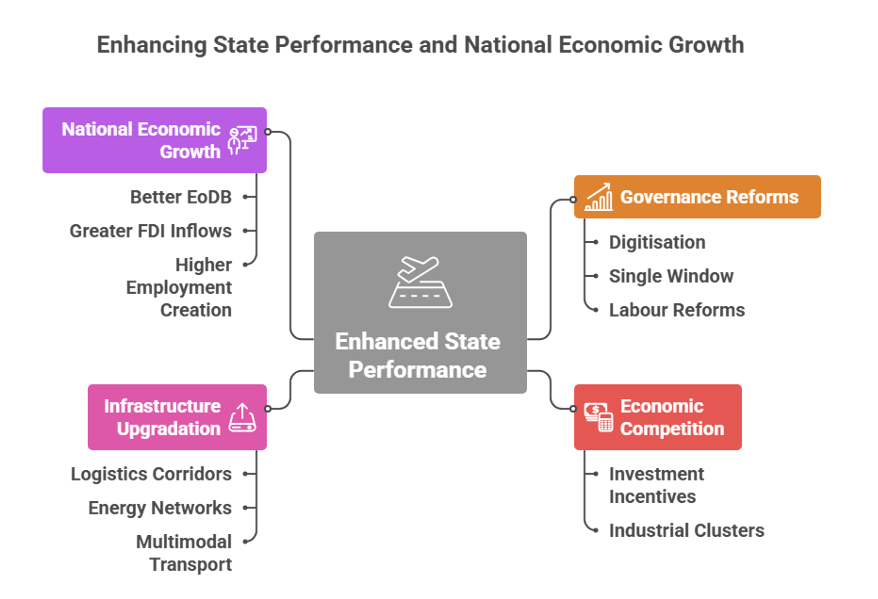
- Mechanisms / Drivers of Inter-State Rivalry
1. Policy Innovation & State-Level Industrial Incentives
States increasingly compete by designing flexible, investor-friendly policy frameworks.
Examples:
- Gujarat’s Semiconductor Policy (2022–25) prompted Maharashtra, Telangana, and Uttar Pradesh to revise semiconductor and electronics policies to match incentive levels.
2. Digital Governance & Single-Window Systems
Rivalry has encouraged states to digitise approval systems and improve transparency.
Examples:
- Karnataka’s E-Udyami single-window system pushed states like Haryana and Rajasthan to enhance their own digital clearance platforms.
3. Investment Promotion & Global Outreach
Chief Ministers now engage directly with global investors, competing aggressively for FDI.
Examples:
- Gujarat, Maharashtra, Karnataka, and Tamil Nadu conducted major roadshows in Japan, South Korea, UAE, and the U.S. to attract manufacturing investments.
4. Infrastructure Readiness & Logistics Expansion
States compete by offering superior logistics, industrial corridors and energy availability.
Examples:
- Odisha’s port modernisation (Paradeep, Dhamra) triggered upgrades in neighbouring Andhra Pradesh and West Bengal
5. Skill Development & Workforce Competitiveness
States are building specialised skilling ecosystems to attract industries requiring trained labour.
Examples:
- Tamil Nadu Skill Development Corporation (TNSDC) pushed states like Karnataka and Kerala to strengthen sector-specific skilling.
6. Sector-Focused Industrial Clusters
States compete by creating clusters aligned to sunrise sectors.
Examples:
- Gujarat International Finance Tec-City (GIFT City) triggered competition from Maharashtra’s IFSC plan and Bengaluru’s fintech hub.
7. Branding and State-Level Investor Summits
States compete in branding themselves to investors through high-visibility summits.
Examples:
- Vibrant Gujarat, Magnetic Maharashtra, Invest Karnataka, Happening Haryana, and Global Investors Summit (UP) illustrate this trend.
Challenges & Risks of Inter-State Rivalry
1. Risk of a “Race to the Bottom” in Fiscal Incentives
In their attempt to outbid each other, states may offer unsustainable subsidies, tax waivers, and land concessions, undermining long-term fiscal health.
Examples:
States offering massive electricity subsidies to data centres (Tamil Nadu, Uttar Pradesh, Telangana) risk creating long-term financial burdens.
2. Widening Regional Disparities
Economically advanced states attract most of the high-value manufacturing and FDI, potentially deepening interstate inequalities.
Examples:
- Over 70% of India’s electronics manufacturing is concentrated in Tamil Nadu, Karnataka, Uttar Pradesh, and Maharashtra, leaving BIMARU and Northeastern states relatively behind.
3. Infrastructure and Human Capital Gaps
States with better ports, power supply, logistics parks, and skilled workforce attract more investment, reinforcing existing advantages.
Examples:
- Odisha and Andhra Pradesh gain from port-led growth, while landlocked states face structural disadvantages.
4. Fragmentation and Coordination Failure
When rivalry turns excessive, states may pursue isolated strategies that duplicate efforts instead of building complementarities.
Examples:
- Multiple states developing parallel semiconductor fabs without assessing national demand risks duplication and inefficiency.
5. Neglect of Social Sector Priorities
Overemphasis on attracting industry can divert resources away from health, education, and welfare.
Examples:
- States prioritising industrial parks and expressways sometimes under-allocate funds for public health infrastructure, as seen in the strain during COVID-19 waves in states like UP and Maharashtra.
6. Environmental and Land-Use Conflicts
Fast-tracked projects may bypass environmental safeguards, leading to ecological risks.
Examples:
- Rapid clearances for mega projects in Maharashtra’s coastal belts and Andhra Pradesh’s port expansions raised concerns over mangrove loss and displacement.
- Policy Implications & Way Forward
- Promote Governance-Based Competition, Not Concession-Based Rivalry
- Business Reform Action Plan (BRAP) by DPIIT encourages states to compete on regulatory governance rather than incentives.
- Strengthen Institutional Capacity at the State Level
- PM Gati Shakti – National Master Plan unifies logistics and planning data across states, reducing duplication in infrastructure.
- Encourage Inter-State Learning, Peer Benchmarking & Cooperative Federalism
- NITI Aayog’s Aspirational Districts Programme (ADP) demonstrates successful competitive-collaboration among districts and can be scaled for inter-state learning.
- Ensure Balanced Regional Development
- PM Gati Shakti Economic Corridors, Bharatmala, and Sagarmala can integrate backward regions with national markets.
- Embed Human Capital and Skill Development into Competition
- Skill India Mission, PM Kaushal Vikas Yojana (PMKVY) provide a national backbone for state-level skilling.
- Strengthen Sustainable & Green Competition
- National Green Hydrogen Mission can guide states to compete in renewable energy responsibly.
- Compensatory Afforestation Fund Management and Planning Authority (CAMPA) ensures ecological balance despite industrial expansion.
Conclusion: Effective inter-state rivalry requires a balance between competitive federalism and cooperative federalism. Government schemes such as PM Gati Shakti, PLI, BRAP, Skill India and National Industrial Corridors provide a coordinated national architecture, while states innovate locally.