Context
The Indian Space Research Organisation (ISRO) has issued its second Announcement of Opportunity (AO), inviting proposals from the Indian solar physics community for observation time on the Aditya-L1 mission. This initiative aims to enhance scientific utilization of the data collected by India’s first dedicated solar observatory.
Core Mission
- Primary Objective: Aditya-L1 is India’s first dedicated space-based solar mission.
- Operational Location: The spacecraft is positioned at the Sun-Earth L1 (Lagrange Point 1- 1.5 million km from Earth).
- Observation Capabilities: It conducts continuous, uninterrupted observations of the Sun from its stable orbit at the L1 point.
- Data Policy: Scientific data gathered from the mission is regularly released into the public domain for global scientific use.
Launch Details:
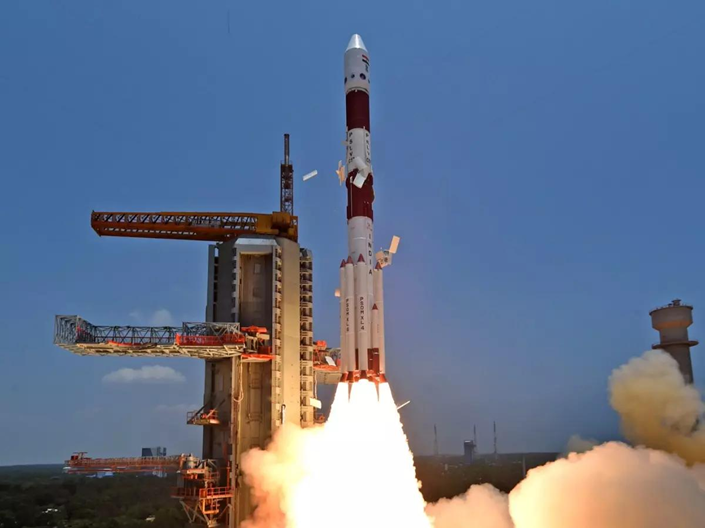
- Launch Vehicle: PSLV-C57
- Launch Date: 2 September 2023
- Launch Site: Satish Dhawan Space Centre
Technical Significance of L1 (Lagrange Point 1)
- Uninterrupted View: A major advantage of placing a satellite in a halo orbit around the L1 point is that it provides a continuous view of the Sun without any occultation or eclipses.
- Real-time Monitoring: This position allows for real-time tracking of solar activities and their impact on space weather.
Payloads (Instruments)
- VELC – Visible Emission Line Coronagraph (main payload)
- SUIT – Solar Ultraviolet Imaging Telescope
- ASPEX – Solar wind particle experiment
- PAPA – Plasma Analyser
- MAG – Magnetometer
Key Achievements
- Successfully inserted into halo orbit around L1 (Jan 2024)
- Continuous solar observation started
Key Solar Missions (Globally)
- PUNCH (NASA): It uses four suitcase-sized satellites to image the sun’s inner corona, bridging the gap between the sun and Earth to understand the origins of solar flares.
- Proba-3 (ESA): The European Space Agency’s Proba-3 is designed to study the solar corona and solar winds by creating a solar eclipse using two high-precision satellites.
- Solar Polar Orbit Observatory (China/NSSC): Planned for 2029, this mission aims to provide high-inclination views of the sun, which is crucial for understanding its magnetic field structure.
- Parker Solar Probe (NASA): Currently orbiting in the sun’s atmosphere to analyze its structure, launched in 2018.
- Solar Orbiter (ESA/NASA): Active since 2020, capturing high-resolution images of the Sun’s polar regions.
Match the following solar missions:
| Mission | Agency |
|---|---|
| 1. PUNCH | NASA |
| 2. Proba-3 | ESA |
| 3. Solar Polar Orbit Observatory | China |
| 4. Parker Solar Probe | ESA |
Answer: A
Explanation:
| No. | Mission | Agency | Status | Key Details |
|---|---|---|---|---|
| 1 | PUNCH | NASA | Correct | Stands for Polarimeter to Unify the Corona and Heliosphere. It is a NASA mission designed to image the outer corona of the Sun. |
| 2 | Proba-3 | ESA | Correct | A European Space Agency (ESA) mission. It is the world’s first precision formation-flying mission, creating an artificial eclipse to study the Sun’s faint corona. |
| 3 | Solar Polar Orbit Observatory | China | Correct | A proposed mission by China aimed at orbiting the Sun’s poles to study solar magnetic fields and the solar cycle. |
| 4 | Parker Solar Probe | ESA | Incorrect | The Parker Solar Probe is a flagship NASA mission (not ESA). It is the first spacecraft to “touch” the Sun by flying through the solar corona. |