Context
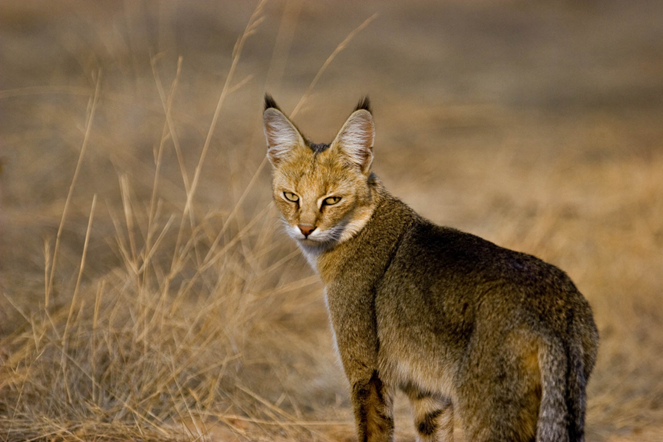
Recently, a study highlighted that the secretive Jungle Cat (Felis chaus) increasingly requires habitat conservation efforts outside of traditionally protected areas. The report emphasizes that while these felines are adaptable, the rapid conversion of wetlands and scrublands into agricultural or urban landscapes isolating their populations.
1. Jungle Cat (Felis chaus)
- Physical Features: It is a medium-sized cat with long legs and a short tail. It is distinguished by small black ear tufts and a lack of prominent body spots.
- Behavior: Unlike most cats, it is diurnal (active during the day). It is an agile hunter of rodents, birds, and small reptiles.
- Habitat: It inhabits scrublands, grasslands, and wetlands. It is highly adaptable and is often found in agricultural fields like sugarcane and cotton.
- Distribution: It is the most widespread small cat in India, found from the Himalayan foothills to the tip of Kanyakumari.
2. Fishing Cat (Prionailurus viverrinus)
- Physical Features: It is roughly twice the size of a typical house cat, with a stocky build, short legs, and a powerful tail. It has a spotted and striped coat and partially webbed paws which aid in swimming.
- Behavior: It is a specialist predator that primarily hunts fish. It is known to dive into water to catch prey and is predominantly nocturnal.
- Habitat: It is an obligate wetland specialist. It is strictly found in mangroves, marshes, swamps, and reed beds. It is the State Animal of West Bengal.
- Distribution: In India, its population is fragmented, with major strongholds in the Sundarbans, the Chilika Lake (Odisha), and the Coringa Wildlife Sanctuary (Andhra Pradesh).
3. Comparative Conservation Status
| Feature | Jungle Cat | Fishing Cat |
| IUCN Red List | Least Concern | Vulnerable |
| WPA, 1972 | Schedule I | Schedule I |
| CITES | Appendix II | Appendix II |
| Primary Threat | Habitat fragmentation / Hybridization | Wetland drainage / Mangrove loss |
Q. Consider the following statements regarding the Fishing Cat (Prionailurus viverrinus):

1. It is the only wild cat in India that possesses partially webbed paws to assist in aquatic movement.

2. It is currently categorized as ‘Critically Endangered’ on the IUCN Red List due to the rapid loss of mangroves.

3. In India, its distribution is limited only to the Sundarbans and the Western Ghats.

Which of the statements given above is/are correct?
(a) 1 only
(b) 1 and 2 only
(c) 2 and 3 only
(d) 1, 2 and 3

Correct Answer: (a) 1 only

Solution:
•	STATEMENT 1 IS CORRECT: The Fishing Cat has partially webbed paws, which is a specialized adaptation for swimming and catching fish in wetlands.
•	STATEMENT 2 IS INCORRECT: The Fishing Cat is categorized as Vulnerable, not Critically Endangered, on the IUCN Red List.
•	STATEMENT 3 IS INCORRECT: While found in the Sundarbans, the Fishing Cat is not found in the Western Ghats. Its distribution is mainly along the Eastern Coast (Chilika, Coringa) and the foothills of the Himalayas (Terai region).