Context
Recently, debris carrying the logo of ISRO and India’s National Emblem was discovered on an uninhabited island of the Maldives. The debris is believed to have originated from India’s heavy-lift launch vehicle LVM-3, highlighting issues related to space missions and debris management.
1. Technical Identification
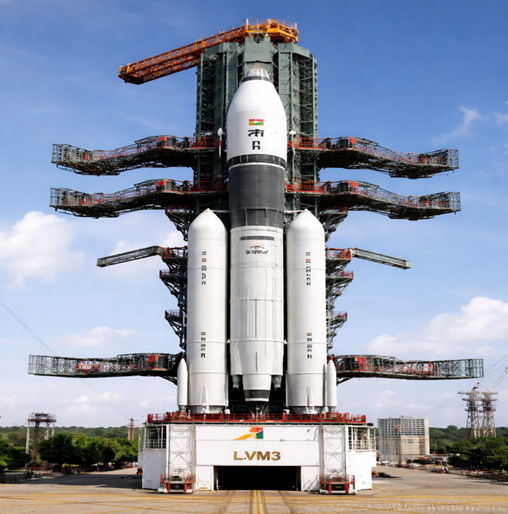
- Launch Vehicle Mark-3 (LVM3): The debris- specifically a payload fairing (PLF)—is believed to be from ISRO’s heaviest rocket, the LVM3.
- Mission Links: The debris likely originated from the LVM3-M6/BlueBird Block-2 Mission launched in December 2025 or the CMS-03 communication satellite launch in November 2025.
- Rocket Configuration: The LVM3 is a three-stage vehicle comprising two solid strap-on motors, a liquid core stage, and a cryogenic upper stage.
2. Different types of launch vehicles
Launchers or Launch Vehicles are used to carry spacecraft to space. India has three active operational launch vehicles: Polar Satellite Launch Vehicle (PSLV), Geosynchronous Satellite Launch Vehicle (GSLV), Geosynchronous Satellite Launch Vehicle Mk-III (LVM3).
I. PSLV (Polar Satellite Launch Vehicle)
- It is the Indian Space Research Organisation’s (ISRO) reliable third-generation, 4-stage “workhorse” launch vehicle, first successful in 1994
- Has four variants based on strap-on boosters: 6, 4, 2, and Core-Alone.
- Used for launching:
- Earth Observation satellites
- Navigation satellites
- Key Missions: Successfully launched India’s first space observatory, Astrosat, Chandrayaan-1 in 2008, and Mangalyaan in 2013.





II. GSLV (Geosynchronous Satellite Launch Vehicle)
- It is a three-stage, 49–52m tall, 420-tonne rocket developed by ISRO to launch heavy communication satellites (up to ~2.5 tonnes) into Geostationary Transfer Orbit (GTO).
- Uses indigenous Cryogenic Upper Stage.
- Key missions include launching NavIC navigation satellites (NVS-01, NVS-02)
III. Launch Vehicle Mark III (LVM-III)
- The Launch Vehicle Mark III (LVM3), formerly known as GSLV Mk III, is ISRO’s most powerful, three-stage medium-lift launch vehicle designed for heavy satellite deployment.
- Key Missions: LVM3 successfully launched the Chandrayaan-2 and Chandrayaan-3 missions.
- Can launch:
- 4-tonne satellites to GTO
- 10-tonne payloads to LEO
- Selected for Gaganyaan Human Space Mission.
With reference to LVM-3 (Launch Vehicle Mark-3), consider the following statements:

I. It is the heaviest operational launch vehicle of India.

II. It is capable of launching about 4-tonne class satellites into GTO.

III. It has been selected as the launch vehicle for India’s Gaganyaan mission.

Which of the statements given above is/are correct?

(a) I only
(b) I and II only
(c) II and III only
(d) I, II and III

Answer: D

Explanation:
•	Statement I — Correct: LVM-3 is the heaviest operational launch vehicle developed by ISRO.
•	Statement II — Correct: It can launch about 4-tonne class communication satellites into Geosynchronous Transfer Orbit (GTO).
•	Statement III — Correct: The human-rated version of LVM-3 has been selected for India’s Gaganyaan human spaceflight mission.