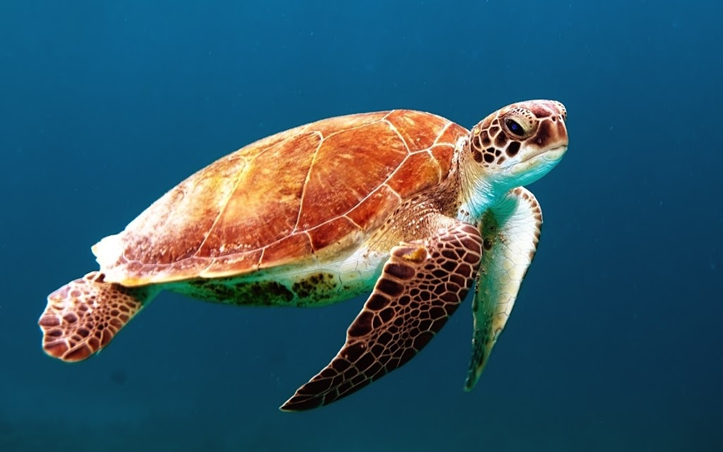
Context
Recently, a 17-year study published in the journal Animals (2026) has highlighted that Loggerhead sea turtles (Caretta caretta) are shrinking in size and producing fewer eggs due to the dual pressures of warming oceans and declining marine productivity.
1. Physical Characteristics
- Appearance: They are named for their massive heads and exceptionally strong jaws, which allow them to crush hard-shelled prey.
- Size: They are the world’s largest hard-shelled turtles. In terms of overall size, they are second only to the leatherback turtle (which has a soft shell).
2. Habitat and Distribution
- Global Range: They have a cosmopolitan distribution, inhabiting the temperate and subtropical waters of the Atlantic, Pacific, and Indian Oceans, as well as the Mediterranean Sea.
- Indian Context: While five species of sea turtles are found in Indian waters (Olive Ridley, Green, Hawksbill, Leatherback, and Loggerhead), the Loggerhead is not known to nest on Indian beaches. It is occasionally spotted in the Gulf of Mannar and offshore waters during migration.
3. Unique Behavioral Traits
- Diet: They are omnivorous but primarily carnivorous, feeding on bottom-dwelling invertebrates like crabs, clams, mussels, and jellyfish.
- Magnetoreception: These turtles use the Earth’s geomagnetic field as both a map and a compass to navigate thousands of kilometers during trans-oceanic migrations.
- Temperature-Dependent Sex Determination (TSD): Like many reptiles, the sex of the hatchlings is determined by the temperature of the sand. Warmer temperatures produce females, while cooler temperatures produce males.
4. Conservation Status and Protection
- IUCN Red List: Vulnerable.
- CITES: Appendix I (prohibits international trade).
- Wildlife Protection Act (WPA), 1972: Schedule I (highest level of legal protection in India).
5. Threats
- Climate Change: Rising temperatures lead to a “feminization” of the population (excessive female hatchlings) and reduced body size.
- Bycatch: Accidental entanglement in fishing gear (trawls and longlines) is a leading cause of mortality.
- Pollution: Ingestion of marine debris, particularly plastics which are mistaken for jellyfish.
- Light Pollution: Artificial lights on beaches disorient hatchlings, preventing them from finding the ocean.
6. Major turtle spice in India
| Species Name | IUCN Status | Key Characteristics | Presence in India |
| Olive Ridley (Lepidochelys olivacea) | Vulnerable | Smallest and most abundant; famous for Arribada (mass nesting). | Major nesting: Odisha (Gahirmatha, Rushikulya, Devi River). |
| Green Turtle (Chelonia mydas) | Endangered | Only strictly herbivorous species as adults; named for the color of its fat. | Major nesting: Gujarat, Lakshadweep, and Andaman & Nicobar. |
| Hawksbill (Eretmochelys imbricata) | Critically Endangered | Distinctive hawk-like beak; hunted for its beautiful shell (tortoiseshell). | Found in coral reefs of Andaman, Nicobar, and Lakshadweep. |
| Leatherback (Dermochelys coriacea) | Vulnerable | Largest of all sea turtles; has a rubbery shell instead of a hard one. | Nesting restricted to Andaman and Nicobar Islands. |
Q. With reference to the Loggerhead Sea Turtle (Caretta caretta), consider the following statements:

1. It is the only hard-shelled sea turtle species that is strictly herbivorous in its adult stage.
2. The sex of its hatchlings is determined by the incubation temperature of the nest rather than genetics.
3. While it is found in Indian waters, it does not have any recorded nesting sites on the Indian mainland.

How many of the statements given above are correct?

(a) Only one
(b) Only two
(c) All three
(d) None

Correct Answer: (b)

Explanation:
•	STATEMENT 1 INCORRECT: Loggerhead turtles are omnivorous and primarily carnivorous. They have powerful jaws designed to crush hard-shelled prey like crustaceans and mollusks.
•	STATEMENT 2 CORRECT: Loggerheads exhibit temperature-dependent sex determination (TSD), where warmer sands result in more female hatchlings.
•	STATEMENT 3 CORRECT: Although the Loggerhead is one of the five species found in the Indian Ocean and near the Indian coast, it is the only one among them that does not nest on Indian shores (nesting is mostly in Oman and Australia in this region).