Context
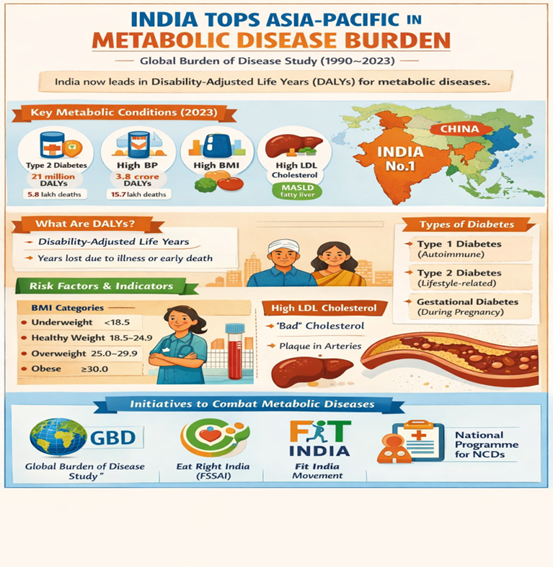
A recent study published in the journal Metabolism, based on the Global Burden of Disease (GBD) Study (1990-2023), highlights that India and China now possess the highest absolute metabolic disease burdens in the Asia-Pacific region.
The report indicates that India has overtaken China in terms of Disability-Adjusted Life Years (DALYs) for specific metabolic conditions as of 2023.
I. Key Findings of the Report
- Major Conditions Tracked: The study analyzed five specific metabolic diseases and risk factors: Type 2 diabetes mellitus, high systolic blood pressure (BP), high body mass index (BMI), high LDL cholesterol, and metabolic dysfunction-associated steatotic liver disease (MASLD).
- India’s 2023 Statistics:
- Type 2 Diabetes: Accounted for approximately 21 million DALYs and 5.8 lakh deaths.
- High Systolic BP: Caused nearly 3.8 crore DALYs and approximately 15.7 lakh deaths.
- Leading Position: In terms of DALYs, India replaced China (which held the top spot in 1990) to lead the list of the top 5 countries in the Asia-Pacific region.
- Disability-Adjusted Life Year (DALY): This is a critical metric used to measure the overall disease burden, expressed as the number of years lost due to ill-health, disability, or early death.
II. Static Linkages
A. Metabolic Diseases
- Mechanism: These diseases occur when the body’s normal process of breaking down, storing, or using energy from food is disrupted.
B. Types of Diabetes
Type 1 Diabetes
- An autoimmune condition where the body attacks insulin-producing cells in the pancreas, where the pancreas produces little to no insulin.
- Usually develops in children or young adults.
- Requires lifelong insulin therapy.
Type 2 Diabetes
- The most common type.
- Occurs when the body becomes resistant to insulin or does not produce enough insulin.
- Often linked to lifestyle factors such as obesity and lack of physical activity.
Gestational Diabetes
- Develops during pregnancy.
- Usually disappears after childbirth but increases the risk of Type 2 diabetes later.
C. Metabolic Dysfunction-Associated Steatotic Liver Disease (MASLD): It involves the buildup of excess fat in the liver not caused by heavy alcohol use. It is often asymptomatic but can progress to inflammation (MASH), cirrhosis, and liver cancer.
2. Indicators and Risk Factors
- BMI (Body Mass Index): A measure of body fat based on height and weight. Rising BMI is cited as a steady risk factor in the Indian population.
- BMI Categories for Adults (Age 20+):
- Underweight: Below 18.5
- Healthy Weight: 18.5 – 24.9
- Overweight: 25.0 – 29.9
- Obese: 30.0 or higher
- LDL (low-density lipoprotein) Cholesterol: Often termed “bad” cholesterol; LDL carries cholesterol from the Liver to different parts of the body; high levels can lead to a buildup of plaque in arteries.
3. Holistic Overview: Relevant Global & National Frameworks
| Initiative | Description |
| Global Burden of Disease (GBD) | A comprehensive regional and global research program of disease burden. |
| Eat Right India (FSSAI) | A flagship movement by the Indian government to ensure safe, healthy, and sustainable food. |
| Fit India Movement | A nation-wide movement to encourage Indians to include physical activity in their lives. |
| National Programme for NCDs | National program focused on preventing and controlling Non-Communicable Diseases. Funded by the Centre and States (60:40 ratio), with special support (90:10) for Northeastern/hilly states. |
With reference to 'Disability-Adjusted Life Years' (DALYs), consider the following statements:

1. It is a measure of the gap between current health status and an ideal health situation where the entire population lives to an advanced age, free of disease and disability.

2. It combines the years of life lost due to premature mortality and the years lived with a disability.

Which of the statements given above is/are correct?
(a) 1 only
(b) 2 only
(c) Both 1 and 2
(d) Neither 1 nor 2

Answer: (c) Both 1 and 2 are correct.

Explanation:
•  Statement 1 is correct: Disability-Adjusted Life Years (DALYs) are designed to quantify the "burden of disease" by measuring the gap between the current health status of a population and an ideal situation where everyone lives to the standard life expectancy in full health.

•  Statement 2 is correct: The DALY is a summary metric that adds together two distinct components:
1.	Years of Life Lost (YLL): Calculated from the number of deaths multiplied by a standard life expectancy at the age at which death occurs.
2.	Years Lived with Disability (YLD): Calculated by multiplying the prevalence of a disease or its complications by a weighted factor that reflects the severity of the disability.