Recent satellite-based studies, including ISRO’s analysis using 2023 data, have revealed that methane emissions from major Indian landfills are significantly higher than official estimates, prompting regulatory scrutiny by the National Green Tribunal and renewed focus on satellite monitoring for waste-sector climate mitigation.
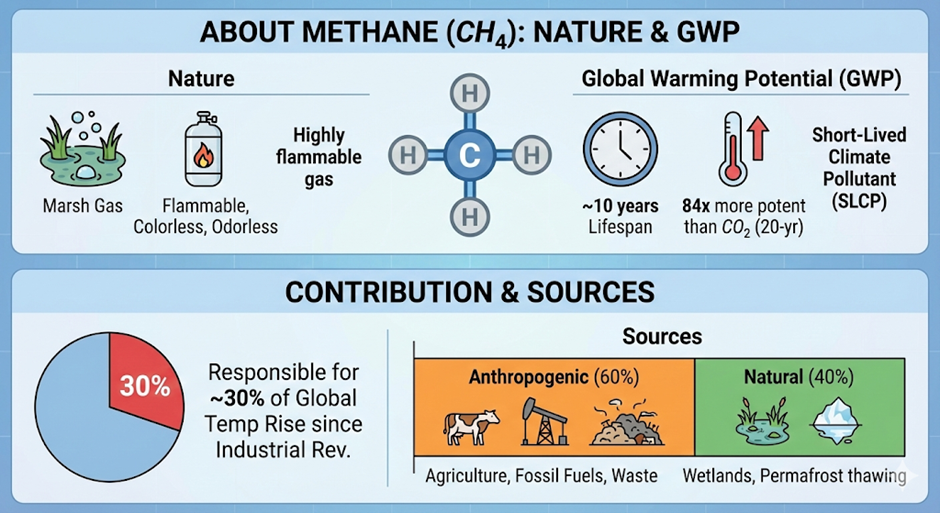
About Methane (CH4)
- Nature: It is a colourless, odourless, and highly flammable gas, often referred to as “Marsh Gas.”
- Global Warming Potential (GWP): It is a Short-Lived Climate Pollutant (SLCP) with a lifespan of ~10 years. However, it is 84 times more potent than CO2 in trapping heat over a 20-year period.
- Contribution: Responsible for approximately 30% of the global temperature rise since the Industrial Revolution.
Global Methane Emissions: Sectoral Analysis
Human-induced (anthropogenic) methane emissions are primarily concentrated in three key sectors:
- Agriculture (~40%): The leading source, driven principally by enteric fermentation in livestock and anaerobic conditions in paddy cultivation.
- Fossil Fuels (~35%): Emissions arise from fugitive leakages during coal mining and the extraction, processing, or transport of oil and natural gas.
- Waste Management (~20%): Methane is generated through the anaerobic decomposition of organic matter in landfills, open dumpsites, and wastewater treatment systems.
The Data Discrepancy
A major hurdle in mitigating methane is the lack of accurate data. Traditional models often underestimate emissions compared to real-time satellite monitoring.
- Traditional Models: Rely on “inventory-based” estimates (waste volume * baseline assumptions). These are often outdated (e.g., based on 2018 estimates) and fail to capture real-time leakages.
- Satellite Findings (ISRO & Others): Advanced satellites (e.g., Carbon Mapper, SRON) have revealed massive discrepancies
Policy & Technological Interventions
- The Feedback Loop Strategy: A proposed mechanism where satellite detection (identifying hotspots) triggers immediate ground-level verification (fixing gas collection leaks or covering exposed waste).
- Associated Schemes:
- Swachh Bharat Mission: Provides the existing framework for waste management reforms.
- Gobardhan Scheme: Focuses on converting biodegradable waste into compressed biogas (Bio-CNG). Example: Indore has successfully utilized this to set up Bio-CNG plants.
- Global Comparison: The International Energy Agency (IEA) notes that ~70% of fossil fuel methane emissions can be mitigated using existing technologies.
Q. With reference to the nature and impact of Methane (CH4), consider the following statements:
- It is a long-lived climate pollutant that persists in the atmosphere for over a century.
- It is approximately 84 times more potent than Carbon Dioxide in trapping heat over a 20-year period.
Which of the statements given above is/are correct?
(a) 1 only
(b) 2 only
(c) Both 1 and 2
(d) Neither 1 nor 2
Answer: B
Explanation:
Statement 1 is incorrect: Methane is classified as a Short-Lived Climate Pollutant (SLCP) with an atmospheric lifespan of approximately 10 years, unlike Carbon Dioxide which can persist for centuries.
Statement 2 is correct: Despite its short lifespan, Methane is significantly more potent, with a warming potential roughly 84 times higher than CO2 over