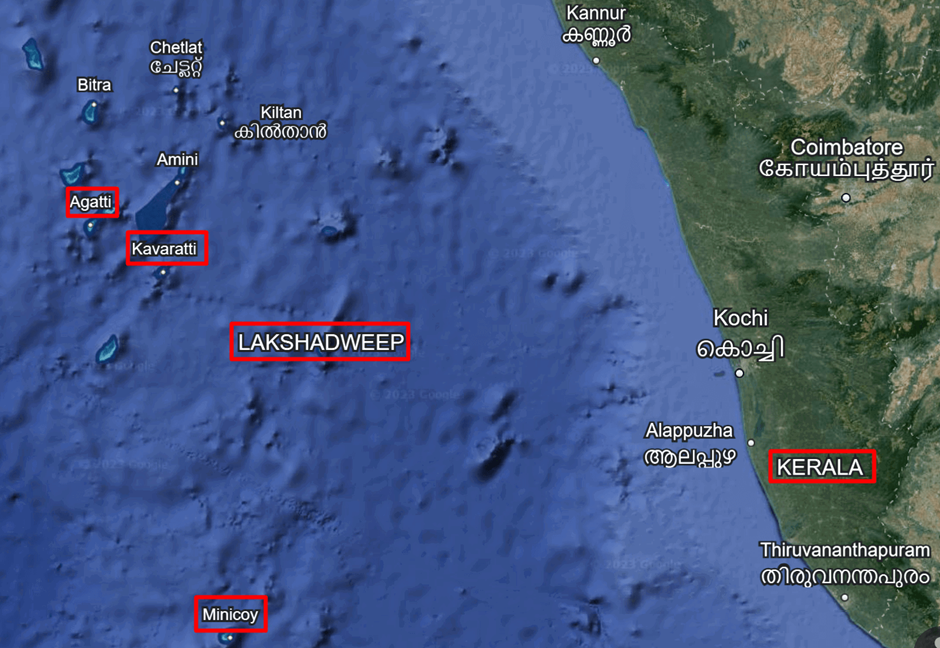
The Indian armed forces are ramping up their presence in the strategically vital Lakshadweep archipelago. The Southern Naval Command (SNC) has confirmed that a new Naval detachment on Bitra Island will be fully operational by next year, while the Indian Air Force (IAF) is expanding facilities on Agatti and constructing a new air base on Minicoy.
1. Why the Strategic Push?
- Maritime Security: To counter increasing Chinese presence in the Indian Ocean Region (IOR).
- Anti-Piracy: To mitigate threats of piracy in the Arabian Sea.
- Shipping Lanes: To secure heavy international shipping traffic passing through the Nine Degree Channel.
2. Geographical Profile
- Origin: Lakshadweep consists of 36 islands of coral origin (atolls).
- Concept Check: An atoll is a ring-shaped coral reef usually formed on the rim of a submerged volcano. Corals are skeletons of marine polyps.
- Divisions:
- Amindivi Islands: The northernmost group.
- Minicoy Islands: The southernmost and largest group.
- Topography: Flat terrain with low elevation (< 5 meters); devoid of hills, streams, or valleys.
- Administrative:
- Capital: Kavaratti.
- Jurisdiction: Under the Kerala High Court.
3. Historical Evolution
- Discovery Myth: Linked to Cheraman Perumal, the last Chera ruler of Kerala. Myths suggest a search party sent by the Raja of Kolattunad discovered the islands after a storm.
- Early Settlers: Malabari sailors, followed by Hindus (Nambudiris, Nairs) and Mukkuvans.
- Political Control:
- Ruled by the Arakkal Kingdom of Kannur (Kerala’s only Muslim dynasty) from the 16th century until 1908.
- Part of the Malabar district under the British.
- Became a Union Territory in 1956 following the States Reorganisation Act.
4. Unique Socio-Cultural Fabric
- Religion & Society: Predominantly Muslim but follows a unique Islamic Matrilineal system (Marumakkathayam), reflecting strong pre-Islamic Hindu influences.
- Caste System: Retains a caste structure unlike standard Islamic practice.
- Cultural Markers:
- Use of the ancient Vattelutu script (old Malayalam).
- Traditional songs alluding to Hindu deities (Ram) and snake worship.
- Languages:
- Malayalam: Official language.
- Mahl: Spoken in Minicoy (similar to Dhivehi of Maldives).
- Jazari: A dialect spoken in the islands.