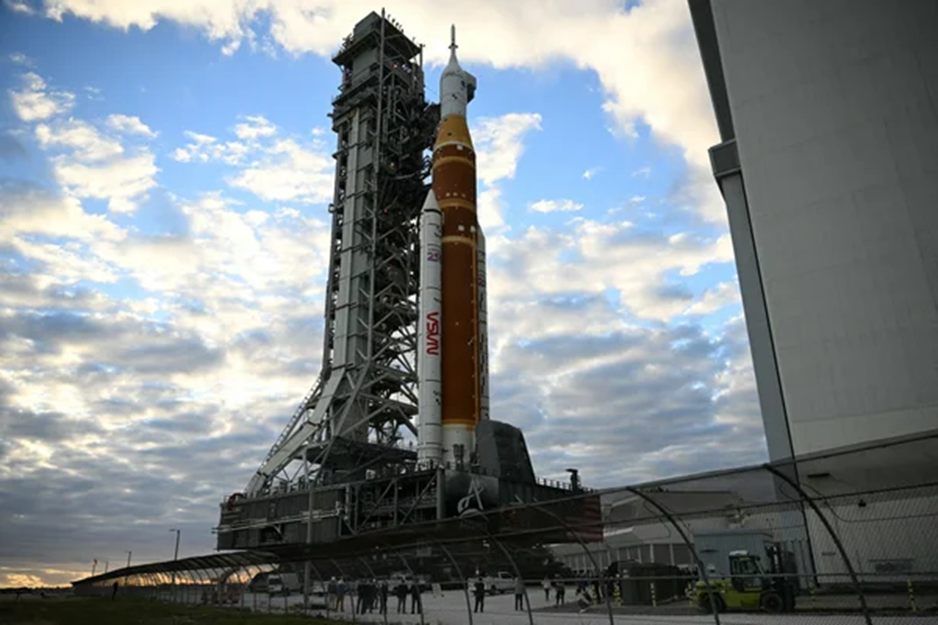
Why In the News?
Recently, the Artemis II mission is poised for a historic liftoff, with NASA targeting a launch window opening on February 6, 2026. This mission signifies the first time in over 50 years—since the Apollo 17 mission in 1972-that humans will venture beyond Low Earth Orbit (LEO) toward the lunar vicinity.
About the Mission:
- Operational Goal: Artemis II is NASA’s first human spaceflight mission under the Artemis program, featuring a lunar flyby (without landing) to evaluate deep-space systems with astronauts on board the Orion spacecraft.
- Trajectory: The mission will utilize a Hybrid Free-Return Trajectory. Orion will travel around the far side of the Moon, using lunar gravity to “slingshot” back to Earth without a major propulsion burn.
- Launch vehicle: Space Launch System (SLS) Block 1.
- Duration: A 10-day round trip covering approximately 685,000 miles.
- International Partners: ESA (Europe), JAXA (Japan), and CSA (Canada).
- Fuel Source: The SLS core stage utilizes Cryogenic Liquid Hydrogen (LH2) and Liquid Oxygen (LOX).
- Final Phase: High-speed atmospheric reentry at 25,000 mph, concluding with a precision splashdown in the Pacific Ocean.
- Re-entry Dynamics: Orion will enter Earth’s atmosphere at 25,000 mph (Mach 32), testing the resilience of its advanced heat shield against temperatures reaching 2,800°C.





Technological Pillars:
- Space Launch System (SLS): Specifically designed as the only vehicle capable of launching the Orion spacecraft, astronauts, and large cargo directly to the Moon in a single launch.
- Orion Spacecraft: A partially reusable crew module paired with the European Service Module (ESM). The ESM is a critical international contribution (ESA) providing power, propulsion, and life-support consumables (air/water).
- Optical Communications (O2O): Artemis II will debut Laser-based communication, enabling high-definition data transmission from lunar distances- a jump from traditional radio frequency (RF) systems.
Strategic Roadmap:
- Artemis III (Target 2027-28): Scheduled to land the first woman and first person of colour at the Lunar South Pole—a region selected for its water-ice deposits in “Permanently Shadowed Regions” (PSRs).
- Lunar Gateway: A modular space station in Near-Rectilinear Halo Orbit (NRHO). It will serve as a staging post for surface missions and a precursor for crewed Mars expeditions.
- Artemis Accords: A US-led international framework for peaceful space exploration. India became a signatory in 2023, facilitating ISRO-NASA synergy in lunar and planetary science.
Artemis Phase I to IV
The Artemis program follows a structured progression to establish a sustainable human presence on the Moon.
| Mission | Primary Objective | Status/Timeline |
| Artemis I | Uncrewed test of SLS and Orion around the Moon. | Completed (2022) |
| Artemis II | First crewed lunar flyby (no landing). | Feb 2026 (Target) |
| Artemis III | Crewed landing at the Lunar South Pole. | Planned (2027-28) |
| Artemis IV | Delivery of the Lunar Gateway habitat modules. | Future Mission |
With respect to the orbital mechanics of the Artemis II mission, consider the following statements:
I.	Artemis II is NASA’s first crewed Artemis mission, performing a lunar flyby to test Orion’s deep-space systems.
II.	Space Launch System (SLS) the sole rocket designed to launch Orion, astronauts, and heavy cargo to the Moon in one mission.
III.	The mission profile involves a high-speed atmospheric reentry at speeds exceeding Mach 50.

Which of the statements given above are correct?
(a) I and II only
(b) II and III only
(c) I and III only
(d) I, II, and III
Answer: (A)
Explanation:
Statement I is correct: Artemis II is NASA’s first human spaceflight mission under the Artemis program, featuring a lunar flyby (without landing) to evaluate deep-space systems with astronauts on board the Orion spacecraft.
Statement II is correct: The SLS is the only rocket that can launch Orion, four astronauts, and heavy cargo to the Moon in one go.
Statement III is incorrect: Orion will enter Earth's atmosphere at 25,000 mph (Mach 32), testing the resilience of its advanced heat shield against temperatures reaching 2,800°C.
Practice Today’s MCQs