After Reading This Article You Can Solve This UPSC Mains Model Question:
“Examine the role of the National Gas Grid in enhancing India’s energy security and regional equity. What are the major bottlenecks in its effective implementation?” 15 Marks (GS-3, Economy)
Context
West Asia conflict involving the U.S., Israel, and Iran effectively closed the Strait of Hormuz, disrupting 90% of India’s LPG imports. Consequently, the government issued the Natural Gas (Supply Regulation) Order, 2026, prioritizing PNG and fertilizers to mitigate the severe national energy shortage.
Background of National Gas Grid (NGG)
1. Early Conceptual Origins (1950s–1970s)
The idea of a National Gas Grid in India dates back to 1955, when Syed Husain Zaheer proposed a nationwide gas pipeline network based on coal gasification.
- He envisioned a “Town Gas Supply Scheme”:
- Gas produced from coal
- Transported through pipelines to cities and industries
2. Vision & Goals
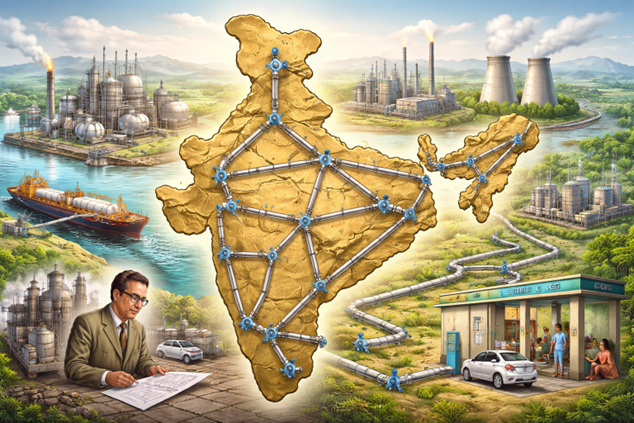
- “One Nation, One Gas Grid”: Integrating regional networks into a single national unit for equitable gas distribution.
- Objective: Increase the share of natural gas in the energy mix from ~6.7% to 15% by 2030.
3. Regulatory Framework
- PNGRB Act, 2006: Established the statutory board to regulate the downstream sector (transport, storage, and distribution).
- Common Carrier Principle: Mandates “open access” to pipelines, preventing infrastructure monopolies.
- Unified Tariff (2023): Replaced multiple additive fees with a single “One Nation, One Tariff” model, drastically lowering costs for consumers far from gas sources (e.g., NE India).
4. Structural Evolution
- Initial Phase: Centered on the HBJ (Hazira-Vijaipur-Jagdishpur) pipeline, primarily serving Northern India’s fertilizer and power sectors.
- Regional Integration:
- South: Connection via the Kochi-Mangaluru pipeline.
- East: Pradhan Mantri Urja Ganga (JHBDPL) connecting Bihar, Jharkhand, West Bengal, and Odisha.
- Northeast: Indradhanush Gas Grid (IGGL) linking all eight NE states to the national network.
Need for the National Gas Grid
1. Transition to a Gas-Based Economy
- Target Alignment: Essential to increase natural gas share in the energy mix from ~6.7% to 15% by 2030.
- Bridge Fuel: Necessary to move away from “dirtier” fossil fuels (coal/oil) toward Net Zero 2070 goals.
2. Ending “Energy Poverty” (Regional Balance)
- Geographical Equity: Connects the “gas-starved” Eastern and North-Eastern regions to the supply-rich Western and Southern coasts.
- Uniform Growth: Ensures that industrial development is not restricted to coastal states with LNG terminals.
3. Strategic Energy Security
- Import Diversification: Allows India to move gas from any port (West or East coast) to any inland demand center, crucial during maritime disruptions (e.g., 2026 West Asia crisis).
- Strategic Storage: Required to link future strategic gas reserves to industrial and domestic hubs.
4. Industrial & Agricultural Productivity
- Fertilizer Subsidy Control: Reliable gas supply to urea plants via the grid reduces the high cost of production and the government’s subsidy burden.
- Industrial Feedstock: Vital for “Hard-to-Abate” sectors like Steel and Cement that require high-heat energy.
5. Clean Urban Mobility & Cooking
- Pollution Control: Necessary to expand City Gas Distribution (CGD) networks, reducing urban smog by replacing diesel/petrol with CNG.
- LPG Substitution: Reduces the logistics and foreign exchange drain associated with importing and transporting LPG cylinders.
6. Future-Proofing (Hydrogen & Biogas)
- Blending Hub: The grid is the only viable infrastructure for the large-scale transport of Green Hydrogen and Compressed Biogas (CBG) from rural production centers to urban markets.
Significance of the National Gas Grid
1. Energy Security & Stability
- Buffer Against Volatility: Reduces reliance on a single fuel source (like coal or oil).
- Supply Resilience: Enables rapid diversion of gas to deficit regions during geopolitical crises (e.g., the 2026 West Asia supply crunch).
2. Economic Growth
- Industrial Competitiveness: Provides reliable, cheaper fuel to fertilizer, steel, and glass industries.
- Cost Reduction: The Unified Tariff makes gas affordable for industries far from coastal LNG terminals.
3. Environmental Impact
- “Bridge Fuel”: Emits 40% less CO2than coal and nearly zero Particulate Matter (PM), aiding India’s Net Zero 2070 goal.
- Decarbonization: Facilitates the transition of heavy transport (trucks/buses) from diesel to CNG.
4. Social & Infrastructure Benefits
- Consumer Convenience: Direct-to-kitchen PNG eliminates the logistics and safety risks of LPG cylinders.
- Regional Development: Connects under-developed regions (East and Northeast India) to the mainstream industrial economy.
5. Strategic Integration
- Multi-fuel Synergy: Essential for injecting Compressed Biogas (CBG) and Green Hydrogen into existing pipelines, future-proofing India’s energy infrastructure.
Challenges to the National Gas Grid
1. High Import Dependency
- India imports nearly 50% of its natural gas as LNG. Global price volatility (spiked by the 2026 West Asia crisis) makes gas expensive compared to domestic coal, leading to underutilization of gas-based power plants.
2. Exclusion from GST
- Natural Gas remains outside the Goods and Services Tax (GST). This leads to a cascading effect of taxes (VAT and Central Excise) across state borders, increasing the final cost for industries by 10-15% compared to other fuels.
3. Land Acquisition & RoW Issues
- Securing the Right of Way (RoW) for laying pipelines is a major bottleneck. Legal disputes and compensation delays in densely populated states (like West Bengal and Kerala) often lead to significant project cost overruns.
4. Underutilized “Stranded” Assets
- Approximately 14.3 GW of gas-based power capacity remains “stranded” or underutilized because the high cost of imported gas makes the electricity produced commercially unviable for Discoms.
5. Last-Mile Connectivity
- While the “trunk” pipelines (main arteries) are expanding, the City Gas Distribution (CGD) networks face “last-mile” hurdles in old, congested cities, delaying the transition of households to PNG.
6. Technical & Safety Risks
- Integrating Green Hydrogen and Compressed Biogas (CBG) into existing steel pipelines poses technical challenges like “hydrogen embrittlement” (weakening of metal), requiring expensive infrastructure upgrades.
Government Initiatives
1. Infrastructure Projects
- Pradhan Mantri Urja Ganga (PMUG): Connecting the “gas-starved” East (UP, Bihar, Jharkhand, WB, Odisha). It revitalizes defunct fertilizer plants and supports the Matix Fertilizer plant in West Bengal.
- North East Gas Grid (NEGG): Implemented by IGGL, this 1,656 km pipeline aims for full commissioning by March 31, 2026, linking all eight North-Eastern states to the national grid.
2. Pricing & Tariff Reforms
- Unified Pipeline Tariff (2023-2026): A “One Nation, One Grid, One Tariff” model. It eliminates multiple transit fees, ensuring that a consumer in a remote area (like Agartala) pays a transport rate similar to one near a coastal terminal (like Dahej).
- Kirit Parikh Committee Implementation: Moving toward a market-linked pricing regime with a “floor” and “ceiling” price for domestic gas to protect both producers and consumers.
3. Bio-Fuel Integration
- SATAT Initiative: Promoting Compressed Biogas (CBG). As of 2026, the government has mandated a CBG Blending Obligation (CBO) for all City Gas Distribution (CGD) entities to reduce LNG imports.
- National Green Hydrogen Mission: Upgrading the grid to be “hydrogen-ready” for blending green hydrogen into existing natural gas pipelines.
4. Expanding Access
- City Gas Distribution (CGD) Bidding: The 12th CGD Bidding Round (2024-25) has brought nearly 100% of India’s map under authorized gas coverage.
- PM Ujjwala Yojana 2.0: While focused on LPG, it acts as a precursor to PNG by building the “clean cooking” habit in rural India, with over 10.4 crore beneficiaries by early 2026.
Way Forward
1. Fiscal Integration (GST): Include natural gas under the GST regime to eliminate the cascading effect of varied state taxes (VAT/Entry tax). This will reduce industrial fuel costs by 10–15% and create a truly unified national market.
2. Creation of Strategic Gas Reserves: Establish Strategic Natural Gas Reserves (similar to Strategic Petroleum Reserves) in salt caverns or depleted wells. This is critical to buffer against 30–60 day supply shocks caused by maritime chokepoints (e.g., 2026 Strait of Hormuz crisis).
3. Infrastructure “Teeth” (Legal Reform): Enact a “National Transmission Corridor Act” to grant gas pipelines the same legal status as Highways or Railways. This would streamline Right of Way (RoW), reduce land acquisition litigation, and prevent “project-stretch” in states like West Bengal.
4. Independent Transmission System Operator (TSO): Establish an Independent TSO to manage the grid. This ensures “neutral” third-party access to pipelines, separating the transport of gas from the marketing of gas, which encourages private investment and prevents monopolies.
5. Future-Proofing with “Green Blending”: Mandate and subsidize the blending of Compressed Biogas (CBG) and Green Hydrogen into the existing grid. This reduces LNG import dependency and leverages the National Gas Grid as a “decarbonization highway.”
6. Demand Aggregation & Digital Twins: Deploy Real-time Data Monitoring (under the 2026 Information Order) and “Digital Twins” of the grid. This allows for predictive maintenance and “Demand Aggregation” to negotiate better long-term LNG contracts with non-Gulf suppliers like the U.S. and Australia.
Conclusion
The National Gas Grid is the strategic backbone of India’s Net Zero 2070 journey, evolving into a multi-fuel “Energy Highway” that seamlessly integrates natural gas, green hydrogen, and biogas.