Statutory Body: Established under the Wildlife (Protection) Act, 1972 (amended in 2006).
Ministry: Operates under the Ministry of Environment, Forest and Climate Change (MoEFCC).
Composition:
Chairperson: Union Minister of MoEFCC.
Vice-Chairperson: Minister of State, MoEFCC.
Members: Three Members of Parliament (2 from Lok Sabha, 1 from Rajya Sabha), eight experts in wildlife conservation, and various ex-officio government secretaries.
Objective: To provide statutory authority to Project Tiger (launched in 1973) and ensure legal compliance for tiger conservation plans.
2. Key Powers & Functions
Approval of Plans: Approves the Tiger Conservation Plan (TCP) prepared by State Governments.
Ecological Oversight: Evaluates sustainable ecology and can prohibit unsustainable land uses (mining, industry) within tiger reserves.
Normative Standards: Lays down standards for tourism in tiger reserves.
Dispute Resolution: Provides for management focus in addressing human-wildlife conflict and emphasizes coexistence.
Binding Directions: The NTCA can issue written directions to any person or authority for tiger protection, and they are legally bound to comply.
3. Landmark Initiatives
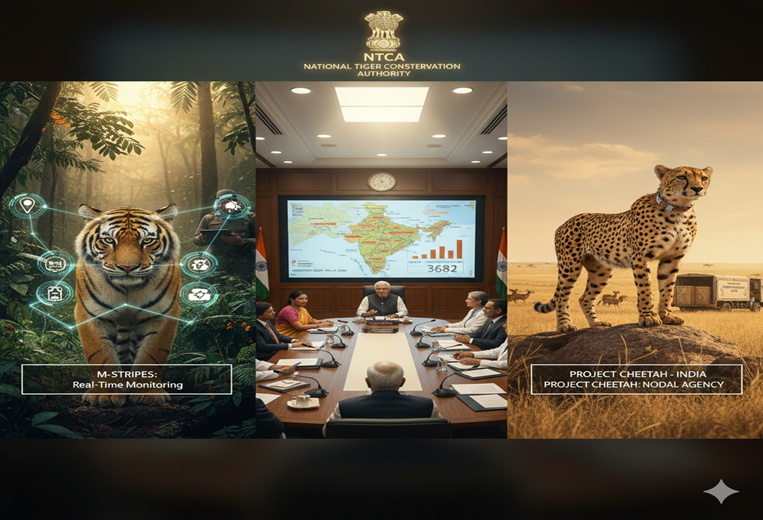
M-STrIPES: (Monitoring System for Tigers – Intensive Protection and Ecological Status). A software-based tool using GPS, GPRS, and remote sensing to monitor patrolling and ecological trends.
Project Cheetah: NTCA is the nodal agency for the inter-continental translocation of cheetahs to Kuno National Park and now expanding to Gandhi Sagar Wildlife Sanctuary (MP) and Banni Grasslands (Gujarat).
Tiger Census (AITE): Conducts the All India Tiger Estimation every four years.
Latest (5th Cycle): India has 3,682 tigers (as of 2023 reports), showing a 6% annual growth rate.
6th Cycle (2025): The 6th cycle was officially launched in late 2024/early 2025 with an emphasis on DNA profiling.
MEE (Management Effectiveness Evaluation): A global framework used by NTCA to rate the performance of Tiger Reserves (Categories: Excellent, Very Good, Good, Fair).
Recently updated for the 50th anniversary (1973–2023).
International Link
India has MoUs with Cambodia (reintroduction) and Bangladesh (Sundarbans).
Funding Pattern
90:10 for NE and Himalayan States; 50:50 for others (Centrally Sponsored Scheme).
Q. With reference to the National Tiger Conservation Authority (NTCA), consider the following statements:
I. It is a non-statutory body chaired by the Prime Minister of India.
II. It has the power to approve the Tiger Conservation Plans submitted by State Governments.
III. It serves as the lead agency for the implementation of Project Cheetah in India.
Which of the statements given above is/are correct?
(a) I and II only
(b) II and III only
(c) I and III only
(d) I, II and III

Answer: (b)
Explanation:

Statement I Incorrect: The NTCA is a statutory body. It was not created by an executive order but by the Wildlife (Protection) Act, 1972, through the 2006 Amendment.
Statement II Correct: Under Section 38 O of the Wildlife (Protection) Act, the NTCA is legally mandated to approve the Tiger Conservation Plan (TCP).
Statement III Correct: The NTCA’s mandate was expanded beyond tigers to include the reintroduction of Cheetahs (Project Cheetah).