Context
Recently, the International Union for Conservation of Nature (IUCN) declared the Emperor Penguin an endangered species, bringing the concept of sentinel species back into focus.
1. What is a Sentinel Species?
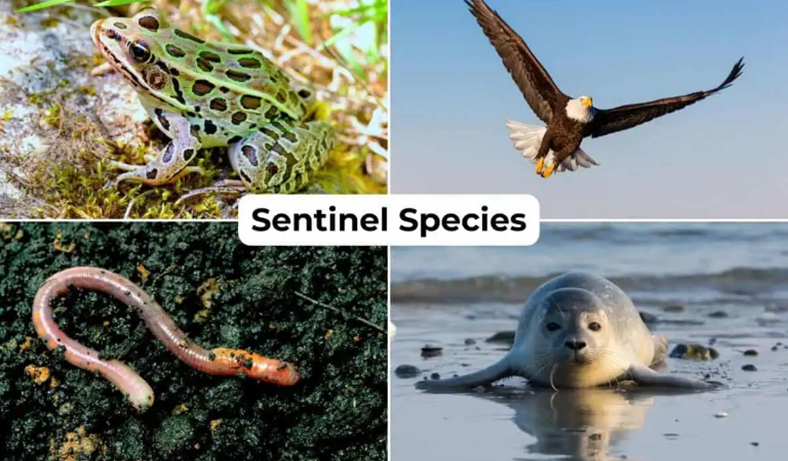
- Sentinel species are organisms—including animals, plants, and microbes—that act as early warning signals for environmental degradation, pollution, or ecological imbalance. Their health, population levels, or behavior reflect the overall condition of their ecosystem, providing vital data often before humans notice broader environmental issues.
- They are among the first to respond to stressors in their environment such as pollution, disease, and environmental change.
- Their response to threats tends to be more apparent than most other species.
Key Characteristics
- High Sensitivity: They are often among the first to respond to environmental stressors like pollutants, disease, or climate changes.
- Bioaccumulation: They often accumulate toxins in their tissues, acting as natural indicators of hazardous levels of pollution.
- Fixed Territory: Many sentinel species occupy a specific area, allowing researchers to pinpoint the source of a problem.
- Physiological Indicators: Their physiology often amplifies environmental changes, making it easier to detect issues.
2. Examples of Sentinel Species and Their Significance
| Species | Ecosystem/Environment | Stressor/Indicator |
| Frogs (Amphibians) | Aquatic & Terrestrial | Permeable skin absorbs pesticides and pathogens; indicates overall ecological stress. |
| Canaries | Coal Mines | Faster metabolism makes them succumb to Carbon Monoxide before humans notice. |
| Honeybees | Agricultural Lands | Used to track agricultural chemical loads (pesticides). |
| Polar Bears | Arctic Region | Monitor the accumulation of Arctic contaminants. |
| Emperor Penguins | Antarctic Region | Sentinel for Climate Warming; their population is projected to halve by the 2080s. |
| Fish Species | Rivers/Oceans | Used to detect industrial runoff and water pollution. |
3. Emperor Penguin
- IUCN Status: Endangered (declared April 9, 2025)
- Habitat: Antarctic region
- Role: Sentinel species for warming in the Antarctic region
- Threat: Climate change is projected to halve their population by the 2080s
- Scientific significance: Their declining population signals broader Antarctic ecosystem stress
4. Why Scientists Monitor Sentinel Species
- They help detect pollution (chemical, industrial, agricultural)
- They serve as bio-indicators of ecosystem health
- Their physiological sensitivity makes them natural early-warning systems
- Monitoring them is cost-effective compared to direct environmental testing
- A declining sentinel population often signals wider ecological stress even before other indicators detect the problem
5. Difference Between Sentinel Species and Indicator Species
| Feature | Sentinel Species | Indicator Species |
| Primary Goal | Early Warning: To alert humans to a specific threat (pollution, disease) before it affects the wider population. Sentinel = Health Signal: Think of a medical check-up for the planet. It’s about the physiology of the animal (e.g., a bird getting a tumor from toxic runoff). | Assessment: To reflect the general health, quality, or character of an ecosystem. Indicator = Presence Signal: Think of a census. It’s about whether the animal can exist there (e.g., if the forest is healthy, the Spotted Owl will be there). |
| Observation | Focuses on the physical health or physiological changes in individuals (e.g., getting sick). | Focuses on the presence, absence, or population density of the species in a habitat. |
| Response Time | Responds very rapidly to stressors. | Responds over a period of time as the habitat changes. |
| Example | Canaries in coal mines (dying from gas before humans notice). | Lichens on trees (their presence indicates clean air/lack of sulfur dioxide). |
With reference to sentinel species, consider the following statements:

I. Sentinel species act as early warning systems by showing physiological or behavioral changes in response to environmental stressors.

II. They are primarily used to indicate only the presence or absence of a species in an ecosystem.

III. Honeybees and frogs are examples of sentinel species used to monitor environmental pollution.

IV. Sentinel species are typically less sensitive than indicator species to environmental changes.

Which of the statements given above is/are correct?
(a) I and III only
(b) II and IV only
(c) I, III and IV only
(d) I, II, III and IV

Answer: (a) I and III only

Explanation:
•  Statement I is Correct: Sentinel species serve as "early warning systems." Because they are highly sensitive to specific environmental changes (like toxins or pathogens), they exhibit physiological (e.g., changes in blood chemistry, tumors) or behavioral (e.g., altered nesting habits) changes before those stressors impact the broader ecosystem or human health.

•  Statement II is Incorrect: This description applies to Indicator Species. While indicator species are used to monitor the presence, absence, or abundance of a population to reflect habitat quality, sentinel species are specifically monitored for their health status and physiological signals.

•  Statement III is Correct: Both are classic examples. Honeybees act as sentinels for agricultural chemical loads (pesticides), and frogs, with their permeable skin, serve as sentinels for pathogens and water-borne toxins.

•  Statement IV is Incorrect: Sentinel species are typically more sensitive—or at least show a more apparent and rapid response—than other species. Their high sensitivity is the primary reason scientists select them to serve as early warning indicators.