Context
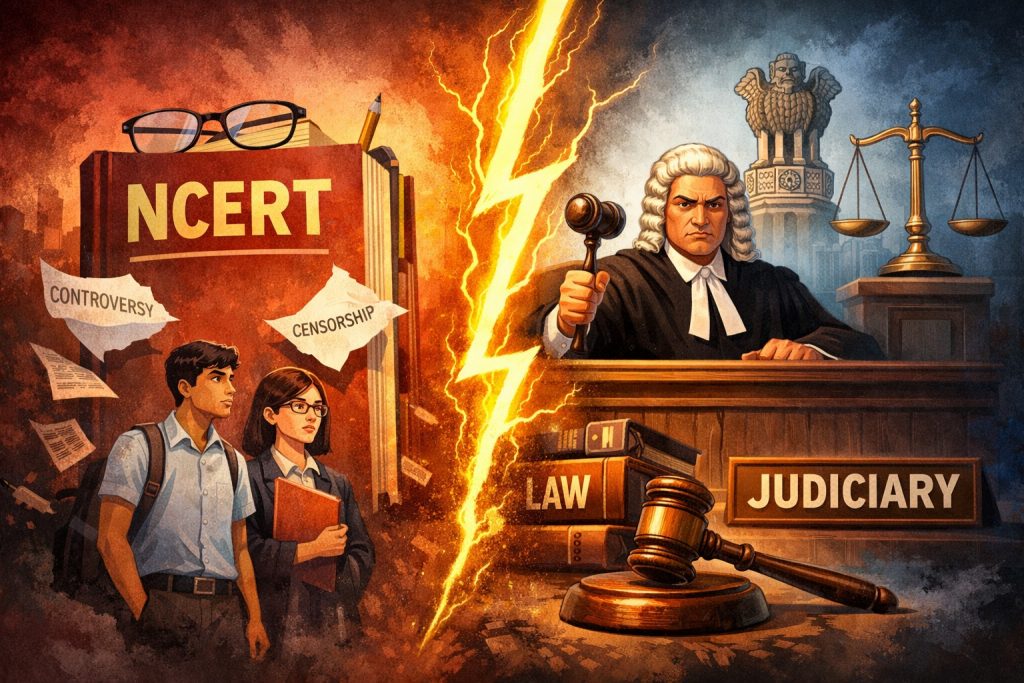
Recently, after a blanket and complete ban imposed by the Supreme Court of India, the National Council of Educational Research and Training (NCERT) withdrew a Class 8 Social Science textbook containing a section on “corruption in the judiciary” in the chapter titled “Role of Judiciary in Our Society.”
The Court held that selective references to “corruption in judiciary” could instil institutional distrust in “impressionable minds”, affecting long-term public confidence in constitutional governance.
1. Key Aspects of NCERT
- The National Council of Educational Research and Training (NCERT), established in 1961 by the Government of India, is an autonomous organization under the Ministry of Education.
- The major objectives of NCERT: To undertake, promote and coordinate research in areas related to school education; prepare and publish model textbooks, supplementary material, newsletters, journals and develops educational kits, multimedia digital materials, etc.
- Role: Acts as the nodal agency for school education, supporting policies like the National Education Policy 2020 (NEP 2020).
- Cultural exchange: NCERT is an implementation agency for bilateral cultural exchange programmes with other countries in the field of school education.
- Key Organizational Structure of NCERT:
- The council headquarter is located at Sri Aurobindo Marg, New Delhi.
- The Union Minister of Education is the President (ex-officio) of the General Body of NCERT.
- Members: Includes Education Ministers of all States and Union Territories.
2. Educational Governance
- Originally, education was in the State List (prior to 1976), granting states exclusive, total control over curriculum, schools, and universities.
- The 42nd amendment, 1976 changed the status of education by putting it on the concurrent list.
- While both Central and State governments can legislate on subjects mentioned under the Concurrent List, however, in case of any conflict, the law made by the Central Government prevails.
3. Constitutional and Legal Dimensions
- Judicial independence: It is a component of the Basic Structure doctrine, as established in the Kesavananda Bharati (1973) judgment, making the protection of institutional credibility constitutionally essential.
- Freedom of Expression vs Institutional Integrity: Article 19(1)(a) of the Indian Constitution guarantees freedom of speech and expression, enabling citizens to express views, publish, and circulate information. This right is not absolute and is balanced by “reasonable restrictions” under Article 19(2), which include protecting institutional integrity against contempt of court, defamation, and public order.
- Contempt of Court: It isclassified in India under the Contempt of Courts Act, 1971. It is categorized as either civil (willful disobedience of orders/undertakings) or criminal (scandalizing the court or interfering with justice).
- Article 129 declares the Supreme Court of India a Court of Record with the power to punish for its own contempt, while High Courts exercise a similar authority under Article 215.
Consider the following statements with reference to Education governance in India:

I. Originally, education was in the State List, but the 44th Amendment in 1976 changed its status by placing it in the Concurrent List.

II. The Union Minister of Education is the President (ex-officio) of the General Body of NCERT.

Which of the following statements is/are correct?
(a) I only
(b) II only
(c) Both I and II
(d) Neither I nor II

Answer: B

Explanation:
•  Statement I is Incorrect: While education was indeed originally a subject in the State List, it was transferred to the Concurrent List by the 42nd Amendment Act of 1976, not the 44th Amendment.
•  Statement II is Correct: According to the rules of the National Council of Educational Research and Training (NCERT), the Union Minister of Education is the ex-officio President of the General Body of NCERT.