After Reading This Article You Can Solve This UPSC Mains Model Question:
Artificial Intelligence is increasingly becoming central to economic competitiveness and strategic autonomy. In this context, analyse the objectives of the New Delhi Declaration on AI Impact. How can India balance innovation with ethical and regulatory safeguards? 15 Marks (GS-3 Science & Technology)
Context
The India-AI Impact Summit 2026 (held February 18–19, 2026, at Bharat Mandapam, New Delhi) was a landmark event where India positioned itself as a leader of the Global South in AI governance.
Background of AI Impact Summit
The Delhi Summit followed a sequence of global meetings that evolved in focus:
- Bletchley Park, UK (2023): Focused on AI Safety and existential risks (The Bletchley Declaration).
- Seoul, South Korea (2024): Focused on AI Safety & Innovation balance.
- Paris, France (2025): The AI Action Summit, emphasizing geopolitical competition and standards.
- New Delhi, India (2026): The AI Impact Summit, shifting the focus to implementation, inclusion, and the Global South.
Key Highlights: The “Seven Chakras” (Pillars)
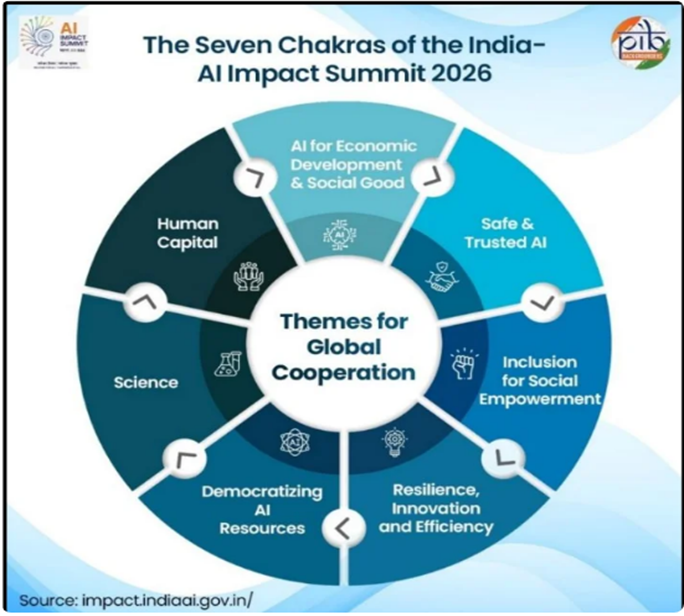
The Declaration is structured around seven thematic pillars that define the global roadmap for AI:
- Democratizing AI Resources: Ensuring affordable access to compute, data, and models for all nations.
- Economic Growth & Social Good: Leveraging AI to boost productivity and social welfare.
- Secure & Trusted AI: Establishing ethical guardrails and voluntary safety benchmarks.
- AI for Science: Using AI to accelerate research in healthcare, agriculture, and climate.
- Access for Social Empowerment: Inclusion-by-design for underserved communities and local languages.
- Human Capital Development: Focus on mass skilling, reskilling, and AI literacy.
- Resilient, Efficient & Innovative AI: Promoting sustainable resource use and energy-efficient systems.
Key Outcomes of the New Delhi Declaration of AI Impact Summit
1. The New Delhi Declaration & Global Frameworks
The headline outcome was a non-binding but significant declaration based on the “Seven Chakras” (Pillars).
- Charter for the Democratic Diffusion of AI: A voluntary framework to expand access to foundational AI resources (compute, datasets, and algorithms) to prevent technology concentration in a few nations.
- Global AI Impact Commons: A digital platform to share and replicate successful AI use cases in sectors like healthcare and agriculture across borders.
- Trusted AI Commons: A collaborative repository for benchmarks, safety tools, and ethical best practices to ensure responsible development.
2. Geopolitical and Strategic Shifts
- Pax Silica Initiative: India formally joined this US-led framework to secure supply chains for semiconductors, advanced computing hardware, and critical minerals.
- Vishwa Bandhu Role: India positioned itself as a “Global Friend,” bridging the technological standards of the Global North with the socio-economic aspirations of the Global South.
- GPAI Expansion: The summit hosted the Global Partnership on AI (GPAI) Ministerial Meeting, welcoming new members like Saudi Arabia and Malta.
3. Economic and Infrastructure Commitments
- Massive Investment Pledges: The summit secured over $250 billion in infrastructure investment commitments (data centers, fab plants) and roughly $20 billion for deep-tech venture funding.
- Compute Power (GPU) Expansion: India announced a ramp-up to 100,000 GPUs by the end of 2026 under the IndiaAI Mission 2.0 to provide affordable compute to startups and researchers.
- MSME AI Stack: Plans to launch an “AI Playbook” for small businesses, modeled after the success of UPI, to democratize productivity tools.
4. Indigenous Technological Breakthroughs
- Sovereign LLMs: Launch of Indian-trained frontier models by Sarvam AI (Sarvam-30B and Sarvam-105B) and BharatGen (17B parameter Indic-language model).
- Hardware Innovation: Unveiling of Sarvam Kaze, a made-in-India AI smart glass initiative.
- MANAV Vision: Prime Minister Modi unveiled the MANAV framework (Moral, Accountable, National Sovereignty, Accessible, Valid) as India’s ethical compass for AI.
5. Human Capital & Social Impact
- AI Workforce Development Playbook: Guidelines for nations to prepare for an AI-driven economy through skilling and reskilling.
- Flagship Challenges: Recognition of innovators through AI for ALL (inclusion), AI by HER (women-led), and YUVAi (youth-led) awards.
- Judicial Integrity: Launch of “AI Essentials for Judges” to prevent “Black-Box Justice” and ensure algorithmic tools remain subordinate to human reasoning.
Concerns Regarding the AI Impact Summit
1. Lack of Binding Enforcement
- Aspirations vs. Actions: There is no international body or verification mechanism to ensure countries actually follow the principles of “Democratic Diffusion.”
- Voluntary Framework: Unlike the European Union (EU) AI Act, this declaration lacks strict penalties, risking becoming a “spectacle” without real accountability.
2. The “Silent” Labor Crisis
- Job Displacement: Significant threat to India’s 5.8 million Information Technology (IT) workforce despite the summit’s focus on reskilling.
- Vulnerable Roles: High risk of mass unemployment in entry-level coding, data entry, and administration due to Generative Artificial Intelligence (GenAI).
3. Human Rights and “Redlines”
- Absence of Prohibitions: No explicit bans on high-risk practices like Predictive Policing or Biometric Surveillance, which often harm marginalized groups.
- Safeguard Gaps: Organizations like Amnesty International criticized the lack of concrete commitments to stop “destructive practices” by tech giants.
4. Geopolitics and “Data Colonialism”
- Data Colony Risk: Fear that the Global South will supply raw data and talent while United States (US) and China firms retain ownership of high-value models.
- Geopolitical Exclusion: The absence of Taiwan—the global semiconductor hub—due to diplomatic sensitivities was seen as a major strategic gap.
5. Environmental and Sustainability Issues
- Resource Intensity: Training massive models leads to exponential growth in energy consumption.
- Water Stress: Data centers require roughly 11 lakh liters of water per day for cooling, threatening water-scarce regions.
6. Implementation and Logistics
- The “Spectacle” Critique: Some observers felt the event functioned more like an AI trade expo (focusing on investment deals) rather than a governance forum.
- Domestic Credibility: Incidents of “rebranding” foreign technology as indigenous (e.g., Chinese robot dogs) raised concerns about the vetting of domestic AI claims.
Measures for Inclusive AI Growth in India
1. Democratizing Access through DPI (Digital Public Infrastructure)
- AI-DPI Convergence: Utilizing the “India Stack” (UPI/Aadhaar) model to treat AI as a public good. Building “common digital rails” allows MSMEs to access high-quality data and models independently of Big Tech.
- Bhashini & Language Inclusion: Leveraging the BHASHINI platform to provide voice-based services in local dialects, ensuring the non-literate population can access banking and governance.
2. Strengthening Sovereign AI & Infrastructure
- IndiaAI Mission 2.0: Expanding national compute to 100,000 GPUs and subsidizing costs (approx. ₹65/hour) to democratize innovation beyond wealthy corporations.
- Indigenous LLMs (BharatGen): Developing Foundational Models trained on domestic data to ensure cultural, social, and linguistic relevance.
3. Sector-Specific Measures for Last-Mile Impact
- Agriculture (Kisan e-Mitra): Deploying AI for personalized crop advisories, pest detection via mobile images, and climate-resilient farming.
- Healthcare (Suman Sakhi): Supporting ASHA workers with AI chatbots and diagnostic tools for maternal and child health tracking in rural centers.
- Education (DIKSHA AI): Utilizing AI for personalized regional language content and identifying potential student dropouts.
4. Protecting the Workforce (The “Human Capital” Pillar)
- Digital ShramSetu: An AI platform for 490 million informal workers that matches skills to jobs and provides micro-credentials for on-the-job learning.
- AI Workforce Playbook: Setting global standards for “mass reskilling” to transition workers from data entry to AI-augmented roles.
5. Ethical and Safe Governance
- MANAV Framework: Ensuring AI is Moral, Accountable, National (Sovereign), Accessible, and Valid.
- “Glass Box” Accountability: Requiring transparency in AI used for public welfare. If a citizen is denied a benefit by an AI algorithm, they must have a “Right to Explanation” to understand why.
Conclusion
The New Delhi Declaration marks a shift toward Sovereign AI and Democratic Diffusion. By integrating AI with Digital Public Infrastructure (DPI), India is pioneering a human-centric model that ensures frontier technology bridges global divides, fostering an inclusive, sustainable, and equitable digital future.