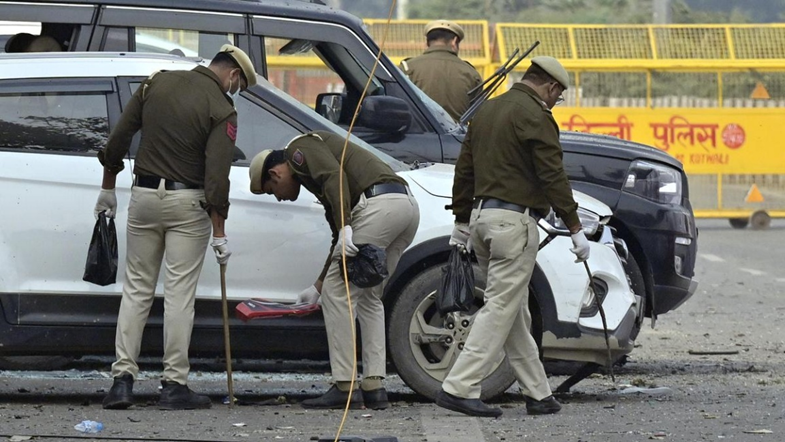
Why in the News?
India is facing a renewed phase of security challenges marked by the resurfacing of sophisticated terror modules targeting urban centres, especially New Delhi. This threat emerges at a time when India’s regional diplomatic environment is fragile, making counter-terror efforts more complex.
India’s Regional Setting & Strategic Isolation
India, despite being a major power in world affairs, appears increasingly on the sidelines on key geopolitical issues. Several regional developments contribute to this:
- Volatile neighbourhood from West to East – Afghanistan remains unstable, Pakistan dysfunctional yet hostile, and India’s ties with Bangladesh experience periodic friction.
- Pakistan factor remains central – Political instability and strengthening of the military establishment in Pakistan continue to empower elements hostile to India.
- Erosion of past diplomatic buffers – Earlier, cooperative neighbourhood engagement diluted security pressures. Today, mistrust dominates.
This strategic isolation amplifies India’s security burden, especially in defending its capital city — the political heart of the country.
Escalating Hostility from Pakistan & Its Implications
- Pakistan’s leadership cycles have led to rising influence of hard-line military actors.
- India must remain alert to the persistent possibility of cross-border terrorism resuming at scale.
- Diplomatic engagement is minimal, which reduces avenues for tactical de-escalation.
A deterioration in bilateral ties increases space for terror groups to escalate operations with geopolitical justification.
The New Face of Terror in India
Urban terrorism has evolved significantly compared to earlier decades:
Key Characteristics
- High professionalism — meticulous planning, logistical coordination, advanced explosive materials
- Network-based operations — links across states and even countries
- Use of legitimate cover — professionals like doctors and engineers aiding concealment
- Target preference — densely populated urban hubs and symbolic state institutions
Urban India is now the primary battleground because disruption here yields maximum national and global impact.
Evidence from Recent Investigations
- Explosive recoveries in Delhi indicate capabilities for mass casualty strikes.
- Past attacks like the 2008 Mumbai attacks and various blasts in Delhi continue to guide current terror strategies.
- A module in Jammu & Kashmir funded by Pakistan recently exposed.
- Radicalisation and financing through charity fronts still active.
Thus, both old groups are re-emerging and new cells are being incubated.
Understanding the Threat and National Response Priorities
| Emerging Pattern in Terror Threat | What It Means for India | Necessary Response |
| Professional, networked terror modules | Capable of coordinated, high-impact attacks | Pre-emptive intelligence and integrated operations |
| Local enablers + cross-border support | Complex to detect; deeper penetration into society | Stronger policing and community engagement |
| Affinity with ideological polarisation | Greater recruitment & concealment opportunities | Social unity and counter-radicalisation measures |
| Capital as primary target | Attack on governance, morale, stability | Hardening urban infrastructure and surveillance |
Governance Challenges in Securing Delhi
- Multiple agencies share responsibility → chances of coordination gaps
- Dense population & heritage structures make emergency response more complex
- Political sensitivities restrict preventive policing strategies
Ensuring urban safety demands seamless cooperation among central agencies, state police, local administration, and civil society.
Re-evaluating India’s Counter-Terror Approach
India must simultaneously act inside and outside its borders.
Internal Measures
- Strengthen intelligence sharing among agencies
- Upgrade policing, surveillance, and forensic investigation
- Community-based early warning systems to detect radicalisation
- Public preparedness drills for emergencies
External Measures
- Diplomacy to isolate terror sponsors
- Regional cooperation for intelligence & extradition
- International pressure on nations sheltering terrorist outfits
Balancing strong security action with constitutional rights is essential to retain moral and democratic legitimacy.
The Way Forward
India’s capital is not just a city — it is the symbol of national power, governance, and identity.
Terror outfits understand this; therefore, India’s security strategy must prioritise:
- Urban resilience
- Regional diplomatic recalibration
- Institutional capacity building
- National unity against extremism
Ensuring security in Delhi reflects India’s capability as a strong, stable, modern nation prepared to face evolving threats.
Source: New Delhi’s relative isolation, India’s tryst with terror – The Hindu
UPSC CSE PYQ
| Year | Question |
| 2025 | Terrorism is a global scourge. How has it manifested in India? Elaborate with contemporary examples. What are the counter-measures adopted by the State? |
| 2021 | Analyse the complexity and intensity of terrorism, its causes, linkages and obnoxious nexus. Also suggest measures required to eradicate the menace of terrorism. |
| 2021 | Analyse the multidimensional challenges posed by external state and non-state actors to the internal security of India. Also discuss measures required to combat these threats. |
| 2019 | Examine the role played by Over Ground Workers (OGWs) in assisting terrorist organizations in insurgency/terrorism-affected areas. Discuss measures to neutralise the influence of OGWs. |