Context
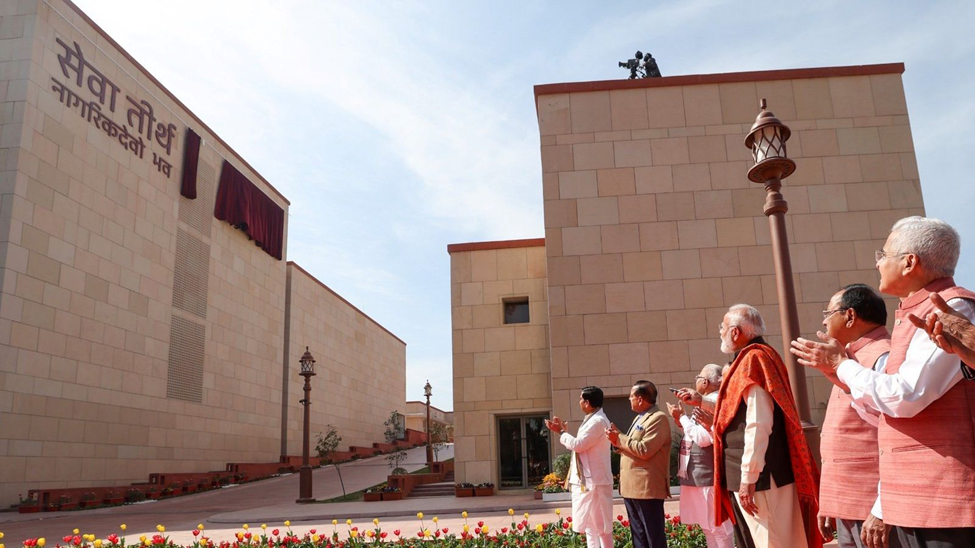
Prime Minister Narendra Modi recently inaugurated the new Prime Minister’s Office (PMO), named ‘Seva Teerth’, and two buildings of the Central Secretariat, named ‘Kartavya Bhavan’.
These structures are part of the broader effort to replace colonial-era architecture (like the South and North Blocks) with buildings that reflect the aspirations of independent India and a “Viksit Bharat”.
1. Architectural Elements (Art & Culture Focus)
The buildings incorporate traditional Indian architectural motifs, making them a significant topic for cultural heritage questions:
- Materiality: The structures are clad in white and red sandstone, referencing material traditions found in historic Indian civic and institutional architecture.
- Stupa Influence: The metal-clad domes are inspired by the Buddha Stupa, introduced as contemporary accent elements.
- Temple Architecture (Entrance Portal): The entrance portal draws inspiration from the stone screen-work of Chalukyan temples dating back to the 11th and 13th centuries.
- Temple Architecture (Plinth): The carved stone plinth band is inspired by the base mouldings of the 12th-century Chennakeshava Temple.
2. Governance and Policy Milestones
On the occasion of the inauguration, several key administrative decisions and commemorative items were released:
- PM RAHAT Scheme: The Prime Minister signed files for this scheme, which provides cashless treatment up to ₹1.5 lakh for accident victims.
- Lakhpati Didis: The target for the Lakhpati Didi scheme (empowering women in Self-Help Groups) was doubled to six crore.
- Agriculture Infrastructure Fund: The target for this fund was doubled to ₹2 lakh crore.
- Commemorative Items: A special postage stamp and coin were released to mark the occasion.
Key Facts About Chennakeshava Temple
Commissioned by: King Vishnuvardhana of the Hoysala Dynasty.
Year: Construction began in 1117 CE to commemorate his victory over the Cholas in the Battle of Talakad.
Location: Situated on the banks of the Yagachi River in Belur, Hassan district, Karnataka.
Deity: Lord Vishnu (Chennakeshava literally means “Handsome Keshava”).
Architectural Style: The temple is a masterpiece of the Vesara style (a hybrid of Nagara and Dravidian styles), characterized by:
- Material: Built using Soapstone (Chloritic Schist), which is soft when quarried but hardens over time, allowing for extremely intricate carvings.
- Stellate Plan: The main shrine is built on a star-shaped (stellate) raised platform called a Jagati.
- Shikara: Interestingly, the original tower (Shikara) is now missing, giving the temple a flat-topped appearance today.




UNESCO Status
- In 2023, it was declared a UNESCO World Heritage Site as part of the “Sacred Ensembles of the Hoysalas,” which also includes:
- Hoysaleswara Temple (Halebidu)
- Keshava Temple (Somanathapura)
With reference to Chennakeshava Temple situated near Hassan district of Karnataka State, consider the following statements :

I. It is an Iconic monument and a world UNESCO heritage site declared in 2023, as part of the Sacred Ensembles of the Hoysalas.

II. It is the only circular temple built in India.

III. Its design has given rise to a popular belief that it was the inspiration behind the new Prime Minister Office ‘Seva Teerth’

Which of the statements given above are correct?

(a) I and II only
(b) II and III only
(c) I and III only
(d) I, II, and III

Answer: C

Explanation:
•  Statement I is Correct: The Chennakeshava Temple at Belur (Hassan district) is indeed an iconic monument. In September 2023, the "Sacred Ensembles of the Hoysalas" (which includes the temples at Belur, Halebidu, and Somanathapura) was officially inscribed as a UNESCO World Heritage Site.

•  Statement II is Incorrect: The Chennakeshava Temple is not a circular temple; it is famous for its stellate (star-shaped) ground plan, a hallmark of Hoysala architecture. Furthermore, it is certainly not the "only" circular temple in India (others include the Chausath Yogini temples in Mitawali or Hirapur).

•  Statement III is Correct: According to the provided article, the new Prime Minister's Office, named 'Seva Teerth', explicitly incorporates design elements from this temple. Specifically, the carved stone plinth band of the new complex is inspired by the base mouldings of the 12th-century Chennakeshava Temple.