Context
Recently, on February 20, 2026, the Tamil Nadu Forest Department, in collaboration with the Kerala Forest Department, released the findings of the First Synchronised Nilgiri Tahr Survey 2026, which revealed a 21% increase in the species’ population over the last two years.
1. Biological & Behavioral Profile
- Endemicity: It is the only mountain ungulate endemic to the Western Ghats of India (found only in Tamil Nadu and Kerala).
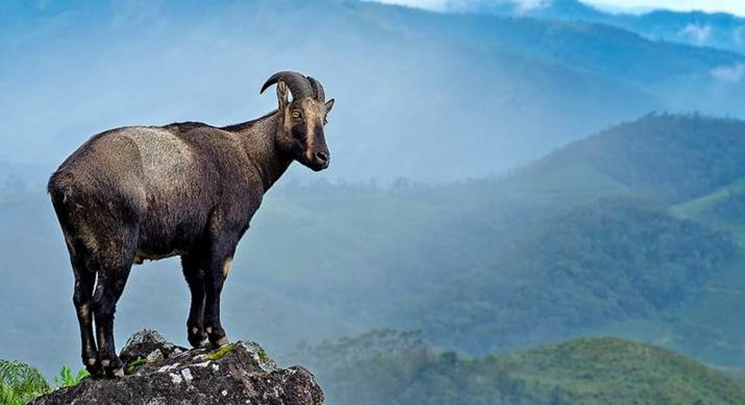
- Saddlebacks: Adult males develop a light grey or white patch on their backs as they mature, leading to the nickname “Saddlebacks.”
- Physical Traits: They are diurnal (active during the day), stocky goats with curved horns and specialized hooves with a rubbery core for gripping steep, slippery cliffs.
- State Symbol: It is the State Animal of Tamil Nadu.
2. Habitat & Ecosystem
- Shola-Grassland Mosaic: They reside in high-altitude montane grasslands (1,200m to 2,600m) interspersed with stunted evergreen forests known as Sholas.
- Preferred Terrain: They are highly adapted to steep cliffs and rocky outcrops, which serve as crucial escape routes from predators like tigers, leopards, and dholes.
- Key Populations:
- Eravikulam National Park (Kerala): Holds the largest and densest single population globally.
- Mukurthi National Park (Tamil Nadu): Established specifically for the conservation of the Nilgiri Tahr.
- Anamalai Tiger Reserve (Grass Hills): Another significant stronghold.
3. Conservation Status & Threats
- IUCN Red List: Endangered.
- Wildlife (Protection) Act, 1972: Schedule I (Highest level of legal protection in India).
- Primary Threats:
- Habitat Fragmentation: Caused by invasive species (Wattle, Eucalyptus), hydroelectric projects, and monoculture plantations.
- Climate Change: Scientists predict a loss of nearly 60% of their suitable habitat by the 2030s due to rising temperatures.
- Infectious Diseases: Vulnerability to diseases transmitted from domestic livestock.
4. Project Nilgiri Tahr (2022–2027)
- Launch: Inaugurated by the Tamil Nadu government with an outlay of ₹25 crore.
- Objectives: Radio-telemetry studies, reintroduction to historical habitats, and clearing invasive species from grasslands.
Q1. With reference to the "Nilgiri Tahr," consider the following statements:

1. It is the only mountain ungulate species found in India that is endemic to the Western Ghats.

2. Under the Wildlife (Protection) Act, 1972, it is categorized under Schedule II to allow for limited regulated hunting.

3. The Eravikulam National Park in Kerala is home to the largest surviving population of this species in the wild.

How many of the above statements are correct?

A) Only one
B) Only two
C) All three
D) None

Correct Answer: B

•	STATEMENT 1 IS CORRECT: While India has other mountain ungulates (like the Himalayan Tahr), the Nilgiri Tahr is the only one endemic to the Western Ghats/Southern India.
•	STATEMENT 2 IS INCORRECT: The Nilgiri Tahr is listed under Schedule I of the WPA 1972, providing it the absolute highest level of protection; hunting is strictly prohibited.
•	STATEMENT 3 IS CORRECT: Eravikulam National Park is widely recognized as the primary stronghold, hosting approximately half of the global population.