Context
Recently, the Reserve Bank of India (RBI) announced a substantial liquidity injection plan involving the purchase of Government of India securities worth ₹1 lakh crore through Open Market Operations (OMO). This decision, involves two separate auction tranches of ₹50,000 crore each, scheduled for March 9 and March 13, 2026. The move is strategically timed to counteract expected liquidity tightening in the banking system due to significant cash outflows from mid-month advance tax payments and Goods and Services Tax (GST) collections.
1. What is OMO?
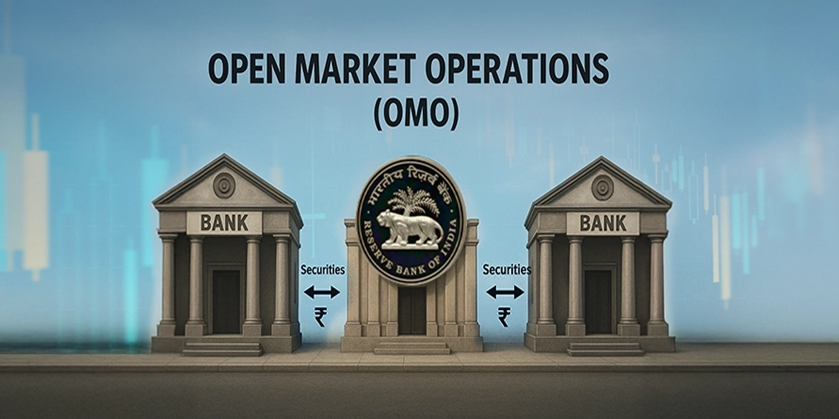
Open Market Operations are one of the quantitative (general) monetary policy tools used by the central bank (RBI) to regulate the money supply in the economy. It involves the outright purchase or sale of government securities (G-Secs) and Treasury Bills in the open market.
2. Mechanism of OMO
The RBI manages liquidity by interacting with the secondary market:
- OMO Purchase (Liquidity Injection): When the RBI buys G-Secs from the market, it pays the commercial banks/financial institutions in cash. This increases the reserves of the banks, leading to a higher money supply and potentially lower interest rates.
- OMO Sale (Liquidity Absorption): When the RBI sells G-Secs, it takes cash out of the banking system. This reduces the loanable funds available with banks, thereby decreasing the money supply and controlling inflationary pressures.
3. Impact on Bond Yields
There is an inverse relationship between the price of a bond and its yield:
- During an OMO Purchase, the demand for bonds increases, which pushes the bond prices up. As bond prices rise, the bond yield falls.
- During an OMO Sale, the supply of bonds in the market increases, causing bond prices to fall and bond yields to rise.
4. Comparison with Other Tools
| Feature | OMO | Repo Rate (LAF) |
| Duration | Generally for durable or long-term liquidity. | Used for short-term (overnight to 14 days) liquidity. |
| Nature | Outright buying and selling; ownership changes. | Repurchase agreement; securities act as collateral. |
| Flexibility | RBI can choose specific securities to buy/sell. | Uniformly applicable to all eligible participants. |
5. Key Participants and Platform
- Platform: OMOs are conducted electronically on the E-Kuber system, which is the Core Banking Solution (CBS) platform of the RBI.
- Participants: Commercial banks, primary dealers, and other designated financial institutions.
Q. With reference to the Indian economy, consider the following statements regarding Open Market Operations (OMOs):

1. When the Reserve Bank of India conducts an OMO purchase, it leads to an increase in the yields of the underlying government securities.

2. OMOs are primarily used by the RBI to manage short-term, overnight liquidity mismatches in the banking system.

3. The RBI uses the E-Kuber platform to conduct OMO auctions through a multi-security price method.

Which of the statements given above is/are correct?
(a) 1 and 2 only
(b) 2 and 3 only
(c) 3 only
(d) 1, 2 and 3

Solution: (c) 3 only

•	STATEMENT 1 IS INCORRECT: In an OMO purchase, the RBI increases the demand for bonds, which leads to an increase in bond prices. Because bond prices and yields are inversely related, an OMO purchase causes bond yields to decrease, not increase.
•	STATEMENT 2 IS INCORRECT: OMOs are generally used for managing durable (long-term) liquidity. Short-term or overnight liquidity mismatches are managed through the Liquidity Adjustment Facility (LAF), such as Repo and Reverse Repo operations.
•	STATEMENT 3 IS CORRECT: The RBI conducts OMOs electronically on its E-Kuber platform. For the March 2026 operations, it specifically utilized a multi-security auction format to manage specific tranches of G-Secs.