Context
According to an analysis based on data from the Empowered Indian MPLADS dashboard, a significant portion of MPLADS funds recommended for works outside a Member of Parliament’s (MP’s) home State or constituency is being directed toward a single State in India.
1. MPLADS Fund Utilization Patterns
- Geographical Concentration of Funds:
- Uttar Pradesh received over 84% of all MPLADS funds recommended for works outside an MP’s home State or constituency.
- Uttar Pradesh utilizes more than twice the MPLADS funds compared to the second-highest State, Tamil Nadu, which accounts for around 9% of the total funds.
2. About MPLADS Scheme
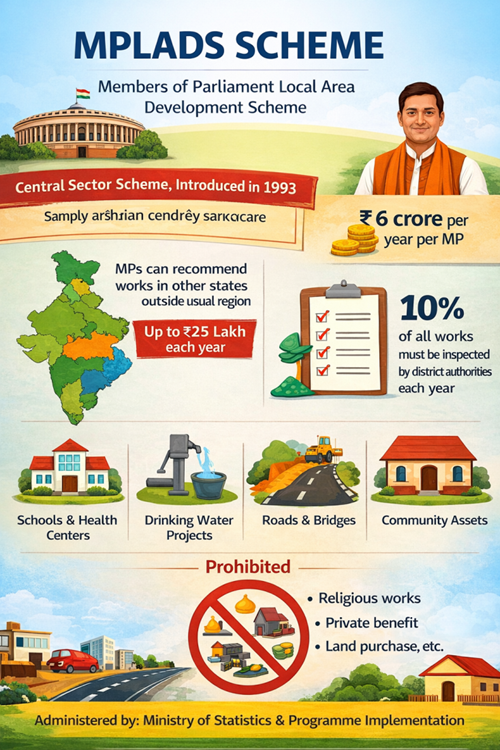
- The MPLAD Scheme is a Central Sector Scheme(introduced in 1993), fully funded by the Government of India.
- The main objective of the Scheme: To enable each Member of Parliament to recommend works of developmental nature with emphasis on the creation of durable community assets based on the locally felt needs of the people.
- Nodal Ministry: Initially, MPLADS was administered by the Ministry of Rural Development, but since October 1994 it has been managed by the Ministry of Statistics and Programme Implementation.
- Funds Allocation: Each MP is entitled to ₹5 crore per annum
- An elected Lok Sabha MPs can recommend works in their Lok Sabha constituencies. Rajya Sabha MPs can recommend works within the state of election.
- Nominated members can recommend works anywhere in the country.
- However, an elected MP can recommend works anywhere in the country outside their usual area, with a limit of ₹25 lakh per financial year, except in cases of calamity.
- Special Provisions: MPs are to recommend every year, works costing at least 15 per cent of the MPLADS entitlement for the year for areas inhabited by Scheduled Caste population and 7.5 per cent for areas inhabited by S.T. population.
- Nature of Funds: This fund is non-lapsable and can be carried forward if not utilised in a given year.
- Types of Projects Funded under MPLADS:
- Construction of roads, pathways, and small bridges
- Environment, wild animals, forest and other natural resources
- Installation of street lights and drainage systems
- Building school classrooms, libraries, and labs
- Providing drinking water facilities in schools
- Development of health centres and purchase of medical equipment
- Creation of drinking water supply systems and hand pumps
- Construction of community halls, parks, and playgrounds
- Building sanitation facilities and Anganwadi centres
- Energy supply and distribution systems
3. Monitoring and Implementation:
- Ministry of Statistics and Programme Implementation shall regularly monitor the implementation of the MPLADS, including overall position of funds released, cost of works sanctioned, funds utilized, etc.
- Role of Central Nodal Agency: It shall periodically review the physical and financial progress of MPLADS funds, and take up the matter with the State Nodal Authority, Nodal District Authority, or the Implementing District Authority.
- Role of the State/ UT Governments: It shall designate a Department of the State/ UT to be the State Nodal Department, and the Administrative Secretary of that department to be the State Nodal Authority to coordinate and monitor the implementation of the MPLADS in that State/ UT. A State Monitoring Committee, chaired by the Chief Secretary, reviews MPLADS implementation and fund utilization with concerned authorities and MPs at least once a year.
- Role of the District Authority:
- They shall be responsible for overall monitoring and supervision of the works under the scheme at the district level.
- They shall inspect at least 10% of the works under implementation every year.
With reference to the funds under the Members of Parliament Local Area Development Scheme (MPLADS), which of the following statements are correct?

I. The MPLAD Scheme is a Central Sector Scheme(introduced in 1993), fully funded by the Government of India.

II. MPLADS funds are sanctioned on yearly basis and the unused funds cannot be carried forward to the next year.

III. The district authority must inspect at least 10% of all works under implementation every year.

IV. MPLADS scheme is supervised and implemented by the Ministry of Rural development.

Select the correct answer using the code given below:
(a) I, II and III
(b) II and IV
(c) I and III
(d) II, III and IV

Answer: C

Explanation:
•  Statement I is correct. The MPLAD Scheme is a Central Sector Scheme that was introduced in 1993, and it is fully funded by the Government of India.
•  Statement II is incorrect. MPLADS funds are sanctioned on a yearly basis, but unused funds can be carried forward to the next year.
•  Statement III is correct. The district authority is responsible for inspecting at least 10% of all works under implementation every year.
•  Statement IV is incorrect. The MPLADS scheme is supervised and implemented by the Ministry of Statistics and Programme Implementation, not the Ministry of Rural Development.