After read this article you can solve this UPSC Mains Model Question:
“Pakistan’s recent re-engagement with West Asia marks a recalibration of its foreign policy driven by economic compulsions and evolving regional geopolitics.” Critically examine the factors behind Pakistan’s strategic re-entry into West Asia and analyse its implications for regional stability and India’s interests.
(GS-2 International Relation)
Context: The Geopolitical Pivot:
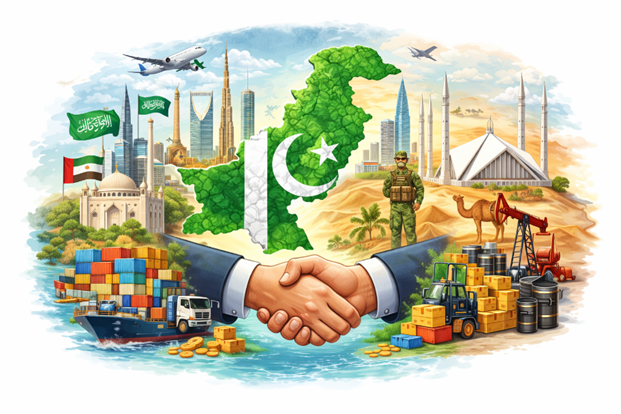
For nearly a decade, Pakistan’s relationship with West Asian monarchies (Saudi Arabia, UAE, Qatar) was strained, primarily due to Islamabad’s 2015 refusal to join the Yemen war and its perceived tilt toward a Turkey-Qatar-Malaysia axis. However, by late 2025, a significant diplomatic “Thaw” has occurred, with Pakistan repositioning itself as a security and economic partner.
Recent Key Developments:
- Saudi-Pakistan Strategic Mutual Defense Agreement (SMDA): Signed in September 2025, this pact is a watershed moment. It includes a “NATO-like” clause where any aggression against one is considered an attack on both.
- Libyan Arms Deal: In December 2025, Pakistan signed a $4 billion deal with the Libyan National Army for JF-17 fighter jets and Super Mushak trainers, marking its entry into the high-end conventional arms export market in the region.
- Shift from Aid to Investment: Finance Minister Muhammad Aurangzeb recently announced a pivot away from “aid-seeking” toward “trade and investment-led partnerships” with the Gulf nations.
- Aramco-GO Partnership: Saudi Aramco acquired a 40% stake in Pakistan’s Gas & Oil (GO), signaling deep energy-sector integration.
Reasons for the Re-engagement:
1. Diversification of Security (The “Plan B” Strategy)
- Declining U.S. Reliability: Gulf monarchies are increasingly questioning the durability of U.S. security guarantees. This was accelerated after the Israeli airstrike on Doha (September 9, 2025), which targeted Hamas negotiators. The “light rebuke” from the U.S. to Israel rattled the region.
- The Nuclear Dimension: As the only nuclear-armed Muslim state, Pakistan provides a unique deterrent. The Strategic Mutual Defense Agreement (SMDA) with Saudi Arabia acts as an “extended deterrence” mechanism, signaling to both Washington and Tel Aviv that Riyadh has alternative security pillars.
2. Shift from “Aid to Trade” (Economic Realism)
- The “Uraan” Strategy: Pakistan has officially pivoted its foreign policy from seeking grants to seeking investments. Finance Minister Muhammad Aurangzeb (Dec 2025) noted that discussions on a Free Trade Agreement (FTA) with the GCC are at an “advanced stage.”
- Gulf Investment in Reko Diq: Massive investments by Saudi Arabia and Qatar in Pakistan’s mining (Copper/Gold) and energy sectors have turned Pakistan into a stakeholder for Gulf economic success, rather than just a “charity case.”
3. Pakistan’s Evolving Military Diplomacy
- Field Marshal Asim Munir’s Outreach: The elevation of General Asim Munir to Field Marshal and his frequent visits to Riyadh, Washington, and Benghazi (Libya) have institutionalized Pakistan’s military as a reliable, professional partner for regional stability.
- Middle Power Pragmatism: Pakistan is positioning itself as a provider of “professional military expertise without great-power baggage.” This is evident in the recent Pakistan-Libya defense ties (Dec 2025) focused on training and counterterrorism.
4. Role as a Mediator & Regional Hub
- Trump’s Mediation: The 2025 U.S. administration, under Donald Trump, has used Pakistan as a conduit for regional peace talks. Pakistan’s role in brokering the ceasefire during the 4-day India-Pakistan conflict (May 2025) elevated its diplomatic standing.
- The Gaza Factor: The U.S. and Gulf states are reportedly pressing Pakistan to contribute troops to a Gaza Stabilisation Force. Pakistan’s willingness to engage in “stabilisation diplomacy” has earned it significant political capital.
5. Managing the “Sectarian Tightrope”
- Strategic Autonomy: By closing the Iranian border (June 2025) and aligning strictly with the Sunni-led Gulf security framework, Pakistan has signaled a decisive choice to prioritize its “West-facing” relationships. This has removed the ambiguity that previously frustrated Saudi Arabia and the UAE.
Significance for India:
1. Challenge to “Strategic De-hyphenation”
For years, India successfully convinced Gulf monarchies to treat India and Pakistan as separate entities—associating India with economy/technology and Pakistan with security/aid.
- The Return of the “Security Nexus”: The SMDA (2025) suggests that the Gulf still views the Pakistani military as its primary “security provider.” This dilutes India’s efforts to position itself as the sole “Net Security Provider” in the Indian Ocean Region.
- Institutional Wedge: The pact challenges the assumption that India’s economic outreach (e.g., the $100bn Saudi investment pledge) would permanently install an institutional wedge between Islamabad and Arab states.
2. Security & Nuclear Deterrence Implications
- The “Nuclear Umbrella” Concern: Western reports and Indian analysts (like Manoj Joshi, 2025) speculate that the SMDA could extend Pakistan’s nuclear deterrence to Saudi Arabia. This “Nuclear Sharing” or “Ambiguity” creates a new layer of complexity for India’s own nuclear doctrine and regional stability.
- Aggression Clause: The clause stating “aggression against one is an attack on both” raises a critical question: If India launches a punitive “Surgical Strike” or “Balakot-style” air strike following a terror attack, will it trigger a collective response from the Gulf? This increases the perceived cost of escalation for New Delhi.
3. Complicating India’s “Link West” Policy
- Multipolar Alignment: Saudi Arabia is chasing its own “Strategic Autonomy” by multi-aligning with both India (Economic/Vision 2030) and Pakistan (Security/Ideology).
- The I2U2 & IMEC Conflict: India’s preferred regional architecture—like the India-Middle East-Europe Economic Corridor (IMEC)—requires a stable, pro-India West Asia. A resurgent Pakistan-Gulf military bloc could introduce new vetoes or delays in these trans-regional projects.
4. Defense Competition & Exports
- Arms Race in the Gulf: Pakistan’s recent success in exporting JF-17 Block III jets and drones to Libya and potentially Saudi Arabia (2025) directly competes with India’s ambitions to export the Tejas (LCA) and BrahMos missiles to the same region.
- Training and Doctrine: Pakistan’s decades-long experience in training Gulf forces gives it “Soft Power” in the military bureaucracy of these nations, which India is only now starting to build through joint exercises like Desert Cyclone.
5. Diplomatic “Quarantine” Challenges
- Failure of Isolation: India’s strategy to “internationally quarantine” Pakistan—especially after the Pahalgam attack (April 2025)—has faced a setback. The SMDA proves that Pakistan’s “Military-Bureaucratic Nexus” remains a relevant geopolitical actor that major powers are unwilling to abandon.
- Kashmir Narrative: A resurgent Pakistan with Gulf backing is likely to use multilateral platforms (OIC) to push its narrative on Kashmir more aggressively, complicating India’s communication strategy abroad.
Challenges:
1. The “Sectarian Collision” (The Iran Factor)
Pakistan’s decisive tilt toward the Saudi-led security bloc has severely strained its relationship with Tehran.
- Border Closure (June 2025): Pakistan officially sealed its 900km border with Iran following the Pahalgam Crisis and rising U.S.-Iran tensions. This has crippled local trade in Balochistan and created a brewing humanitarian crisis with thousands of displaced people.
- Security Spillover: Iran has accused Pakistan of allowing its soil to be used for “proxy operations” backed by Western interests, leading to fears of tit-for-tat missile strikes similar to those seen in early 2024.
2. The “Transactional Gap” in Economics
While the Gulf is “back,” the nature of the relationship has changed from “charity” to “commercialism.”
- Bailout Fatigue: Saudi Arabia and the UAE are no longer offering unconditional “cash-in-bank” support. They now demand structural reforms (tax base expansion) and equity in national assets (like the Reko Diq mines or Karachi Port).
- Labor Localization: Gulf nations are aggressively pushing “Saudization” and “Emiratization.” This is displacing millions of low-skilled Pakistani workers, threatening the $25-30 billion remittance lifeline that keeps Pakistan’s economy afloat.
3. Internal Fragility & Militancy
The “re-entry” into West Asian security pacts has made Pakistan a target for internal groups opposed to the military’s pro-Western/pro-Saudi stance.
- BLA & TTP Surge: 2025 saw a 121% increase in fatalities from militant attacks in the first half of the year. Groups like the Balochistan Liberation Army (BLA) specifically target Gulf-funded investment projects, viewing them as “resource theft” by the state.
- Political Fragmentation: The continued imprisonment of Imran Khan and the suppression of the PTI party have created a deep divide between the military-led foreign policy and public sentiment, which remains skeptical of “Western-aligned” defense pacts.
4. The “China-US” Balancing Act
Pakistan is attempting to host U.S. bases (near Pasni) while simultaneously seeking CPEC Phase II funding from Beijing.
- Strategic Distrust: China is increasingly wary of the U.S. “foothold” in Pakistan, while the U.S. is using the Strategic Mutual Defense Agreement (SMDA) to pull Pakistan away from the Chinese orbit. Any misstep could result in Pakistan losing its most reliable long-term strategic partner (China) for a “fleeting” high with the West.
Way Forward:
1. Institutionalizing “2+2” Ministerial Dialogues
- From Leader-led to System-led: India’s current West Asia policy relies heavily on personal chemistry between leaders. To ensure continuity, India should establish 2+2 Dialogues (Foreign + Defense Ministers) with Saudi Arabia and the UAE.
- Objective: This provides a permanent bureaucratic platform for real-time coordination on maritime security, counter-terrorism, and sharing intelligence on regional defense pacts (like the SMDA).
2. Recalibrating IMEC: Focus on the “Eastern Leg”
- Strategic Integration: Given the volatility in the Mediterranean/Levant region (due to the Israel-Hamas-Hezbollah conflicts), India should prioritize the India-to-Arabian Peninsula corridor.
- Digital & Energy Grids: By fast-tracking undersea fiber-optic cables and green energy grids with Abu Dhabi and Riyadh, India can lock in economic interdependence that makes “choosing sides” between India and Pakistan costly for the Gulf.
3. Defense “Minilateralism” and Export Push
- Security Net Provider: India should graduate from joint exercises to being a defense manufacturing hub for the region.
- Competitive Exports: Fast-tracking the export of BrahMos missiles, Pinaka rockets, and Tejas LCA to Oman and UAE (as discussed in Dec 2025) will create a “user-supplier” dependency that balances Pakistan’s legacy military training role.
4. “Strategic Insulation” and Narrative Management
- Managing OIC Rhetoric: Rather than reacting with “tit-for-tat” diplomatic protests against OIC resolutions (often pushed by Pakistan), India should maintain diplomatic minimalism.
- Global South Leadership: India must leverage its role in the G20 and BRICS+ to frame its West Asia engagement as a “non-intrusive alternative” to the security-centric, high-risk models currently being pursued by Islamabad.
5. Fintech and DPI Diplomacy
- Digital Public Infrastructure (DPI): India should fully integrate its UPI and Rupee-based trade mechanisms with Gulf financial systems.
- Leveraging Diaspora: With over 9 million Indians in the GCC sending $47 billion in remittances (2024 data), seamless cross-border financial integration acts as a “soft power” anchor that a military-heavy Pakistan cannot replicate.
Conclusion
India lies in ‘Strategic De-hyphenation 2.0.’ While Pakistan seeks a ‘Return to Mainstream’ via military pacts, India must cement its status as an Indispensable Economic and Technological Partner. By shifting focus from ‘managing Pakistan’ to ‘shaping regional architecture’ (via IMEC and 2+2 dialogues), India can ensure that its interests in West Asia remain insulated from the shifting sands of bilateral military alliances.”